
A customer has paid, then notices the wrong size. Another asks whether a missing accessory can still be added. A third accepts a relevant offer after payment, but your fulfillment team now has to decide whether that item belongs on the original shipment or in a second package. These moments are where choosing a one click upsell Shopify app becomes an operations decision, not just a conversion decision.
The strongest tools differ in how they place offers, update existing orders, handle payment deltas, pause fulfillment, expose controls in customer accounts, and support Shopify Plus checkout surfaces. They also differ in testing depth, analytics, pricing models, and the amount of governance your team must build around them.
This comparison covers Mayra Apps, Zipify OCU, AfterSell, Upsell.com, Rebuy, UpsellPlus, Honeycomb, CartHook, Monk, and Cleverific. Mayra Apps deserves particular attention for merchants that want more than an upsell screen. It combines one-click offers with customer self-service order editing in Shopify's new customer accounts and the Order status page, while writing changes back to the original Shopify order.
Table of Contents
- What a one-click upsell Shopify app must control
- 1. Mayra Apps
- 2. Zipify OCU
- 3. AfterSell Post Purchase Upsell
- 4. Upsell.com
- 5. Rebuy Personalization Engine
- 6. UpsellPlus
- 7. Honeycomb Upsell & Cross-Sell
- 8. CartHook Upsell
- 9. Monk Free Gift & Upsell
- 10. Cleverific AI Post-Purchase Upsells
- Top 10 Shopify One-Click Upsell Apps, Feature Comparison
- Choose the App That Fits Your Order Workflow
What a one-click upsell Shopify app must control
A post-purchase offer appears after the customer has completed payment, which removes much of the friction associated with asking for another purchase. Shopify describes this surface as the stage between checkout and the thank-you page, after payment has been captured and before the customer leaves the store, as explained in its overview of post-purchase upsells and checkout functionality.
That placement creates a useful commercial advantage, but it also creates a governance problem. The merchant has an existing order, payment record, inventory commitment, fulfillment workflow, and customer communication to protect. An app that increases accepted add-ons but creates split shipments or manual reconciliation may not improve the customer experience overall.
Public benchmark material places post-purchase offers among the stronger-performing upsell placements. One independent 2026 guide cites commonly observed acceptance rates of 5% to 12%, average revenue lift of 12% to 22% for well-matched offers, and a broader post-purchase range of 3% to 8%. It also cites about $24 per accepted post-purchase offer in one guide. These figures are directional benchmarks, not promises for an individual store, and the guide attributes performance to low payment friction and offer relevance. See the Shopify upsell conversion benchmarks for the underlying discussion.
Before installing, separate the questions into two groups:
- Offer performance: Can the app target the purchased SKU, run downsells, test variants, and report accepted revenue?
- Order integrity: Does it append items to the original order, preserve fulfillment consistency, support approval rules, and show the customer what changed?
The second group is often underdeveloped in comparison content. A relevant offer still needs a safe path through inventory, fraud review, fulfillment timing, refunds, and customer-account visibility.
1. Mayra Apps
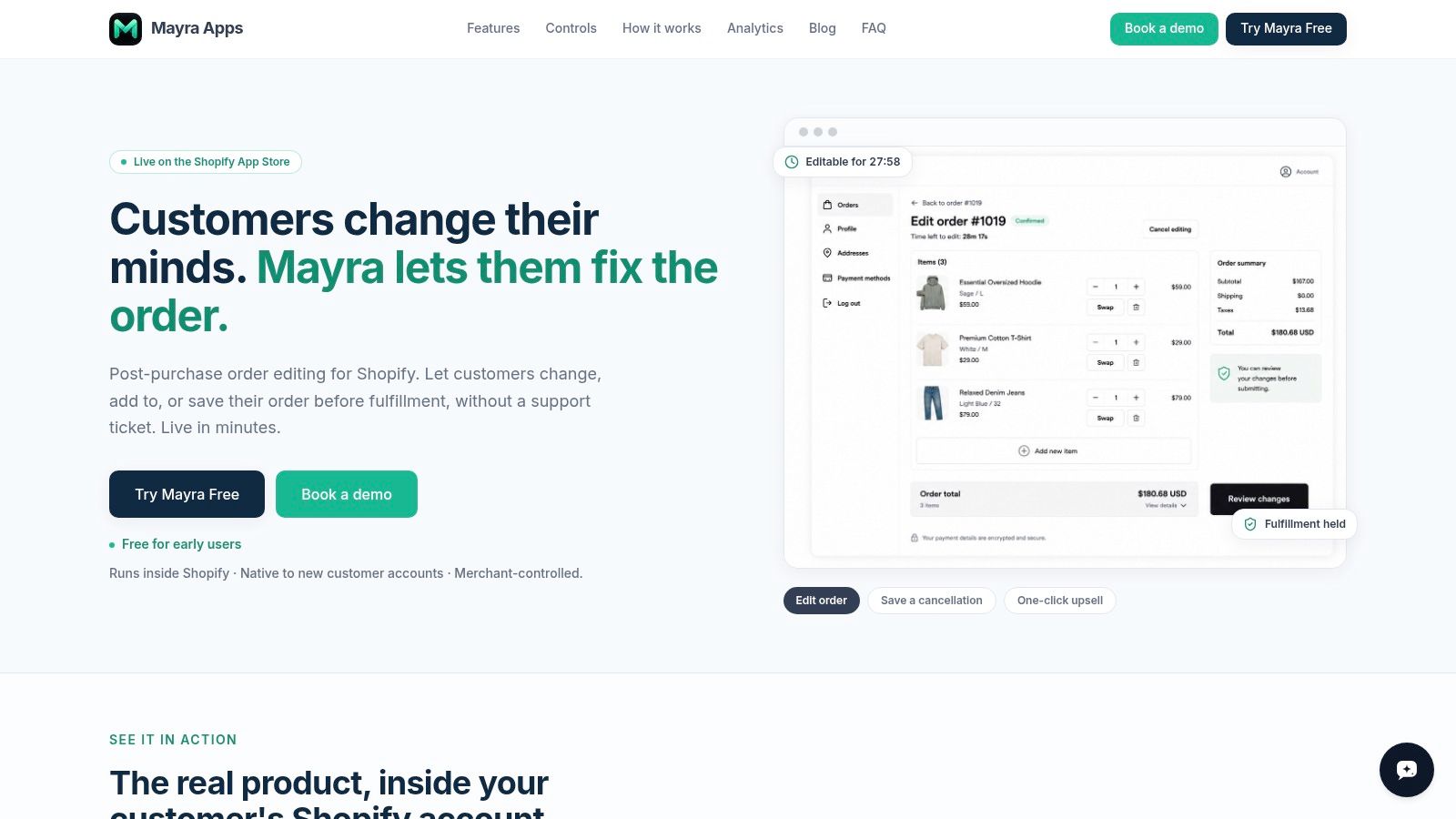
Mayra Apps is the strongest fit in this list for a merchant whose post-purchase problem includes order changes, cancellation requests, and fulfillment risk, not only incremental revenue. It adds one-click upsells inside Shopify's new customer accounts and on the Order status page, with accepted products added to the same Shopify order rather than sent through a separate checkout.
Customers can change quantities, swap variants, update shipping addresses, add items, or remove items through a self-serve flow. Mayra writes those changes back to the original order, keeping Shopify admin as the operational system of record. That matters when support, warehouse, finance, and customer service teams need one order record instead of a chain of related transactions.
Governance and order safety
Mayra gives merchants control over the conditions under which an order can change. Teams can set edit windows, enable or disable particular capabilities, require approval above defined thresholds, and exclude products, collections, tags, countries, high-value orders, or orders already in flight. During an active edit, shipments are automatically placed on fulfillment hold so the warehouse doesn't ship while the customer is changing the order.
Financial handling runs through Shopify. Additional charges are invoiced automatically, while refunds can process automatically or wait for approval according to the merchant's settings. Mayra also supports cancellation deflection through reason capture and store-credit offers, with a full cancellation path available when saving the order isn't appropriate.
Practical fit and trade-offs
The analytics focus on store-specific activity, including orders edited, revenue recovered, orders saved, and modeled ticket avoidance. An inputs-based estimator helps merchants use their own data rather than relying on external benchmarks. Mayra is currently positioned as an early-access product, free for early users, with pricing beyond that stage not published on its site.
Best operational fit: Choose Mayra when the same post-purchase surface needs to fix an order, save a cancellation, and capture a relevant add-on without losing control of fulfillment.
The main constraint is compatibility validation. Mayra is built for Shopify's new customer accounts and the Order status page, so merchants should test those surfaces, payment behavior, fulfillment holds, approval rules, and complex fulfillment flows before a broader launch.
2. Zipify OCU
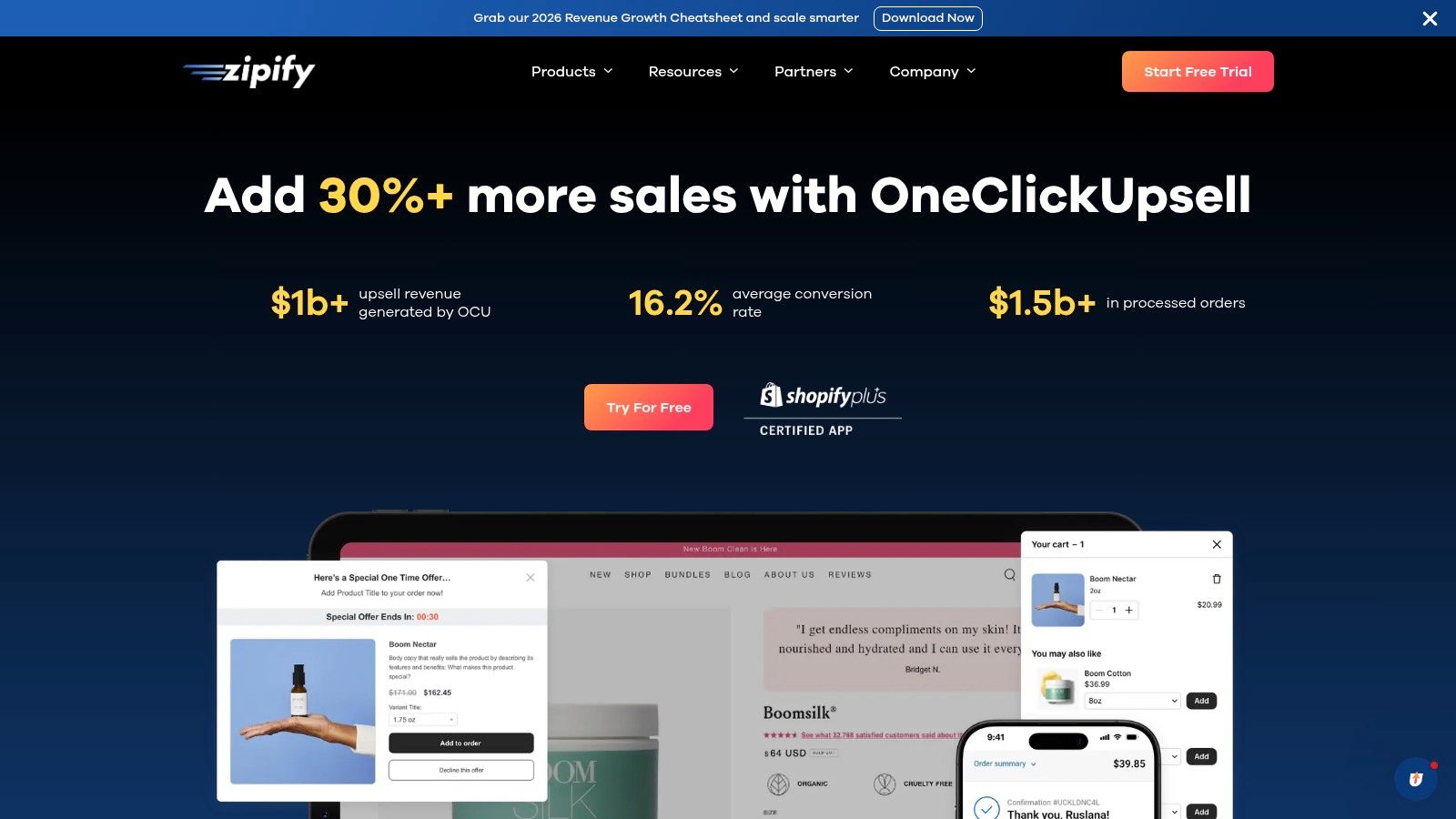
Zipify OCU is a mature funnel-first choice for merchants that want to test offers across several stages of the buying journey. Its documented coverage includes pre-purchase offers, one-click post-purchase upsells and downsells, thank-you page offers, and optional checkout functionality for Shopify Plus merchants. Templates and guided setup reduce the work required to launch an initial funnel.
The product has a substantial category scale signal. Zipify says OneClickUpsell has generated more than $1 billion in upsell revenue, processed more than $1.5 billion in orders, and reported a 16.2% average post-purchase upsell conversion rate across 50,000+ Shopify stores on its OneClickUpsell product page. Those are vendor-reported figures, so they should be treated as product-level context rather than a forecast for your store.
Testing and placement breadth
OCU is suited to teams that want one application for pre-purchase, post-purchase, thank-you page, and Shopify Plus checkout experiments. Its A/B testing and live testing workflows help merchants validate offer logic instead of launching a large set of unrelated prompts at once.
A practical limitation is that its broader surface coverage can increase implementation and merchandising complexity. Usage-based tiers may also become more expensive as accepted revenue or activity grows, and the plan notes identify no built-in subscription billing pause.
For a deeper explanation of the format, see this guide to one-click upsells on Shopify. OCU is the better match for a funnel team measuring offer performance. It isn't the obvious choice for a merchant whose primary issue is customer-initiated order editing, fulfillment holds, or approval governance on an existing order.
3. AfterSell Post Purchase Upsell
AfterSell focuses on post-purchase and thank-you page monetization. Its core tools include one-click upsells and downsells, templates, design controls, A/B testing, and analytics. That makes it a practical option for a merchant that wants a focused offer flow rather than a broader merchandising platform.
The application can also support cart drawer functionality through Rokt Upcart and checkout customizations for Shopify Plus. Those capabilities expand the available surfaces, but they also introduce a modular consideration. A merchant that needs the cart drawer may need to evaluate separate functionality and pricing rather than assuming the post-purchase plan includes every surface.
Where it fits
AfterSell is a good candidate for teams that want to launch quickly, compare offer variants, and keep pricing easier to understand at the plan level. Its post-purchase orientation gives the team a clear starting point: choose an offer tied to the purchased item, define the fallback or downsell path, and review acceptance and revenue reporting.
The Shopify Plus limitation matters for checkout work. Standard Shopify merchants should assess the post-purchase and thank-you page capabilities on their plan, while Plus merchants can separately evaluate whether checkout promotional offers justify the additional setup.
Use this explanation of post-purchase upsells when defining the customer journey before implementation. AfterSell handles the offer layer well, but merchants should verify how accepted products are represented in the original order, how fulfillment is consolidated, and what operational controls are available for edits or exceptions.
4. Upsell.com
Upsell.com, formerly ReConvert, is a broad customer-journey upsell platform with a particularly strong thank-you page heritage. It supports one-click post-purchase offers, thank-you page widgets, product and cart offers, and checkout functionality that depends on Shopify Plus. Its rules and automation tools let merchants target offers beyond a single generic recommendation.
The product makes sense for stores that want to monetize both the immediate post-purchase moment and the thank-you page experience. That distinction matters because the two surfaces serve different jobs. A post-purchase offer seeks an immediate add-on without reopening payment, while a thank-you page can support additional content, merchandising, and customer guidance after the transaction path is complete.
Thank-you page strength
Upsell.com's lineage gives it a useful advantage for merchants that want to customize the post-order page rather than treat it as a receipt-only destination. Teams can use widgets and targeted offers to connect the original purchase with related products or next steps.
The trade-off is cost and plan complexity. The base entry price is positioned as accessible for initial testing, but usage charges can apply beyond the base plan. Advanced checkout blocks and related features depend on Shopify Plus, so a store should map its intended surfaces before comparing plans.
Upsell.com is less suitable when the primary requirement is order editing, fulfillment holds, or customer-account self-service. It is more suitable for a growth marketer that wants broad offer coverage and a highly configurable thank-you page.
5. Rebuy Personalization Engine
Rebuy is designed for merchants that need personalization and merchandising controls across a more complex catalog. Its capabilities include AI recommendations, merchandising rules, A/B testing, analytics, no-code widgets, developer-friendly implementation, post-purchase upsell and downsell flows, thank-you page placements, and checkout extensions for Shopify Plus.
The key distinction is that Rebuy behaves more like a personalization engine than a narrow post-purchase funnel tool. That can be valuable for a larger brand with several product relationships, multiple customer segments, and a team capable of maintaining rules alongside automated recommendations.
Recommendation logic and Shopify limits
Rebuy's combination of AI recommendations and manual merchandising rules gives operators two ways to control relevance. Automated suggestions can help generate ideas, while explicit rules can prevent unsuitable products from appearing in a high-value customer moment. Its documentation also identifies Shopify limitations that teams should review before building a complex sequence, including a two-offer acceptance cap in Shopify post-purchase flows, as documented in the Rebuy Shopify App Store listing.
Rebuy offers a free plan option through the App Store, while broader pricing and configuration can become more involved because the platform uses a build-your-plan model. Checkout features require Shopify Plus.
For merchants working on broader basket strategy, this Shopify average order value guide provides useful context. Rebuy is the strongest match here for advanced merchandising. It may be excessive for a small store that only needs one tightly matched add-on and simple order handling.
6. UpsellPlus
UpsellPlus concentrates on checkout and post-purchase monetization while still covering product pages, cart or drawer offers, and thank-you page add-ons. Its feature set includes one-click post-purchase offers, targeting rules, discount handling, and Shopify Plus checkout extensions.
That positioning makes it a practical option for a merchant that wants multiple offer surfaces without adopting a larger personalization platform. The setup guidance is geared toward quick deployment, and the pricing page is transparent enough to support an initial plan comparison.
Checkout and post-purchase balance
The main decision is whether checkout is a central requirement. UpsellPlus can support checkout extensions, but advanced checkout customization is stronger on Shopify Plus. Standard-plan merchants should focus their evaluation on the product, cart, post-purchase, and thank-you page surfaces that are available in their setup.
The app's smaller ecosystem can be an advantage for a focused team that wants fewer moving parts. It can also be a limitation for a brand seeking extensive merchandising, developer tooling, or a large network of connected commerce capabilities.
UpsellPlus doesn't primarily address post-purchase order editing or fulfillment consolidation. Before launch, confirm whether accepted items update the original order or create a separate operational path, then test refunds, payment deltas, inventory reservations, and warehouse timing with a real but controlled order flow.
Operational test: Don't judge a checkout or post-purchase app only by whether the offer accepts. Follow the accepted item through admin, fulfillment, refunds, customer communication, and the Order status page.
7. Honeycomb Upsell & Cross-Sell
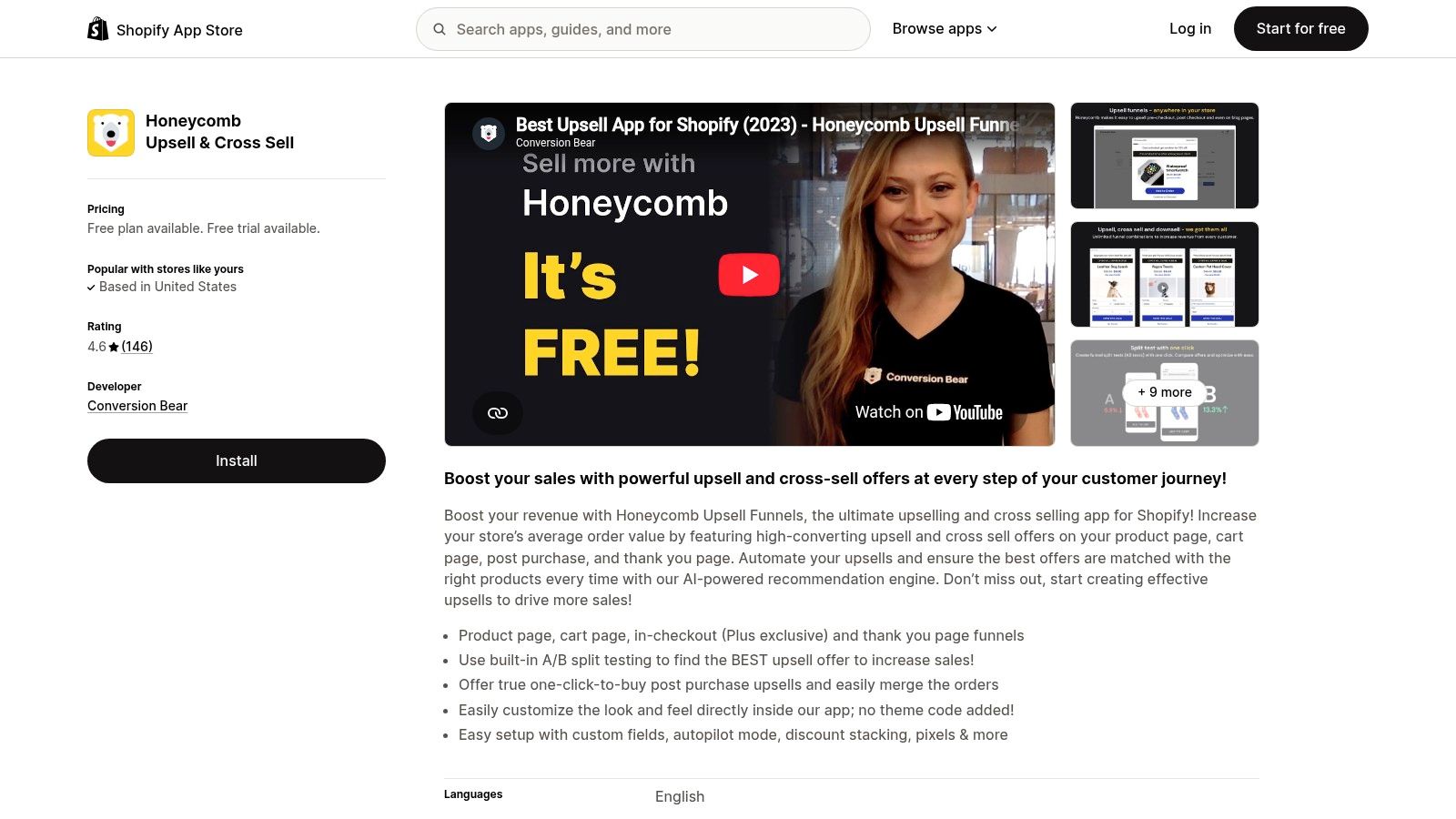
Honeycomb is built for merchants that want a straightforward funnel builder with accessible testing. It supports product, cart, post-purchase, and thank-you page funnels, along with one-click post-purchase offers, downsells, split testing, analytics, and an AI recommendation engine.
Its operational distinction is important. The plan notes identify order merge support, which makes Honeycomb more relevant than a purely presentation-layer upsell tool for merchants concerned about split shipments. That doesn't eliminate the need for testing, but it gives the app a clearer story around how an accepted add-on can relate to the original order.
A practical entry point
Honeycomb offers a free plan for initial testing and uses clear plan tiers with monthly funnel-view limits. That model is easier to understand than a platform priced around a larger set of personalized merchandising services, but the view caps need to be modeled against the store's traffic and intended placement coverage.
Documentation addresses post-purchase eligibility and payment behavior, which should help teams validate whether their chosen Shopify setup can support the desired flow. Checkout blocks remain Shopify Plus-dependent.
Honeycomb is a good fit for a smaller or growing store that wants to build and compare funnels without a heavy implementation program. It may not be enough for a merchant that needs extensive order editing permissions, approval thresholds, fulfillment holds, or customer-account workflows. In that case, order governance should outrank the simplicity of the funnel builder.
8. CartHook Upsell
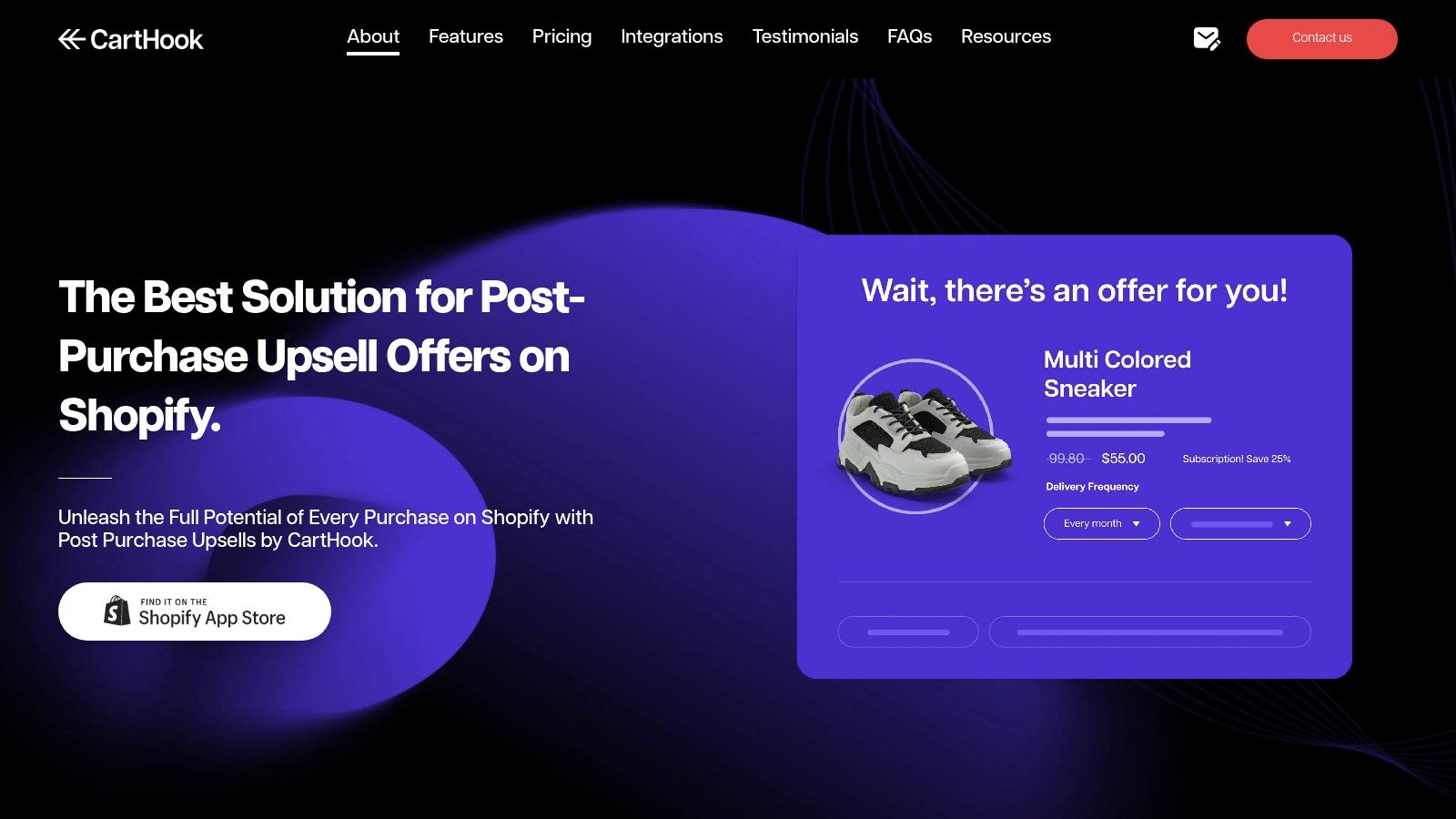
CartHook is a focused post-purchase tool for merchants that want simple acceptance flows, downsells, and measurable funnel testing. Customers can accept a one-click offer without re-entering payment information, while the drag-and-drop builder supports multi-step upsell and downsell sequences.
The app also includes targeting rules, A/B testing, performance reporting, and thank-you page offers. Recharge integration and language coverage can make it more relevant for subscription-oriented or international teams, although each merchant should confirm the current compatibility of its connected systems.
Pricing and support considerations
CartHook uses order-count-based pricing tiers, with revenue share applying on lower tiers and most tiers carrying a revenue-share fee according to the plan notes. That pricing model can align cost with order activity, but it should be modeled against gross accepted revenue and contribution margin, not only against the number of orders.
User reviews have noted variability in support, so support responsiveness belongs in the pilot evaluation. A simple builder can shorten launch time, but a team still needs to test offer eligibility, declined-offer paths, order records, refunds, and fulfillment behavior.
CartHook is a sensible choice for a merchant whose priority is a dedicated post-purchase funnel. It is less suitable if the team wants customer self-service editing, broad account-based controls, or a single system for operational changes and upsells.
9. Monk Free Gift & Upsell
Monk combines upsells and cross-sells with free-gift and promotion mechanics. Its coverage includes product pages, cart and drawer offers, Shopify Plus checkout placements, and post-purchase offers powered by Shopify checkout and post-purchase APIs.
The app stands out when the merchandising strategy includes gifts with purchase, BOGO structures, and promotional playbooks alongside conventional add-ons. Auto-recommendations can support setup, while migration assistance and order-count-based pricing provide a clearer path for merchants moving from another offer tool.
Gift-led strategy and complexity
A gift-led strategy can be more compelling than a standard discount when the added product reinforces the original purchase. It can also create more complicated eligibility, inventory, and margin rules. Merchants should decide whether a free gift is a customer acquisition mechanic, a threshold incentive, a retention tool, or a post-purchase add-on before combining it with upsell flows.
Advanced checkout placements require Shopify Plus. Teams using multiple offer types at once should expect a learning curve, particularly around exclusions, stacking rules, inventory availability, and customer communication.
Monk is the best fit in this list for promotion-led merchandising. It isn't the natural first choice for a support team seeking self-serve address changes or a fulfillment manager requiring edit-window holds. If order consolidation is critical, verify how each accepted offer is represented in Shopify admin and in fulfillment workflows.
10. Cleverific AI Post-Purchase Upsells
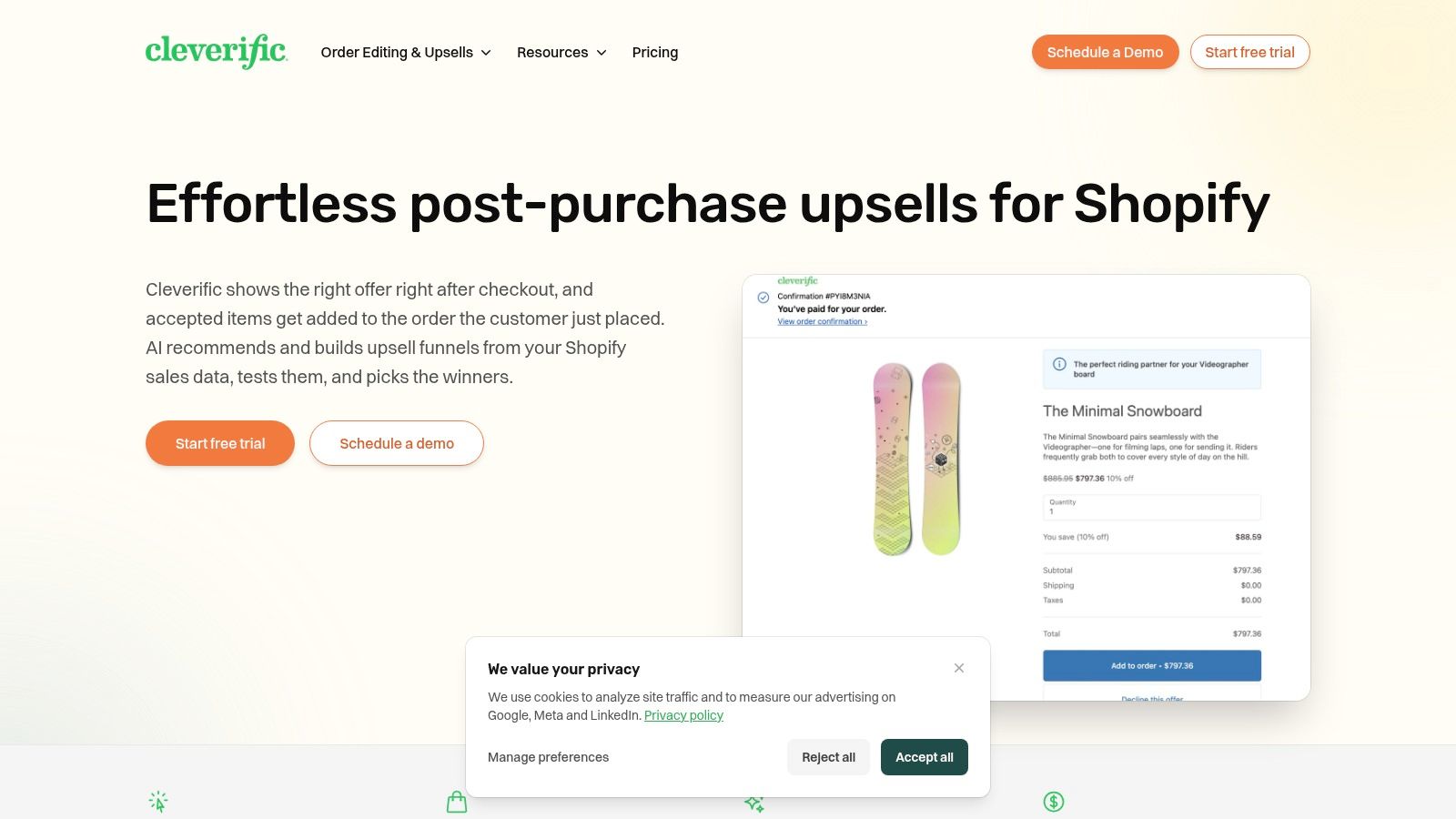
Cleverific pairs post-purchase upsells with order editing. Its one-click offers appear on thank-you and Order status page surfaces, while AI uses order history to propose co-purchase-based funnels and copy. Accepted products are appended to the original order, which is designed to help merchants avoid split shipments.
That combination puts Cleverific closer to Mayra than to funnel-only products, although the operating model is different. Its order-editing function can handle practical post-purchase changes, while approval and eligibility controls help teams decide which orders can be modified and under what conditions.
Fulfillment consolidation and payment fit
Cleverific supports charging order deltas through Shopify Payments and supported gateways. Merchants should verify gateway compatibility before launch, especially if the store uses a mixed payment environment or has custom finance workflows.
The AI layer can reduce the effort required to identify likely product relationships and draft offer copy. It shouldn't replace merchant governance. Co-purchase patterns may suggest an offer, but the merchant still needs to check margin, inventory, shipping compatibility, exclusions, customer expectations, and operational timing.
Cleverific is practical for operations teams that want order edits and upsells in one broader suite. Its upsell module is newer than long-standing upsell-only applications, so merchants should test reporting depth, edge cases, integrations, and support processes rather than assuming maturity from the breadth of the feature list. Stores seeking only a single post-purchase offer may find the wider order-editing capability more than they need.
Top 10 Shopify One-Click Upsell Apps, Feature Comparison
| Product | Core features | Quality (★) | Pricing / Value (💰) | Target audience (👥) | Unique selling points (✨) |
|---|---|---|---|---|---|
| 🏆 Mayra Apps | Self‑serve order edits, cancel‑deflection, one‑click upsells, fulfillment holds | ★★★★☆ | 💰 Early‑access free; pricing TBA | 👥 Shopify DTC merchants, support/ops, marketers, agencies | ✨ Native in‑account edits writing back to original order; merchant‑governed rules; auto‑settlement via Shopify |
| Zipify OCU – OneClickUpsell | Pre/post/checkout funnels, templates, A/B testing | ★★★★★ | 💰 Usage‑based tiers; 30‑day trial | 👥 Merchants wanting battle‑tested post‑purchase funnels | ✨ Mature suite with guided setup, templates & testing |
| AfterSell (Rokt) | Post‑purchase & TYP funnels, templates, A/B testing | ★★★★☆ | 💰 Clear plan‑based pricing | 👥 Merchants focused on post‑purchase funnels | ✨ Fast launch templates; clear pricing & Plus checkout support |
| Upsell.com (ReConvert) | TYP widgets, personalized offers, rules & automation | ★★★★☆ | 💰 Low entry price; usage charges beyond base | 👥 Small–mid stores testing thank‑you page ROI | ✨ Deep TYP customization heritage at low entry cost |
| Rebuy Personalization Engine | AI recommendations, post‑purchase flows, analytics, A/B | ★★★★★ | 💰 Build‑your‑plan; free plan option | 👥 Enterprise / fast‑growing brands | ✨ AI‑driven merchandising and enterprise‑grade flexibility |
| UpsellPlus | One‑click post‑purchase, checkout extensions, targeting rules | ★★★★☆ | 💰 Transparent pricing; Plus guidance | 👥 Merchants focused on checkout/post‑purchase ROI | ✨ Quick to deploy with ROI emphasis across surfaces |
| Honeycomb (Conversion Bear) | One‑click post‑purchase, funnels, AI recs, split testing | ★★★★☆ | 💰 Free plan; tiered funnel‑view limits | 👥 Budget‑conscious merchants experimenting with funnels | ✨ True order merge support + AI recommendation engine |
| CartHook Upsell | One‑click offers, multi‑step funnels, A/B testing, analytics | ★★★★☆ | 💰 Order‑count tiers; revenue‑share on lower plans | 👥 Merchants wanting simple drag‑and‑drop funnels | ✨ Drag‑and‑drop builder and clear reporting |
| Monk Free Gift & Upsell | Post‑purchase upsells, gifts/BOGO, auto‑recommendations | ★★★★☆ | 💰 Order‑count pricing; migration help | 👥 Merchants using gift/BOGO promotional strategies | ✨ Combines free‑gift mechanics with upsells in one app |
| Cleverific – AI Post‑Purchase Upsells | One‑click upsells + order edits, AI offer suggestions | ★★★★☆ | 💰 Clear plan comparisons; newer upsell module | 👥 Ops‑focused merchants needing consolidated orders | ✨ Appends accepted upsells to original order to avoid split shipments |
Choose the App That Fits Your Order Workflow
The right app depends on what happens after a customer clicks Accept. If your main objective is post-purchase funnel experimentation, choose a funnel-first product such as Zipify OCU, AfterSell, Upsell.com, Honeycomb, CartHook, or UpsellPlus. These tools are better aligned with merchants that want offer templates, downsells, placement breadth, A/B testing, and fast iteration across post-purchase and thank-you page surfaces.
If merchandising complexity is the central problem, Rebuy deserves the closest review. Its combination of AI recommendations, explicit merchandising rules, testing, analytics, no-code widgets, and developer-friendly options suits brands with larger catalogs or more complicated customer journeys. The trade-off is configuration and pricing complexity, plus Shopify Plus requirements for checkout functionality.
Monk is the logical candidate for gift-led promotions, BOGO mechanics, and playbook-driven offers. Its value comes from combining free-gift logic with upsell surfaces. That flexibility also increases the number of rules your team must govern, especially when gifts, discounts, inventory, and post-purchase acceptance interact.
Mayra Apps and Cleverific deserve priority when order editing and fulfillment consolidation matter as much as AOV. Mayra is particularly relevant when customers need to change quantities, variants, addresses, or line items directly in customer accounts and on the Order status page. It also adds cancellation deflection, merchant-defined approvals, exclusions, automatic fulfillment holds, and Shopify-managed settlement. Cleverific is a strong alternative when the team wants AI-assisted offer creation alongside original-order editing and accepted-item consolidation.
Adoption remains surprisingly open. A 2026 scan of 143,239 Shopify stores found that only 2% had a detectable upsell or cross-sell app installed, and reported that 98.7% of upsell-app users were on Shopify Plus. Review the Shopify upsell and cross-sell app market scan for the source data. The implication isn't that every store needs an app. It is that Plus-level operational requirements and order controls deserve more attention than generic feature comparisons usually provide.
Before installation, verify:
- Shopify surface access: Confirm support for your plan, post-purchase flow, thank-you page, customer accounts, Order status page, and checkout extensions.
- Original-order behavior: Determine whether an accepted item is appended to the existing order, creates a separate order, or follows a configurable path.
- Fulfillment timing: Test holds, split fulfillment, inventory changes, warehouse notifications, and orders already in progress.
- Payment deltas: Run accepted offers, declined offers, refunds, failed additional charges, and gateway-specific scenarios.
- Governance: Review edit windows, eligibility exclusions, product and country rules, approval thresholds, and fraud-review handling.
- Measurement: Compare accepted offer revenue with refunds, support contacts, fulfillment exceptions, and contribution margin.
- Total cost: Model base fees, usage charges, funnel-view limits, order-count pricing, and revenue-share costs together.
A 2025 benchmark reported a 14.6% average post-purchase upsell conversion rate and classified post-purchase as a high-complexity implementation path, as described in Focus Digital's upsell conversion report. That pairing captures the central decision. The placement can perform well, but relevance logic, fast rendering, order handling, and operational controls determine whether the revenue is worth keeping.
Run a controlled pilot with a small set of highly relevant offers. Start with one product relationship, test the complete payment and fulfillment path, review customer-account visibility, and expand only after support and operations teams can handle accepted, declined, edited, refunded, and held orders without manual confusion.
Mayra Apps combines one-click post-purchase upsells with self-serve order editing, cancellation deflection, Shopify-managed payment settlement, merchant-controlled eligibility rules, and fulfillment holds. Visit Mayra Apps to evaluate whether its customer-account and Order status page workflows fit your Shopify order operations.