
Most advice about must-have apps for Shopify starts with acquisition, conversion, and checkout. That's incomplete. The expensive problems often begin after payment, when customers need to change an order, support agents answer “where is my order?” messages, fulfillment teams correct preventable mistakes, and returns turn into lost revenue.
A practical Shopify stack should cover seven operational jobs: post-purchase editing and upsells, lifecycle messaging, support, reviews, merchandising, shipment visibility, and returns. Shopify stores typically rely on several apps rather than one universal tool. Large-scale storefront telemetry across more than 1.5 million stores found an average of 5.6 detected apps per store, with 29.5% running eight or more apps and only 6.8% showing zero detected apps, according to Order Editing's Shopify app ecosystem analysis.
The right selection comes down to integration depth, workflow ownership, pricing exposure, and operational safeguards. Choose the app that solves a measurable bottleneck without duplicating a capability another app already owns.
Table of Contents
- 1. Mayra Apps
- 2. Klaviyo
- 3. Gorgias
- 4. Judge.me
- 5. Rebuy
- 6. AfterShip Tracking
- 7. Loop Returns
- 7 Essential Shopify Apps Comparison
- Build the Stack Around Your Biggest Bottleneck
1. Mayra Apps
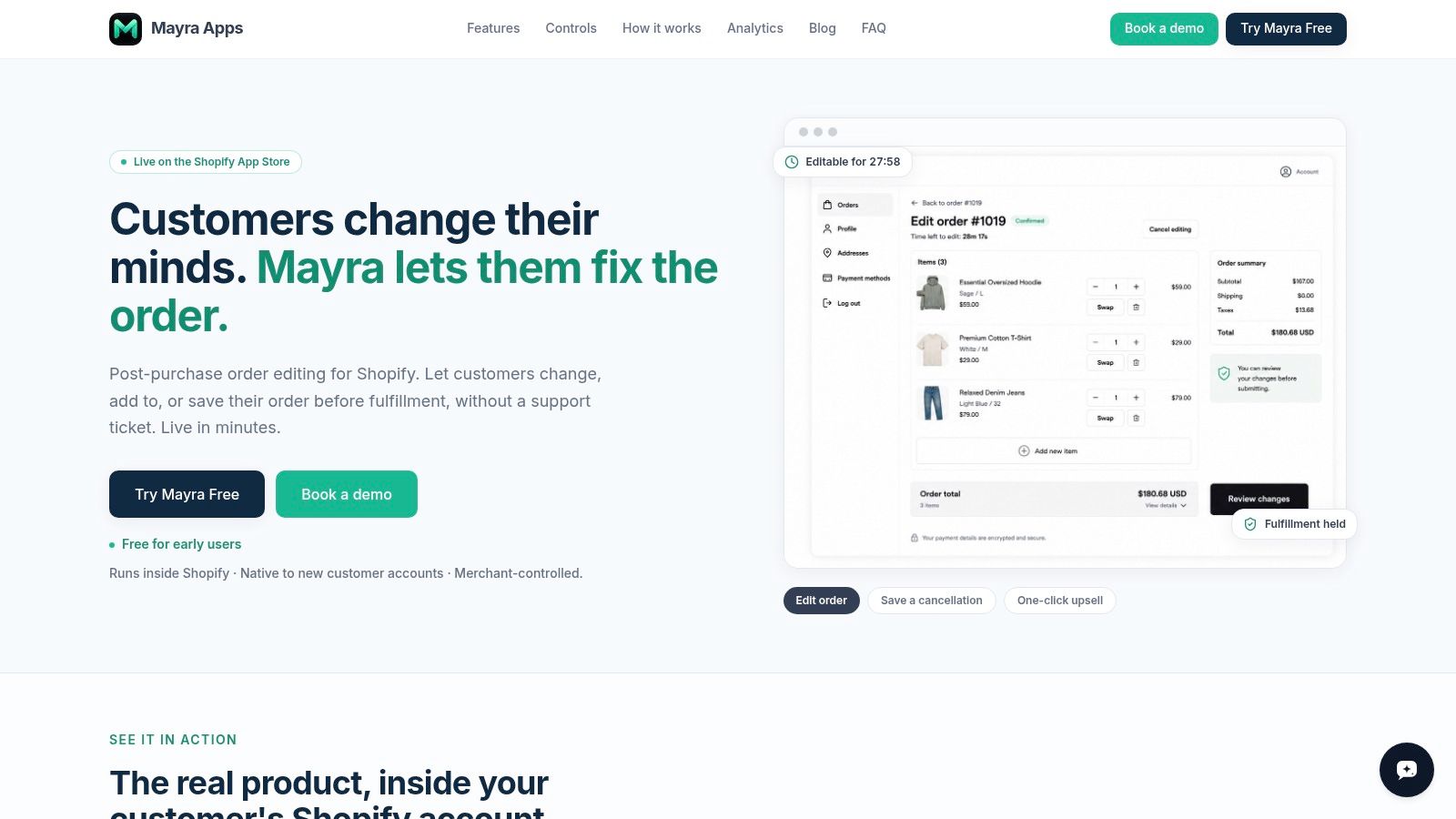
Mayra Apps is the strongest starting point for merchants whose biggest post-purchase problem is avoidable support work. It lets customers edit quantities and variants, update shipping addresses, add or remove items, and manage cancellation intent from their Shopify customer account and Order status page.
The important distinction is where those changes happen. Mayra writes edits back to the original Shopify order, rather than creating a disconnected replacement order or forcing the customer through another checkout. Shopify remains the admin's source of truth, while financial actions such as additional charges and refunds run through Shopify's order workflows.
Why it earns the featured position
Mayra combines self-service with merchant control. Store owners can define edit windows, enable only the capabilities they want, set approval thresholds, and restrict eligibility by product, collection, tag, order value, fulfillment state, or destination. Fulfillment is automatically held while an active edit is in progress, helping prevent a warehouse from shipping an order while the customer is changing it.
That makes Mayra more useful than a simple “edit order” button. A customer who chose the wrong size can swap the variant. Someone who entered an old address can correct it before fulfillment. A shopper who wants to cancel can provide a structured reason and receive a store-credit save offer when the merchant allows it. If the cancellation shouldn't be saved, full cancellation remains available.
Mayra also creates post-purchase upsell opportunities. Relevant recommendations can appear during an edit or on the Order status page, and accepted products are added to the same order. This avoids sending the customer through a separate checkout for a last-minute add-on.
Practical rule: Start with the smallest safe edit policy, then expand permissions after operations and fulfillment teams validate the workflow.
Trade-offs and implementation checkpoint
Mayra is currently in early access, so merchants should expect workflows and features to evolve. Its analytics are store-specific, with modeled estimates clearly identified rather than presented as external benchmarks. Complex fulfillment or third-party logistics arrangements should be tested before a broad rollout.
Install it from Shopify, add the Mayra block to customer accounts and the Order status page, then test quantity changes, variant swaps, address updates, additions, removals, cancellation offers, fulfillment holds, and approval rules with internal test orders.
Best use case: DTC brands with frequent post-purchase requests, address errors, variant mistakes, cancellation attempts, or support tickets that could be resolved by customers themselves.
2. Klaviyo
Klaviyo owns the lifecycle messaging layer. It connects Shopify customer and order data with email, SMS, WhatsApp, RCS, segmentation, automation, and predictive features, making it a strong choice for merchants that want one system to coordinate retention communication.
Its two-way Shopify integration can use customer profiles, orders, products, discounts, and behavioral events to trigger personalized flows. Prebuilt automations cover abandoned carts, post-purchase communication, browse abandonment, and win-back campaigns, while testing tools and predictive analytics support more advanced programs.

The operational trade-off is cost and data discipline. Klaviyo can scale from a few essential flows to a complex customer data program, but the account becomes harder to govern as segments, events, channels, and profile records multiply. Email costs rise with active profiles, while SMS and other messaging channels have separate usage considerations.
Mayra and Klaviyo can work together, but they shouldn't own the same workflow. Mayra should manage the customer's order change or cancellation action. Klaviyo should respond to the resulting order and customer events, such as sending confirmation, replenishment, post-purchase education, or a win-back message. Use this guide to abandoned cart recovery when mapping the difference between pre-purchase recovery and post-purchase retention.
Implementation checkpoint
Begin with one post-purchase flow and one recovery flow. Confirm which Shopify event triggers each message, suppress customers whose orders are canceled, and prevent duplicate messages from overlapping apps. Also review SMS and WhatsApp consent before activating those channels.
Best use case: Stores with enough customer and order activity to justify structured lifecycle automation, especially when retention messaging is scattered across several disconnected tools.
3. Gorgias
Gorgias is the support layer for merchants that need agents to work with Shopify order data without switching between a helpdesk and the admin. It centralizes email, chat, social, phone, and SMS conversations, then places customer and order context inside the ticket.
Agents can perform Shopify actions such as refunds, edits, and cancellations from the support interface. Macros, rules, automation, and an optional AI agent help teams handle recurring questions and routine requests. The result is a support workflow built around the order rather than a generic inbox.

Gorgias works particularly well when support is part of the retention and conversion strategy. An agent can see order status, customer history, and available actions in one place, then resolve an issue without asking the customer to repeat information. Its ecommerce focus and Shopify data integration are major advantages over a general-purpose helpdesk.
The trade-off is that pricing is tied to support demand. Ticket volume can make costs less predictable, and automation or AI features may introduce per-resolution charges. That makes workflow ownership important. If Mayra already gives customers a safe way to edit an order, Gorgias should handle exceptions, approvals, and issues that require human judgment rather than duplicating every self-service action.
Implementation checkpoint
Build macros for the most common order problems, then decide which actions agents may complete immediately and which require approval. Connect tracking, refund, and cancellation information to the ticket view. Review automation regularly so an AI resolution doesn't trigger a refund, cancellation, or address change that conflicts with fulfillment rules.
For broader guidance on structuring an ecommerce support operation, use this guide to ecommerce support for SMBs.
Best use case: Shopify brands with several support channels, repeat order-related questions, and agents who need direct access to Shopify actions.
4. Judge.me
Judge.me is the practical reviews choice for merchants that need dependable social proof without adopting a larger retention or loyalty suite. It supports automated review requests, photo and video reviews, on-site widgets, customer questions and answers, review imports, and Google Shopping review syndication.
Its main strength is focus. The app can collect feedback after purchase, display it where shoppers evaluate products, and extend review content to shopping surfaces beyond the storefront. That gives merchandising and marketing teams usable customer proof without requiring a complex implementation.
The trade-off is scope. Judge.me is not designed to replace a full loyalty, rewards, or user-generated content program. If the store needs points, referrals, creator permissions, advanced community functions, or complex content rights management, additional tools may be required. Adding those tools without assigning ownership can create duplicate review requests and inconsistent customer experiences.
Use Judge.me alongside Klaviyo by keeping the trigger in the reviews app and using Klaviyo for broader customer communication only when the data handoff is intentional. A review request shouldn't compete with a post-purchase education series or arrive while a support issue remains unresolved.
Implementation checkpoint
Set the review request timing around delivery and product use, not just order creation. Exclude canceled or refunded orders where appropriate, confirm the review widget matches the theme, and test how photo and video submissions appear on product pages and external shopping placements.
Best use case: Merchants that need an affordable, lightweight review system with strong visual review support and straightforward implementation.
5. Rebuy
Rebuy owns merchandising and recommendation surfaces across the storefront. It can present cross-sells, upsells, bundles, and personalized recommendations on product pages, cart drawers, checkout extensions, and post-purchase screens. Its Smart Cart is especially useful for merchants that want offers embedded directly into the cart experience.

Rebuy's breadth is its advantage and its risk. One recommendation engine can coordinate offers across multiple customer touchpoints, but a store can quickly create competing widgets if another app also adds cart recommendations, post-purchase offers, bundles, or checkout promotions. Merchants should decide whether Rebuy owns pre-checkout merchandising while Mayra owns post-purchase edits and in-order offers.
Some advanced checkout and post-purchase capabilities depend on Shopify Plus, so plan compatibility must be checked before implementation. Pricing can also be higher than a single-purpose upsell app, particularly when the merchant doesn't need recommendation logic across many surfaces.
A focused approach is better than filling every available placement. The best Shopify upsell apps should be evaluated by placement, order ownership, settlement method, and customer experience, not by the number of widgets they provide.
Implementation checkpoint
Map every existing offer location before installing Rebuy. Choose the primary owner for product-page recommendations, cart offers, checkout extensions, and post-purchase promotions. Then test discount stacking, subscription compatibility, inventory availability, and how accepted offers appear in Shopify orders.
Best use case: Merchants with a clear merchandising strategy that want coordinated recommendations across product, cart, checkout, and post-purchase surfaces.
6. AfterShip Tracking
AfterShip Tracking solves shipment visibility, a job that directly affects both customer confidence and support workload. It centralizes multi-carrier tracking, creates branded tracking pages, and sends automated shipment notifications so customers don't need to search through order emails or contact support for every delivery update.
The branded tracking page gives merchants a controlled post-purchase destination. Instead of sending customers to a carrier site with limited brand context, the store can keep tracking information inside a customer-facing experience that may also connect with marketing and review tools.
AfterShip also supports bulk shipment imports and multiple carriers, which helps operations teams manage a varied fulfillment network. The integration with tools such as Klaviyo and review apps can support a coordinated post-purchase sequence, but merchants should avoid sending too many notifications. A tracking update, delivery message, review request, and promotional email need clear timing rules.
The main trade-off is shipment-volume pricing. Overage exposure can become significant when order volume rises, so plan allowances should be reviewed before launch. Tracking quality also depends on carrier data and correct shipment handoffs from fulfillment systems.
Implementation checkpoint
Connect every active carrier, test branded tracking pages on mobile, and verify that shipment events reach Shopify and the marketing stack correctly. Set notification ownership before activation. After launch, compare tracking-page usage and shipment-related support contacts with the prior workflow.
Best use case: Stores that ship through multiple carriers or receive recurring “where is my order?” requests after fulfillment.
7. Loop Returns
Loop Returns is the returns layer for merchants that want to replace manual email exchanges with a structured self-service process. It provides a returns portal, policy controls, exchange logic, store-credit automation, handling-fee options, and configurable workflows connected to Shopify and fulfillment operations.
The commercial value comes from giving customers alternatives to a straight refund. A shopper may exchange a size, choose another product, or accept store credit, while the merchant controls which options are available under different policy conditions. Loop can also surface upsell opportunities during the returns journey.
Loop is a strong fit for apparel, footwear, and other categories where exchanges and returns create substantial operational work. Its Shopify-native integrations with logistics providers, third-party fulfillment, and order-status workflows help connect customer-facing policy decisions with warehouse execution.
The trade-off is configuration depth. More controls mean more policy decisions, and advanced capabilities may depend on the plan tier. Merchants should also verify inclusions carefully because plan details and pricing can differ between the Shopify App Store listing and the vendor's website.
Returns shouldn't operate independently from post-purchase editing. If a customer can correct a size or variant before fulfillment, that intervention may prevent a return later. Mayra handles the pre-fulfillment change, while Loop should own the formal return or exchange after the order moves into the relevant stage. This Shopify returns management guide can help define that handoff.
Implementation checkpoint
Write the returns policy in operational terms before configuring the portal. Test exchange eligibility, store-credit issuance, handling fees, warehouse notifications, refund approval, and exceptions for final-sale or excluded products. Confirm that returned inventory and customer communications remain synchronized with Shopify.
Best use case: Merchants with frequent returns, complex exchange rules, or a clear preference for retaining value through exchanges and store credit.
7 Essential Shopify Apps Comparison
| Product | 🔄 Implementation Complexity | ⚡ Resource Requirements | 📊 Expected Outcomes | 💡 Ideal Use Cases | ⭐ Key Advantages |
|---|---|---|---|---|---|
| Mayra Apps | 🔄 Low–Medium, Shopify‑native, minimal theme changes | ⚡ Low, admin config, governance rules, onboarding support (early access) | 📊 Reduce tickets, recover cancellations, increase realized AOV; store-specific analytics | 💡 DTC brands, ops/support teams, growth marketers wanting post‑purchase self‑service | ⭐ Native order write‑back, automatic fulfillment holds, fine‑grained merchant controls |
| Klaviyo | 🔄 Medium, connect data layer, build flows and segments | ⚡ Medium, marketing resources, content, list hygiene; costs scale with profiles | 📊 Higher lifecycle revenue via automated email/SMS flows and personalization | 💡 Stores focused on lifecycle marketing and multichannel retention | ⭐ Deep two‑way Shopify sync, prebuilt flows, testing and predictive tools |
| Gorgias | 🔄 Medium, inbox routing, macros, automations and Shopify actions | ⚡ Medium, support team training, ticket volume monitoring (pricing tied to usage) | 📊 Faster resolutions, higher conversion via support, centralized ticket handling | 💡 Merchants treating support as conversion/retention lever | ⭐ Unified inbox with Shopify order actions, ecommerce‑focused automations |
| Judge.me | 🔄 Low, install and enable widgets/requests | ⚡ Low, minimal setup, automated review requests | 📊 More on‑site reviews, UGC and Google Shopping syndication | 💡 Budget‑conscious stores needing reliable reviews at scale | ⭐ Fast setup, photo/video reviews, transparent pricing |
| Rebuy | 🔄 Medium–High, implement recommendations across PDP/cart/checkout | ⚡ Medium–High, product data, design work, Plus for advanced features | 📊 Increases AOV and units per order through personalized upsells | 💡 Stores prioritizing personalization and checkout/post‑purchase upsells (Shopify Plus beneficial) | ⭐ Data‑driven upsells, Smart Cart offers, broad surface coverage |
| AfterShip Tracking | 🔄 Low, integrate carriers and tracking pages | ⚡ Low–Medium, shipment data feed, monitor plan usage (overage risk) | 📊 Reduce WISMO contacts, improve post‑purchase visibility and retention | 💡 Multi‑carrier shippers and stores wanting branded tracking pages | ⭐ Branded tracking pages, automated notifications, wide carrier support |
| Loop Returns | 🔄 Medium, configure returns portal, exchange logic and policies | ⚡ Medium, returns policy setup, logistics/3PL integration; plan tiering | 📊 Fewer refunds, more exchanges/store credit, retained revenue in returns flow | 💡 Apparel, footwear and high‑return verticals needing returns automation | ⭐ Self‑serve returns portal, store‑credit automation, deep Shopify integrations |
Build the Stack Around Your Biggest Bottleneck
Don't install all seven apps at once. Start by identifying the largest avoidable workload or revenue leak, then assign one app to own that workflow. If customers repeatedly request address changes or order edits, start with Mayra. If the largest problem is fragmented customer communication, start with Klaviyo or Gorgias, depending on whether marketing automation or agent productivity is the constraint.
Confirm Shopify compatibility before committing, especially for checkout extensions, customer accounts, fulfillment states, third-party logistics, and Shopify Plus features. Review plan-based limits and pricing exposure as well. Klaviyo charges can expand with active profiles and messaging channels, Gorgias costs depend on support demand, AfterShip requires shipment-volume monitoring, and Rebuy and Loop may reserve advanced capabilities for higher tiers.
Data handoffs deserve the same attention as feature lists. Decide which app creates the customer event, which app sends the message, which app changes the order, and which system reports the final outcome. Don't let a reviews app and a lifecycle platform send competing requests. Don't let two upsell tools place offers in the same cart or post-purchase surface. Don't let a support automation override a fulfillment safeguard.
Validate one workflow at a time:
- Post-purchase edits: Configure edit windows, capability toggles, eligibility rules, approval thresholds, and fulfillment holds before inviting customers to use self-service.
- Lifecycle messaging: Define event triggers, consent requirements, suppression rules, and the difference between abandoned-cart and post-purchase communication.
- Support actions: Connect order data to agent workflows and separate routine actions from exceptions that require approval.
- Review generation: Test request timing after delivery, then confirm canceled, refunded, or unresolved orders are handled correctly.
- Recommendation placements: Map every widget and offer surface so Rebuy and other tools don't duplicate one another.
- Shipment visibility: Monitor carrier connections, tracking events, notification volume, and plan allowances.
- Returns: Confirm policy eligibility, exchange paths, credit rules, warehouse handoffs, and refund behavior.
Measure store-specific outcomes before expanding the stack. Track edited orders, recovered revenue, saved orders, modeled ticket avoidance, support contacts, review generation, shipment inquiries, exchange adoption, and retained value. These metrics will tell you whether an app is solving a real bottleneck or merely adding another layer to the admin.
The best Shopify stack isn't the one with the most installations. It's the one where each app has a defined job, Shopify remains the operational source of truth, and customers can resolve common problems without creating new work for support, fulfillment, or finance.
Mayra Apps helps Shopify merchants manage post-purchase changes directly inside customer accounts and the Order status page, including self-service edits, cancellation deflection with store credit, and one-click upsells. Visit Mayra Apps to see how a controlled post-purchase workflow can reduce avoidable support work while keeping order data in Shopify.