
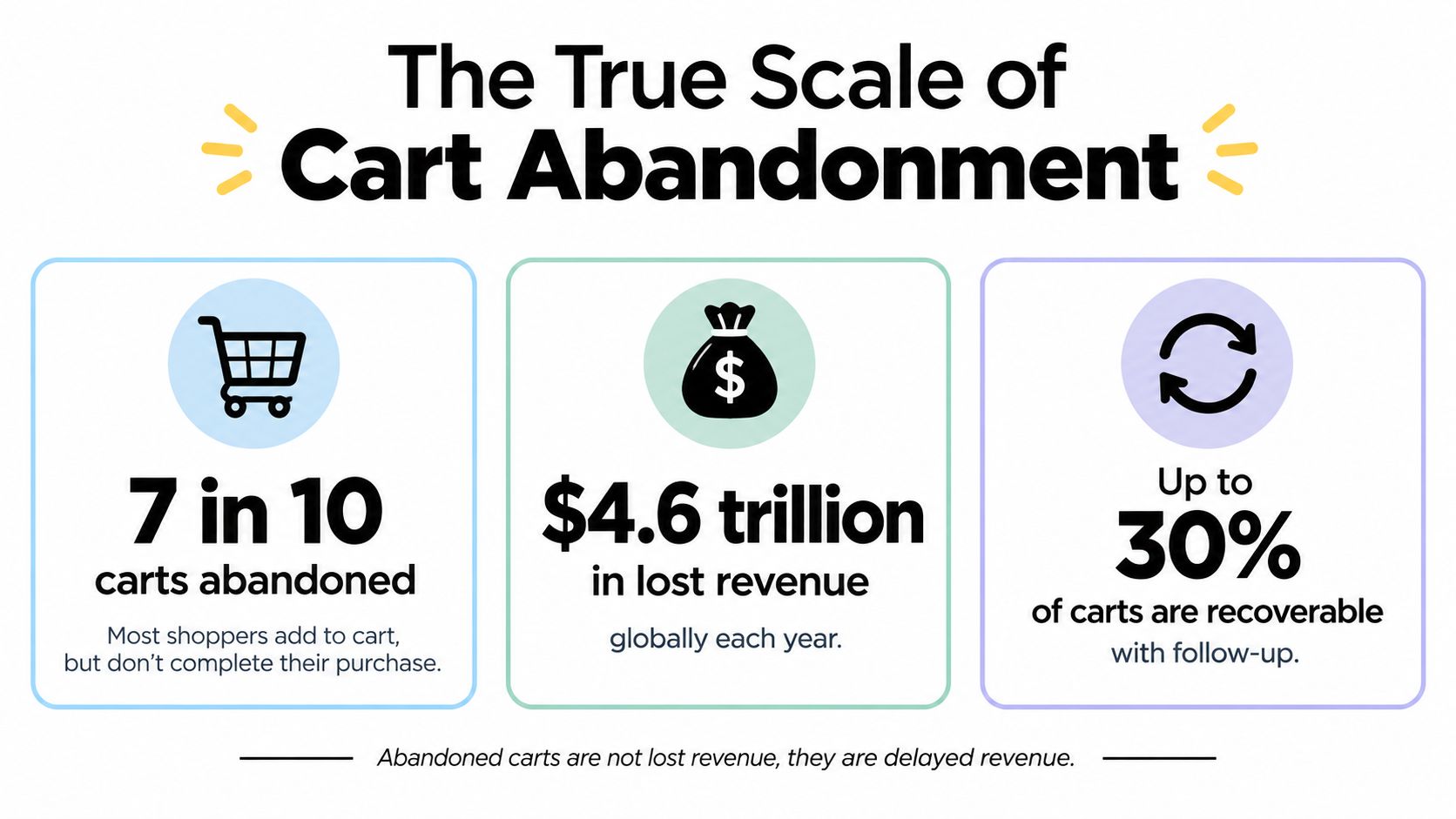
Roughly 70% of shopping carts are abandoned before checkout is completed, according to Baymard Institute's aggregated research, which estimates an average abandonment rate of 70.22% across 50 independent studies (Stripe's summary of cart abandonment research). That means ecommerce teams start roughly seven carts for every three completed orders.
The mistake is treating those carts as a single email opportunity. A profitable recovery program starts earlier, by removing checkout friction, then combines persistent cart experiences, well-timed email and SMS, and post-purchase interventions that prevent avoidable refunds and cancellations. The objective isn't to send more reminders. It's to recover more contribution margin from traffic you've already paid to acquire.
Table of Contents
- The True Scale of Cart Abandonment
- Timing and Channel Selection for Recovery Flows
- Designing Incentives That Protect Your Margins
- Recovering Revenue After the Checkout
- Implementation and Merchant Governance Rules
- Measuring Success Beyond Vanity Metrics
The True Scale of Cart Abandonment
Cart abandonment is a customer-journey problem, not just a marketing leak. Shoppers leave when shipping costs appear late, checkout fields take too long, payment options do not fit, delivery details remain unclear, or they need more time to decide. A reminder can support delayed intent. It cannot repair a checkout that creates doubt.
The 70.22% baseline shows how large the potential recovery pool is before a merchant applies any tactics, per Baymard's aggregated benchmark. For a Shopify operator, an abandoned cart also provides a useful behavioral signal. The shopper selected products and showed enough intent to create a cart, but the reason for leaving is still unknown. Recovery should reduce uncertainty rather than assume a discount will solve every case.
Diagnose the leak before adding messages
Start with funnel analysis, not copywriting. A useful funnel analysis by HelpWithMetrics separates product-page interest, cart creation, checkout initiation, payment failure, and order completion. Each stage calls for a different fix.
Use Shopify analytics and session recordings to examine the following:
- Where do shoppers stop? A sharp drop after shipping costs appear points to price or delivery friction.
- Which devices underperform? Mobile shoppers may struggle with form fields, keyboard behavior, or payment selection.
- Which products create hesitation? Sizing, compatibility, delivery timing, and return conditions may need clearer reassurance.
- Which carts deserve human attention? A high-value cart from a returning customer warrants different treatment from a low-intent first visit.
Pair the recovery plan with a Shopify checkout optimization resource, rather than treating checkout work as a later project. Removing friction before abandonment generally protects more margin than offering a discount after a poor experience.
Build a recovery stack, not a reminder
Email is one layer of the system. On-site recovery preserves the cart, restores context, and removes the need to rebuild the order. Email can address objections, SMS can provide timely visibility when consent exists, and retargeting can support recall without relying on one inbox. The same system should also flag post-purchase risks, including cancellation requests and order changes, so the team can offer an edit or suitable alternative before revenue becomes a refund.
Operating principle: A cart is recovered when the shopper completes an order at acceptable margin, not when a message is opened.
Industry summaries place typical abandoned-cart recovery rates between 10% and 30%, while compiled estimates describe about $260 billion in potentially recoverable revenue across the US and EU through better checkout design and recovery improvements. Treat those figures as broad market context, not a forecast for your store. Results depend on traffic quality, product category, device mix, consent coverage, checkout execution, and the quality of post-purchase save tactics.
Timing and Channel Selection for Recovery Flows
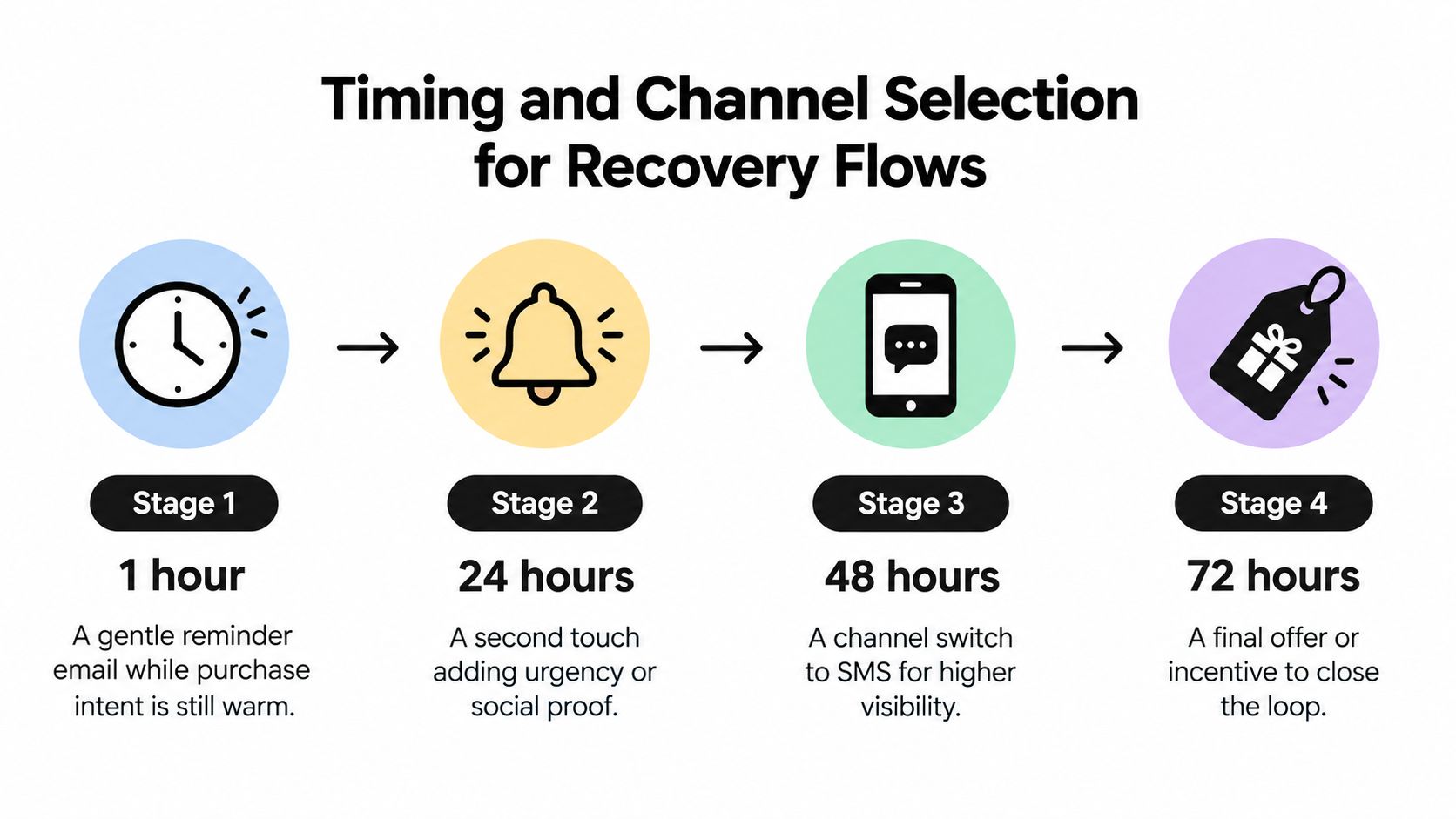
Timing determines whether a shopper is still evaluating the purchase or has already moved on. Compiled recovery data reports that 45% of cart recoveries happen within the first two hours after abandonment. The opening window therefore deserves more attention than a long sequence that begins late.
A practical flow starts with a low-pressure reminder and becomes more persuasive only when the shopper's behavior supports it. A discount is rarely the right first move if the unresolved issue may be delivery, payment, product fit, or checkout friction.
Use the first touch to restore context
Send the first email soon after the cart qualifies for recovery. Show the actual products, selected variants, price, shipping information, and a direct return-to-checkout button. Answer the likely objection instead of repeating the full brand story.
Benchmarks summarized by Shopify report average abandoned-cart email click rates around 6%, with the top 10% reaching 11.3%. Those figures show why one email should not carry the entire program. Strong engagement still leaves many recipients without a completed order.
Build conditional branches around intent:
- Returning customers: Lead with convenience, saved details, and the items they selected. Do not add a discount automatically.
- First-time shoppers: Prioritize shipping clarity, returns, reviews, and payment reassurance.
- High-value carts: Consider a faster human response when the product needs consultation.
- Mobile shoppers with SMS consent: Use SMS for visibility, keep the message short, and make the cart link obvious.
- Discounted carts: Avoid stacking another incentive unless margin rules allow it.
Switch channels with permission and restraint
SMS can improve visibility, but it also interrupts more directly than email. Use it only with appropriate consent, and suppress the message as soon as an order is placed. A useful SMS confirms that the cart remains available and links directly to checkout. It does not need a long product pitch.
Reported channel figures use different denominators. Abandoned-cart email placed-order conversion was reported at 3.33% in 2023, while abandoned-cart SMS showed a 42.02% click-to-conversion rate in 2025. Compare each metric with its own funnel definition rather than treating them as equivalent.
Retargeting supports the recovery system, but owned channels still provide better control over consent, suppression, and message timing. For the distinction between paid audience reminders and customer-based messaging, see AdManage.ai's retargeting vs remarketing. Cap exposure, exclude purchasers quickly, and stop showing an item after the shopper has bought it. Apply the same suppression logic to post-purchase cancellation or edit requests, where a timely order change can protect revenue better than another cart reminder.
Designing Incentives That Protect Your Margins
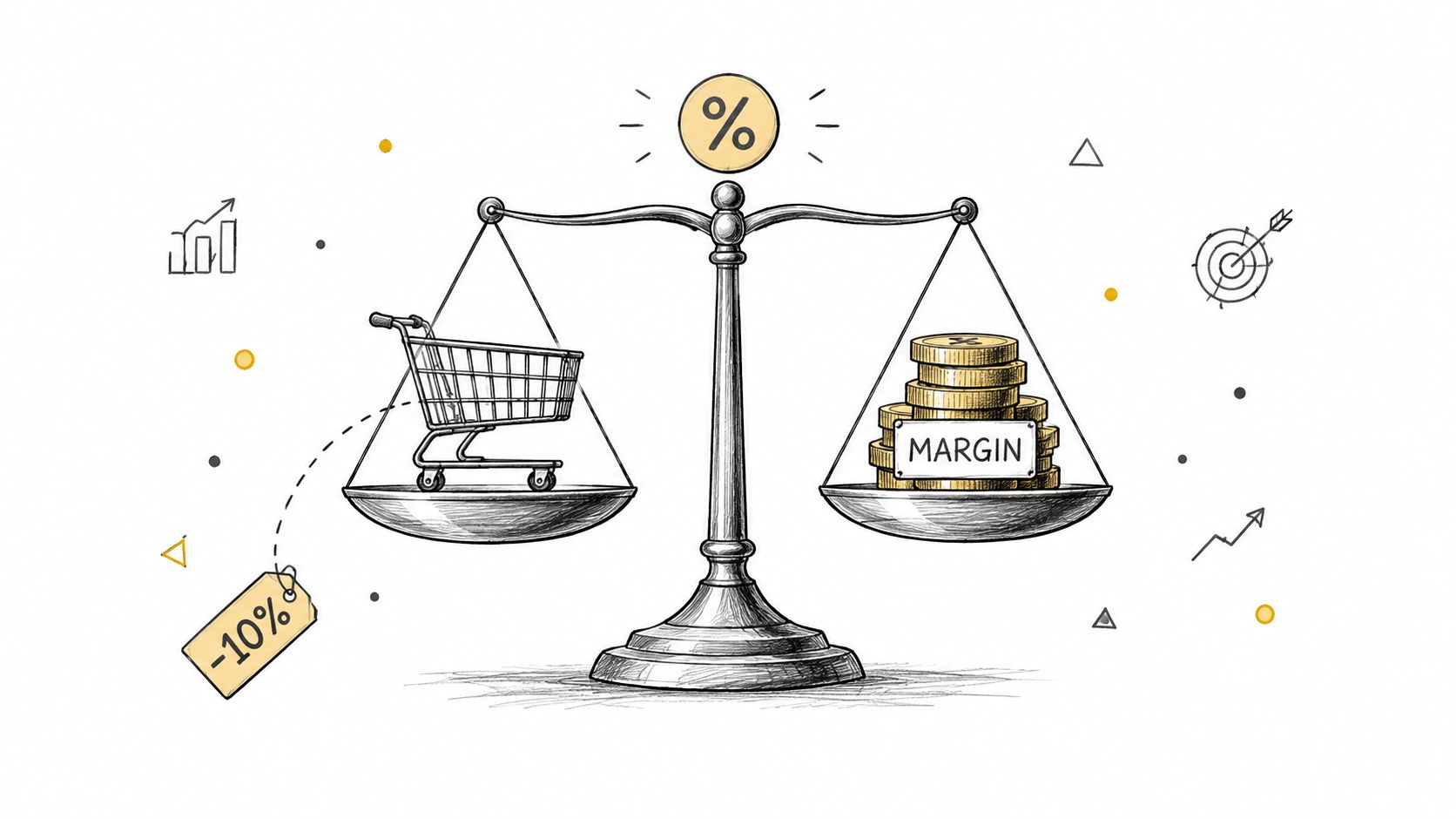
A blanket discount is easy to launch and expensive to normalize. If every abandoned cart receives the same offer, customers can learn to delay checkout until the discount arrives. That makes your recovery flow a margin transfer rather than a conversion system.
The right incentive depends on the barrier. If shipping is the issue, free or reduced shipping may solve it without discounting the product. If the shopper is choosing between products, a gift or bundle can increase perceived value while preserving price integrity. If the cart is already discounted, more price reduction may be unnecessary.
Compare the offer to the objection
| Incentive | Best fit | Margin consideration |
|---|---|---|
| Free shipping threshold | The cart sits just below a profitable shipping threshold | Encourages additional value without reducing product price |
| Gift with purchase | The brand has low-cost, relevant inventory available | Protects perceived price while adding tangible value |
| Bundle value | Products naturally complement one another | Raises order value only if the bundle remains operationally simple |
| Store credit | The customer has an existing relationship with the brand | Retains value for a future purchase rather than paying an immediate price cut |
| Percentage discount | The shopper has high intent but a documented price objection | Use selectively, with eligibility and expiry controls |
An incentive should arrive after the flow has attempted to solve non-price friction. Add a unique code only when the segment qualifies, and make the conditions clear. Don't discount a cart containing a product with limited stock if the primary constraint is availability. Don't offer free shipping when delivery timing, not cost, is the reason the shopper hesitated.
Use on-site prompts before the exit
On-site recovery can intercept uncertainty before the shopper leaves. A cart drawer can clarify delivery dates, show the return policy, preserve the selected variant, and offer a support route for product questions. An exit-intent prompt should be restrained. It can ask whether the shopper needs help, save the cart, or explain shipping rather than immediately presenting a coupon.
Store credit needs its own rules and customer communication. Explain the balance, redemption conditions, and whether it expires. A detailed guide to Shopify store credit can help your team evaluate where credit fits into the wider retention system.
Margin rule: Offer the cheapest intervention that resolves the customer's actual hesitation.
Recovering Revenue After the Checkout
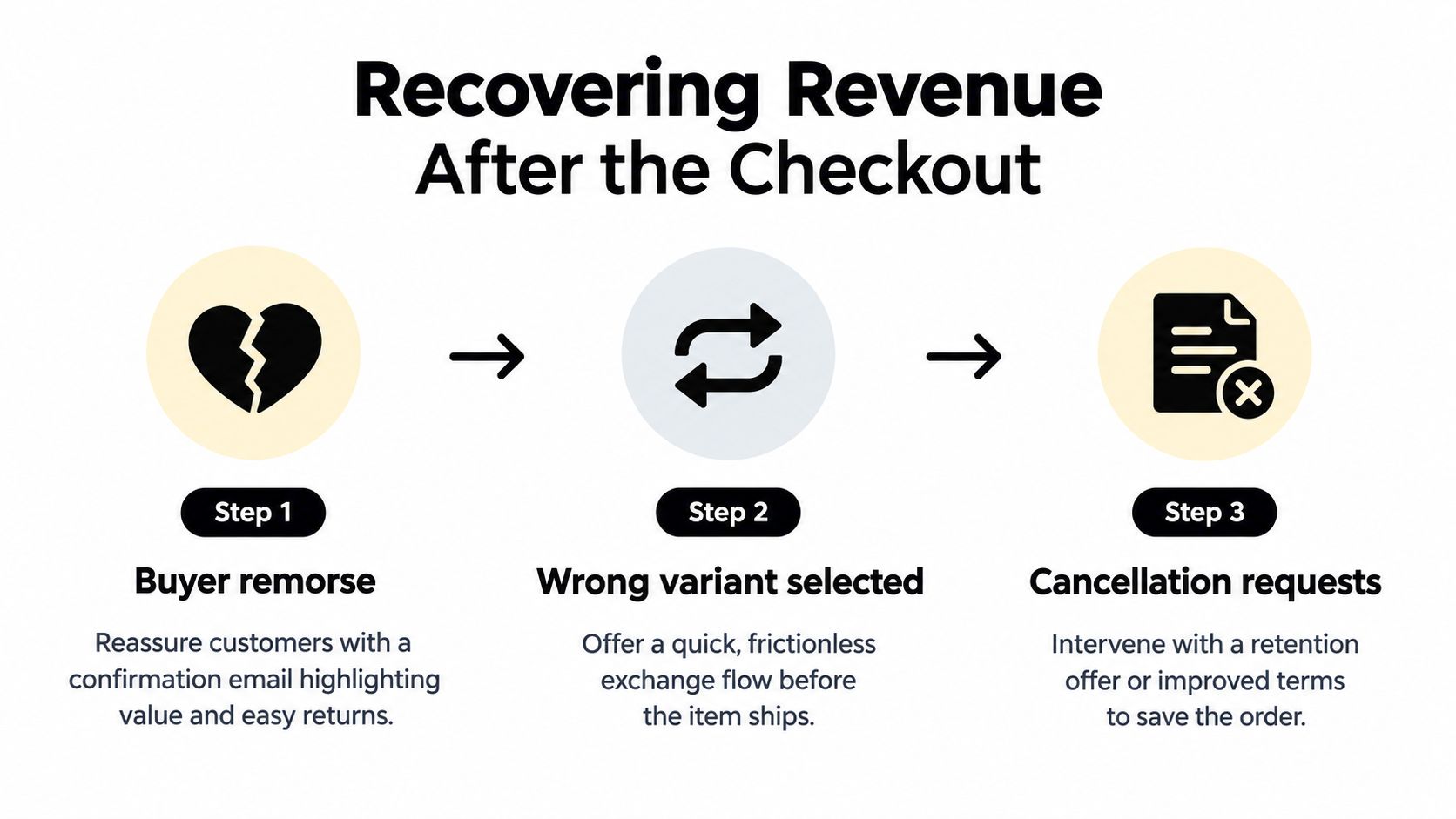
The customer journey doesn't become risk-free when payment succeeds. Buyers can experience remorse, select the wrong size, notice an address error, or decide to cancel before fulfillment. If your only options are a support ticket or a full refund, your team has created unnecessary work and made the customer wait for a solution.
Post-purchase recovery connects directly to abandoned cart recovery because both moments involve interrupted intent. Before checkout, the shopper needs enough confidence to complete the order. After checkout, the customer needs enough flexibility to keep the order when a correction would solve the problem.
Give customers a safe way to correct orders
Self-serve edits work best when the customer can act before the warehouse commits the shipment. Useful permissions may include quantity changes, variant swaps, shipping-address updates, line-item additions, and removals. The interface should show the financial effect before confirmation, including any extra charge or refund.
A size change is the clearest example. Without an edit path, the customer may cancel, place a replacement order, and return the original item. With a controlled exchange or variant update, the merchant can preserve the order while the customer gets the correct product.
The same logic applies to addresses. An incorrect address discovered after fulfillment can create delivery failures, reshipments, and support escalations. Letting customers correct it during the eligible window is a direct operational save.
Deflect cancellation without trapping the customer
Cancellation deflection should never hide the cancellation option. First capture the reason, then present a relevant alternative:
- Price concern: Offer store credit or a lower-friction future purchase option.
- Changed mind: Reinforce the product's value and explain the return process.
- Shipping concern: Show the latest delivery expectation or available alternative.
- Wrong item: Offer an edit or exchange instead of cancellation.
- Duplicate order: Help the customer identify and remove the duplicate.
Full cancellation remains the correct outcome when saving the order isn't appropriate. A transparent fallback protects trust, while reason capture gives merchandising, product, and fulfillment teams useful evidence about recurring problems.
Mayra Apps provides one example of this post-purchase approach, combining self-serve order edits, cancellation reason capture, store-credit save offers, and one-click additions within the Shopify customer account and order status experience. Its controls can write changes back to the original order, while a related guide to post-purchase upsells explains how additional offers can fit after checkout without creating a new checkout.
Implementation and Merchant Governance Rules
Recovery automation touches money, inventory, fulfillment, customer support, and compliance. Launching a flow without operational rules can create a second problem: customers change orders while warehouse staff are packing them, or a promotion applies to a product that shouldn't be edited.
Start by defining the eligible order state. The safest window generally ends before fulfillment begins, but the exact rule belongs to the merchant's warehouse process. Connect the customer-facing edit experience to the same order record used in Shopify admin so support, finance, and operations see the same state.
Set rules before enabling customer access
Write the policy in plain language, then configure it:
- Define the edit window. Set the point at which customers can change an order and the point at which the option closes.
- Choose capabilities. Decide whether shoppers can change quantities, swap variants, update addresses, add items, or remove items.
- Set approval conditions. Route unusual refunds, large-value changes, or margin-sensitive products to a staff review.
- Create exclusions. Exclude products, collections, tags, fulfillment states, or destination countries that require special handling.
- Set value limits. Use order-value caps where a change could create financial or fraud exposure.
- Pause fulfillment during edits. Place an automatic hold on active changes so the warehouse doesn't ship stale information.
The hold is a critical control. A customer who edits a shipping address needs the warehouse to receive the updated instruction before a label is printed. The same applies to variant swaps and item removals. A fast interface without fulfillment synchronization only moves the error downstream.
Make Shopify admin the source of truth
Financial handling should remain visible in Shopify's normal order workflow. Additional items may require a new invoice or charge, while removals and cancellations may require a refund or approval. Customers should receive a clear confirmation, and support staff should be able to inspect the original order, the edit, and the resulting financial action.
Test edge cases before launch. Place an order with multiple variants, attempt an edit near the cutoff, trigger an approval rule, change an address, remove an item, and abandon a cancellation. Then verify inventory, payment status, fulfillment holds, customer notifications, and reporting.
Governance principle: If operations can't explain what happened from the Shopify order record, the automation isn't ready.
Measuring Success Beyond Vanity Metrics
A recovery flow can show strong engagement and still lose money. Shopify benchmark coverage reports an average abandoned-cart email open rate of 50.5%, click-through rates from 8.38% to 9.5%, and placed-order conversion from 3.33% to 10.7% across datasets and implementations. The spread makes one benchmark unsuitable as a forecast. Use these figures to frame tests, not to promise results.
Measure the program at the level where decisions are made. Separate revenue that followed a message from revenue the message caused. Use holdouts or controlled suppression when the platform and consent model allow it, then compare incremental orders, margin, refunds, and support demand.
Track the economics of the whole program
A large-store Metorik dataset covering more than 6,000 WooCommerce stores found that automated recovery emails recovered 3.6% of placed carts, despite strong email engagement, and that recovered carts averaged $174. The practical lesson is direct: calculate recovered revenue per message and recovered margin, rather than stopping at opens and clicks.
| Metric | Definition | Target outcome |
|---|---|---|
| Incremental recovered orders | Orders attributable to the recovery flow above a valid no-flow comparison | More completed orders caused by the program |
| Recovered revenue per message | Attributed revenue divided by messages delivered | Positive contribution after discounts and channel costs |
| Recovered margin per message | Gross margin retained after incentive, refunds, fees, and campaign cost | A recovery program that improves profit, not only sales |
| Recovery by channel | Completed orders and revenue segmented by email, SMS, on-site, and paid retargeting | Budget and contact pressure assigned to productive channels |
| Average order value of recovered carts | Revenue divided by recovered orders, segmented by flow and audience | Visibility into whether recovery favors valuable or low-margin carts |
| Cancellation save rate | Orders retained after a cancellation attempt through an approved alternative | Fewer avoidable refunds with transparent customer choice |
| Edit completion rate | Eligible post-purchase edit attempts completed without support intervention | More customers resolving changes independently |
| Ticket avoidance | Estimated support contacts avoided through completed self-serve actions | Lower support workload without hiding unresolved issues |
| Refund and return impact | Refunds and returns from recovered or edited orders compared with the baseline | Recovery that does not create downstream losses |
Timing needs a separate review. One cited benchmark reports conversion of 20.3% for emails sent within one hour, compared with 12.2% after 24 hours. Another reports 5.2% for a one-hour first-email sequence, 2.8% at 24 hours, and below 1.5% after 48 hours. The datasets and definitions differ, so use the comparison to test urgency rather than set an unquestioned target.
Review results by segment, incentive, device, product category, and customer status. Suppress buyers immediately, remove opted-out customers, and check whether engagement produces support tickets, discount dependency, or returns. SMS timing, on-site friction, and post-purchase actions belong in the same measurement view as email. A customer who edits an order, avoids an unnecessary cancellation, or completes checkout without support may protect more margin than another reminder email.
The strongest system recovers profitable orders before checkout, saves correctable orders afterward, and makes the next customer interaction easier.
Mayra Apps helps Shopify merchants offer controlled self-serve order edits, cancellation deflection with store-credit offers, and post-purchase additions while keeping the original order in Shopify. Visit Mayra Apps to assess whether its merchant rules, fulfillment holds, and customer-account workflows fit your abandoned-cart and post-purchase recovery system.