
A US-built Shopify app has just added fulfillment to your order workflow. Then your UK agency's documentation refers to fulfilment as though it were a separate feature. Your support team uses both forms, your help centre has a third variation in an old article, and nobody knows which spelling belongs in the next email template.
This isn't a grammar problem. It's a localization governance problem. The two spellings describe the same ecommerce process, but the right customer-facing choice depends on market, locale, and surface. Your internal systems need a different rule: one stable label that keeps analytics, APIs, automations, and staff workflows aligned.
Table of Contents
- Why Two Spellings Are Showing Up in Your Shopify Backend
- The Short History Behind the Double L
- How Strongly Each Market Favors Each Spelling
- Where the Spelling Choice Shows Up in a Shopify Store
- Three Strategies for Global Shopify Merchants
- Keeping Your Internal Data Clean Across Markets
- What Mayra Apps and Similar Tools Should Default To
- A Four-Rule Policy You Can Apply This Week
Why Two Spellings Are Showing Up in Your Shopify Backend
Fulfillment and fulfilment are regional spellings of the same noun. Both describe the process of completing or satisfying an obligation, including the ecommerce workflow that takes an order from processing through delivery. Oxford Learner's Dictionaries identifies fulfilment as British English and lists fulfillment as the North American equivalent. Oxford Learner's Dictionaries treats the forms as regional variants, not separate operational concepts.
The split appears in a Shopify stack because different parts of that stack come from different language environments:
- Shopify admin terminology: Core platform labels commonly use the American form, especially in order and shipping workflows.
- Third-party apps: A US-developed app may hard-code “fulfillment” into navigation, status messages, and default notifications.
- Theme translations: A theme marketplace or translation file may use British English for a UK-facing storefront.
- Agency documentation: A UK agency playbook can consistently use “fulfilment,” while an American implementation guide uses “fulfillment.”
- Customer content: Reviews, FAQ submissions, support tickets, and merchant-written copy often preserve whichever spelling the writer encountered first.
That means a merchant can see both spellings without any system being broken. The problem starts when the variants enter the same internal metric, field name, or automation condition as if they represented different values.
Practical rule: Separate the spelling customers see from the terminology your systems store.
Your store needs a surface-by-surface policy, not one universal spelling forced everywhere. Use market language in storefront copy, emails, and help content. Keep a canonical internal label for code and reporting. That approach fits the broader order process covered in this Shopify order workflow guide, where status, eligibility, and operational actions need to remain understandable across the customer and admin experience.
The Short History Behind the Double L
The split began with different spelling standards, not different logistics practices. Noah Webster's American Dictionary of the English Language, published in 1828, promoted conventions that separated American usage from British forms. American English kept fulfill in the verb and formed the noun as fulfillment. British English kept fulfil and fulfilment, alongside patterns found in words such as “enrolment” and “instalment.” The regional distinction is documented by Oxford Learner's Dictionaries.
That history gives Shopify merchants a clear policy basis. Neither spelling signals a different workflow, service level, or operational standard. Choose by market and locale, not personal preference. Use “fulfillment” in customer-facing copy for a primarily US audience, and “fulfilment” for content written specifically for British English readers.
For a global store, apply the choice by surface. Localize the visible spelling in storefront copy, help documentation, and transactional messages, while keeping one stable internal label for workflows, reporting, and integrations. Your localization guide should record the approved form for each market and state that both variants map to the same operational concept. That prevents historical spelling differences from becoming inconsistent admin labels or unreliable SEO metadata.
How Strongly Each Market Favors Each Spelling
A comparative usage dataset estimates that the United States favors fulfillment at approximately 95%, compared with 5% for “fulfilment.” It also puts Canada at 89% versus 11%, India at 76% versus 24%, and the Philippines at 88% versus 12%. In search behavior, the United States shows roughly 34,000 monthly Google searches for “fulfillment” compared with 5,000 for “fulfilment,” while the United Kingdom records approximately 3,900 and 3,700 respectively. The comparative usage estimates are reported by Sapling.
The United Kingdom sits close to an even split, at 51% for “fulfillment” and 49% for “fulfilment.” Australia is estimated at 61% versus 39%, New Zealand at 65% versus 35%, and Ireland at 64% versus 36%. These markets still have regional expectations, even as American ecommerce platforms, international teams, and digital commerce make spelling boundaries less predictable.
| Market | Dominant spelling | Relative share | Note for merchants |
|---|---|---|---|
| United States | fulfillment | 95% vs 5% | Use “fulfillment” as the default |
| Canada | fulfillment | 89% vs 11% | American usage is stronger, but both forms appear |
| United Kingdom | Slightly fulfillment | 51% vs 49% | Use “fulfilment” for explicitly British audiences |
| Australia | fulfillment in the dataset | 61% vs 39% | Confirm the merchant's preferred English style |
| New Zealand | fulfillment in the dataset | 65% vs 35% | A locale policy is safer than a country-only rule |
| India | fulfillment | 76% vs 24% | American digital terminology is common |
| Philippines | fulfillment | 88% vs 12% | Follow the product's established English style unless localized |
Treat these figures as a localization input, not as permission to let each team choose its own spelling. The market pattern gives you a starting rule, while your storefront audience and established brand style determine the final decision.
For Shopify merchants, the recommendation is direct. Use “fulfillment” for a US storefront and “fulfilment” for a British-market landing page. Canada can support either form, but one documented house style prevents inconsistent customer copy and metadata. Australia and other mixed markets need an explicit locale decision rather than an automatic country-based substitution. Record that decision in your localization guide, then apply it consistently across the customer-facing surfaces and internal naming conventions that depend on the same operational concept.
Where the Spelling Choice Shows Up in a Shopify Store
A spelling policy fails when it covers only the homepage. Shopify merchants write this term across the entire post-purchase journey, from the first order confirmation to the final tracking update. Assign each surface an owner and a rule.
Storefront and customer account surfaces
On a US storefront, write order fulfillment. On a British storefront, write order fulfilment. Apply the same decision to shipping banners, delivery explanations, customer account order timelines, tracking pages, and order-status content.
Use the store or customer locale, not the currency. A UK customer paying in US dollars still expects British English if the storefront is configured for that audience. Likewise, a US customer browsing a localized international store shouldn't receive a British spelling because the order is routed through a UK warehouse.
The order status page deserves special attention because it sits between commerce and operations. Customers may use it to review delivery progress, edit an order, or understand why an action is unavailable. Keep its visible language aligned with the storefront's locale, as illustrated by this guidance on Shopify order status pages.
Admin, operations, and notifications
Your admin bar, order labels, warehouse instructions, and staff-facing shipping statuses should use one canonical internal form. My recommendation is fulfillment, even for a business that publishes British English externally. One stable label prevents staff from creating separate filters, tags, and saved views for equivalent concepts.
Transactional email copy should follow the recipient's locale. Localize the subject line, preview text, heading, and explanatory sentence, but don't rename merge tags, event identifiers, or template variables. The same rule applies to Klaviyo and Shopify Email flows. Customers should see native language conventions, while automation logic should continue to rely on stable keys.
For logistics teams comparing storage and warehouse design, terminology is only one part of the customer promise. A resource on ecommerce warehouse vertical storage systems can help connect the language decision to the physical operations behind order processing.
| Surface | US store | UK store | Global or multi-market store |
|---|---|---|---|
| Storefront copy | fulfillment | fulfilment | Match the configured market locale |
| Customer account | fulfillment | fulfilment | Match the customer-facing locale |
| Tracking and order status | fulfillment | fulfilment | Localize visible strings |
| Admin labels | fulfillment | fulfillment | Keep one canonical internal label |
| Transactional emails | fulfillment | fulfilment | Localize templates by recipient locale |
| Help centre and FAQs | fulfillment | fulfilment | Publish market-specific or locale-aware copy |
| SEO titles and descriptions | fulfillment | fulfilment | Create regional variants where search intent justifies them |
Help articles and blog posts should follow their intended reader, not the spelling used by your developer. SEO metadata should use the regional form for the page's target audience. If one global page serves several markets, use the primary audience's form and mention the alternate spelling naturally in explanatory copy. Don't create awkward duplicate pages that differ only by one letter unless you have a genuine regional search and content need.
Three Strategies for Global Shopify Merchants
A post-purchase or shipping app can choose among three workable models. Only one scales cleanly when the product serves multiple English locales.
| Strategy | Internal label | Customer-facing copy | SEO handling | Best for |
|---|---|---|---|---|
| US-default | fulfillment | fulfillment everywhere | One US-oriented terminology set | A US-only product with limited localization |
| UK-default | fulfilment | fulfilment everywhere | One British-oriented terminology set | A product built specifically for British English markets |
| Locale-aware | fulfillment | Localized by locale | Regional pages and metadata | A global Shopify app or multi-market merchant |
US-default
This is the fastest implementation. Engineers use “fulfillment” in code, admin navigation, customer copy, analytics events, and documentation. The product is internally simple, and US-facing content feels natural.
The cost appears in markets where readers expect “fulfilment.” UK, Australian, and some Commonwealth audiences may understand the term perfectly but still notice that the product reads as American. That signal may be harmless for a back-office tool, but it becomes visible in storefront banners, customer emails, and public help content.
UK-default
This model reverses the choice. The team uses “fulfilment” everywhere, which can feel natural to British readers and simplifies content for a UK-first product.
It creates the same problem in reverse. American shoppers may read the copy as foreign or inconsistent with the Shopify terminology they already know. Developers also risk introducing a British spelling into internal fields and API-adjacent identifiers that should remain stable.
Locale-aware
This is the right architecture for a global app. Keep fulfillment as the canonical internal label, then use customer-facing “fulfilment” where the configured English locale calls for British usage. The exact locale map should be documented and reviewed, because country and language preference don't always align.
The work includes translation files, locale testing, metadata rules, and duplicate-content controls. It also requires content governance. Good SEO localization guidance treats language variation as part of search strategy, not as a last-minute proofreading task.
For most Shopify apps, locale-aware wins because it isolates complexity at the presentation layer. The product doesn't need separate fulfillment logic. It needs separate strings.
Keeping Your Internal Data Clean Across Markets
Your database should never contain both fulfillment_status and fulfilment_status for the same state. Pick fulfillment as the canonical internal spelling and use it in event names, database fields, analytics dimensions, exports, API contracts, and developer documentation.
A workable policy looks like this:
- Analytics: Name dimensions and events with the canonical form, such as
fulfillment_statusandfulfillment_event. - Warehouse tables: Keep column names stable across markets. A localized customer string should never create a second warehouse schema.
- Shopify Flow: Normalize conditions and tags on “fulfillment” before a flow evaluates an order.
- Klaviyo: Use one internal property or event name, even when the email text changes by locale.
- Internal search: Map customer-entered “fulfilment” to the canonical “fulfillment” term before returning operational results.
- API and webhooks: Preserve Shopify's standard field names and your own established identifiers. Don't translate developer-facing keys.
- Staff documentation: Define the canonical term in the style guide, then use it consistently in Slack, Confluence, tickets, and release notes.
The alternate form belongs in places where people type naturally. Add it to help-centre search synonyms, customer-facing autocomplete, FAQ copy, and regional SEO content. It shouldn't become a second analytics value.
Data rule: Translate the interface string, never the identity of the event.
This separation is consistent with broader multilingual SEO best practices: adapt the language users encounter while preserving technical consistency underneath. A support agent searching for “fulfilment issue” should find the same records as an agent searching for “fulfillment issue.” One concept should produce one report.
What Mayra Apps and Similar Tools Should Default To
Mayra Apps and similar Shopify tools should use fulfillment as the canonical internal label. Keep it in app code, admin navigation, default status logic, analytics events, and internal documentation. This prevents engineering teams from forking an otherwise identical workflow just because a store uses British English.
Customer-facing strings can still follow the merchant's locale. In a post-purchase widget, tracking page, order-status message, or transactional email, use “fulfillment” for US-oriented English and “fulfilment” for explicitly British English. Don't derive the choice from currency or warehouse location. Read the storefront locale and the merchant's configured language policy.
Mayra's operational context makes this distinction especially important. The app supports post-purchase order edits, including changes to quantities, variants, shipping addresses, and line items. It can place a fulfillment hold while an edit is active, then allow the order to proceed when the change is completed or abandoned. The workflow state stays the same whether the customer sees “fulfillment” or “fulfilment.”
A default policy for product teams
| Surface | Default to | Localized to |
|---|---|---|
| App code and database fields | fulfillment | Never translate identifiers |
| Admin navigation | fulfillment | Keep staff terminology stable |
| Analytics events | fulfillment | Never split dimensions by locale |
| Customer account widget | fulfillment | fulfilment for configured British English |
| Tracking and order-status page | fulfillment | Match storefront locale |
| Transactional email body | fulfillment | Match recipient locale |
| Help centre | fulfillment | Publish market-specific variants |
| US SEO content | fulfillment | Use the US search term |
| UK SEO content | fulfilment | Use the British search term |
For SEO, build regional pages only when the audience and content differ. Use “fulfillment” in US-focused titles, descriptions, and headings, and “fulfilment” in British-market equivalents. Connect equivalent pages with hreflang when appropriate, and mention the alternate spelling in explanatory copy where it helps users rather than stuffing both forms into every title.
Capture both query forms in internal search and structured content where the wording remains natural. Then document the policy in the product style guide and enforce it with content review or linting. A Shopify merchant evaluating Shopify fulfillment apps should see the same operational concept represented consistently, even when the visible copy changes by market.
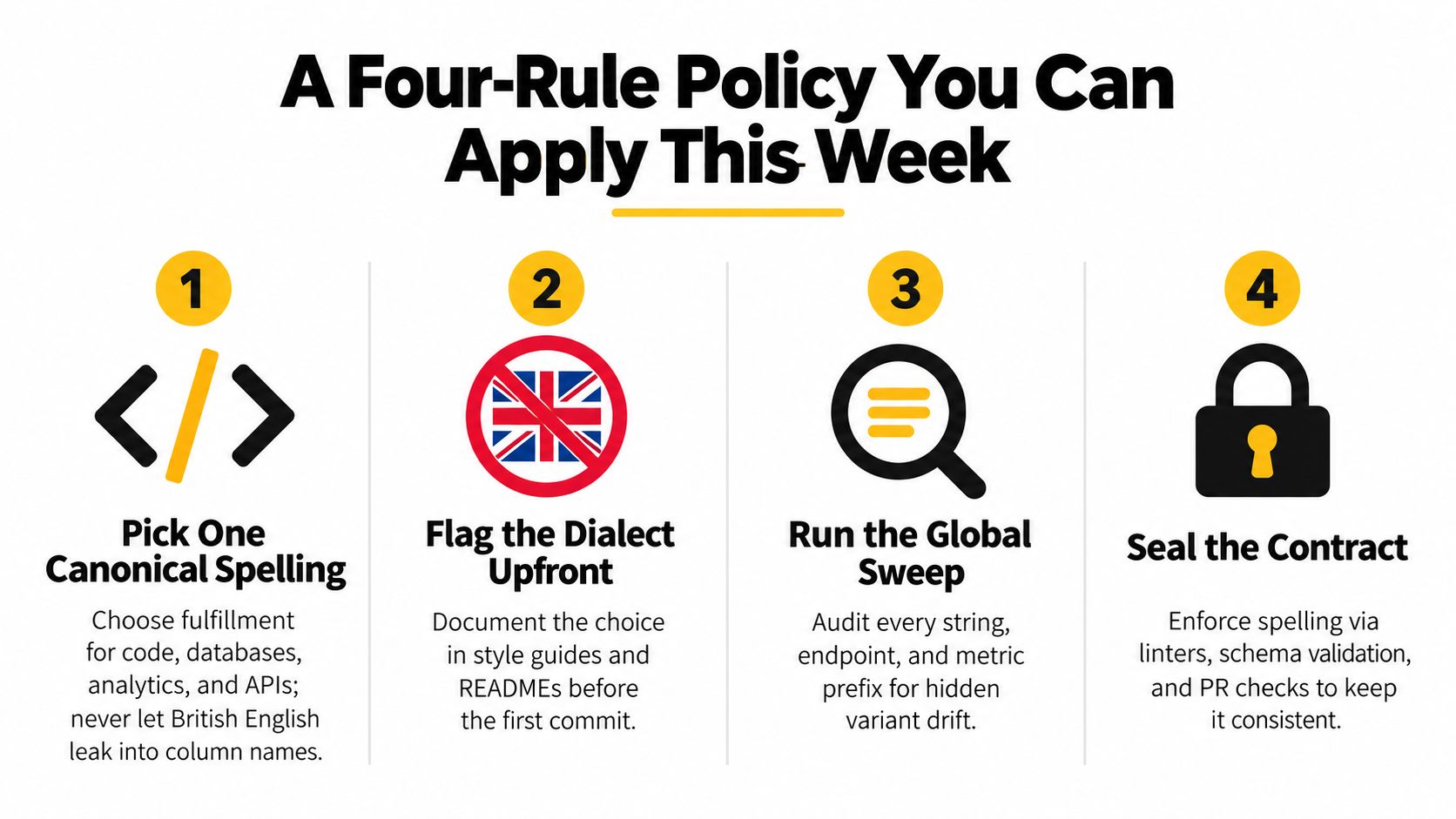
A Four-Rule Policy You Can Apply This Week
You don't need a committee meeting to fix this. Write these four rules into one page, assign an owner, and apply them to the next copy and development release.
Pick one canonical internal spelling. Use fulfillment in code, database fields, analytics events, API contracts, exports, and internal automations. Never allow a British-English string to become a column name or event identifier.
Localize customer-facing copy by market. Use fulfilment for explicitly British-English storefronts, order-status pages, emails, and help content. Use fulfillment for US-oriented English and for markets where your documented product style selects the American form. Store locale should drive the decision, not currency alone.
Build SEO in regional pairs when there is a real audience need. Use “fulfillment” in US-focused metadata and “fulfilment” in UK-focused metadata. Connect equivalent regional pages appropriately, and include the alternate spelling in useful explanatory copy instead of treating one form as wrong.
Lock the policy into production. Add the rule to your style guide and README, audit existing strings, and use linting or pull-request checks to flag drift. Give one person responsibility for approving terminology changes and review the policy regularly.
The decision is straightforward: one internal label, localized customer language, and regional SEO where it serves a real market. Apply that policy to your Shopify storefront, customer accounts, transactional emails, help centre, and reporting this week, then use Mayra Apps to manage post-purchase order edits and fulfillment holds from the Shopify customer experience. Visit Mayra Apps to see how the app fits those workflows.