
You've just paid for the customer's acquisition, won the checkout, and then watched the order become strangely difficult to change. The buyer wants to add a matching product, correct a shipping detail, or reconsider a cancellation. Your growth team wants a post-purchase offer. Operations wants the original order to remain accurate. Finance wants settlement and refunds to behave predictably.
That's the Zipify OneClickUpsell Shopify versus Mayra decision. It isn't a contest between apps with similar feature labels. It's a choice between two placements, two order workflows, and two operating models. Zipify puts a dedicated offer in the immediate post-payment moment. Mayra places upsells inside an order-edit and customer-account experience, where additions sit alongside changes, cancellation deflection, and support prevention.
Table of Contents
- What This Comparison Actually Decides
- How Each App Handles the Post Purchase Surface
- Feature Parity, Integration Differences, and UX
- Settlement, Refund Handling, and Fulfillment Holds
- Platform Constraints and Native Account Integration
- Real World Scenarios for Each Placement Strategy
- Migration, Implementation, and Configuration Steps
- Which App Fits Your Store Profile
What This Comparison Actually Decides
Most merchants begin this comparison with a checklist. They ask whether each app supports one-click acceptance, discounts, targeting, analytics, and order updates. That's a reasonable starting point, but it produces the wrong final question: which app has more features?
The better question is where should the upsell live in your post-purchase architecture?
Zipify OneClickUpsell is built around a dedicated offer page that appears immediately after payment. The customer is still in transaction mode, but the original checkout has already completed. On Shopify Plus, the experience depends on checkout extensibility. On other plans, Zipify uses a script-based offer page. The model is focused, campaign-driven, and designed to make one relevant offer feel like the obvious next step.
Mayra uses a different surface. Its upsell appears in the customer account and order status experience, alongside self-serve order changes. A customer may encounter an offer while changing a variant, adding a product, updating an address, or reconsidering a cancellation. The upsell becomes part of an ongoing order-management interaction rather than a standalone funnel.
For merchants assessing broader platform architecture, Nerdify's ecommerce growth guide offers useful context on how storefront, operations, and technology choices connect. That context matters here because the app affects more than the conversion screen.
Start with the customer's next action
Use this sequence before comparing pricing or dashboards:
- Map the immediate moment. If the customer is most likely to accept a complementary product seconds after payment, a dedicated post-purchase page is the natural fit.
- Map the later interaction. If customers frequently return to change orders, correct addresses, add items, or avoid cancellation, an account-based surface has more opportunities to earn attention.
- Map the order record. Confirm how additions, charges, refunds, taxes, inventory, and fulfillment appear in Shopify admin.
- Map ownership. Decide whether growth owns the workflow or whether support, operations, and finance need shared control.
That last point gets overlooked. A dedicated funnel gives marketers a clean conversion surface, but it can create another operational path to monitor. An order-edit surface gives operations more control, but it relies on the customer returning to the account or order status page.
Read Mayra's Shopify post-purchase app guide if your priority is reducing support friction as well as creating additional revenue. The choice isn't “funnel versus no funnel.” It's impulse monetization versus contextual order management.
How Each App Handles the Post Purchase Surface
The placement decision starts with the customer's next action. Zipify OCU puts the offer directly after payment, while Mayra makes the existing order the place where an addition or change happens.
With Zipify, the customer completes payment and sees an offer before the confirmation experience becomes the final meaningful stop. On Shopify Plus, the offer uses checkout extensibility. On non-Plus stores, a script-based flow creates a separate offer page between checkout and confirmation. The customer accepts without re-entering payment details, and the accepted product is added through the app's post-purchase process.
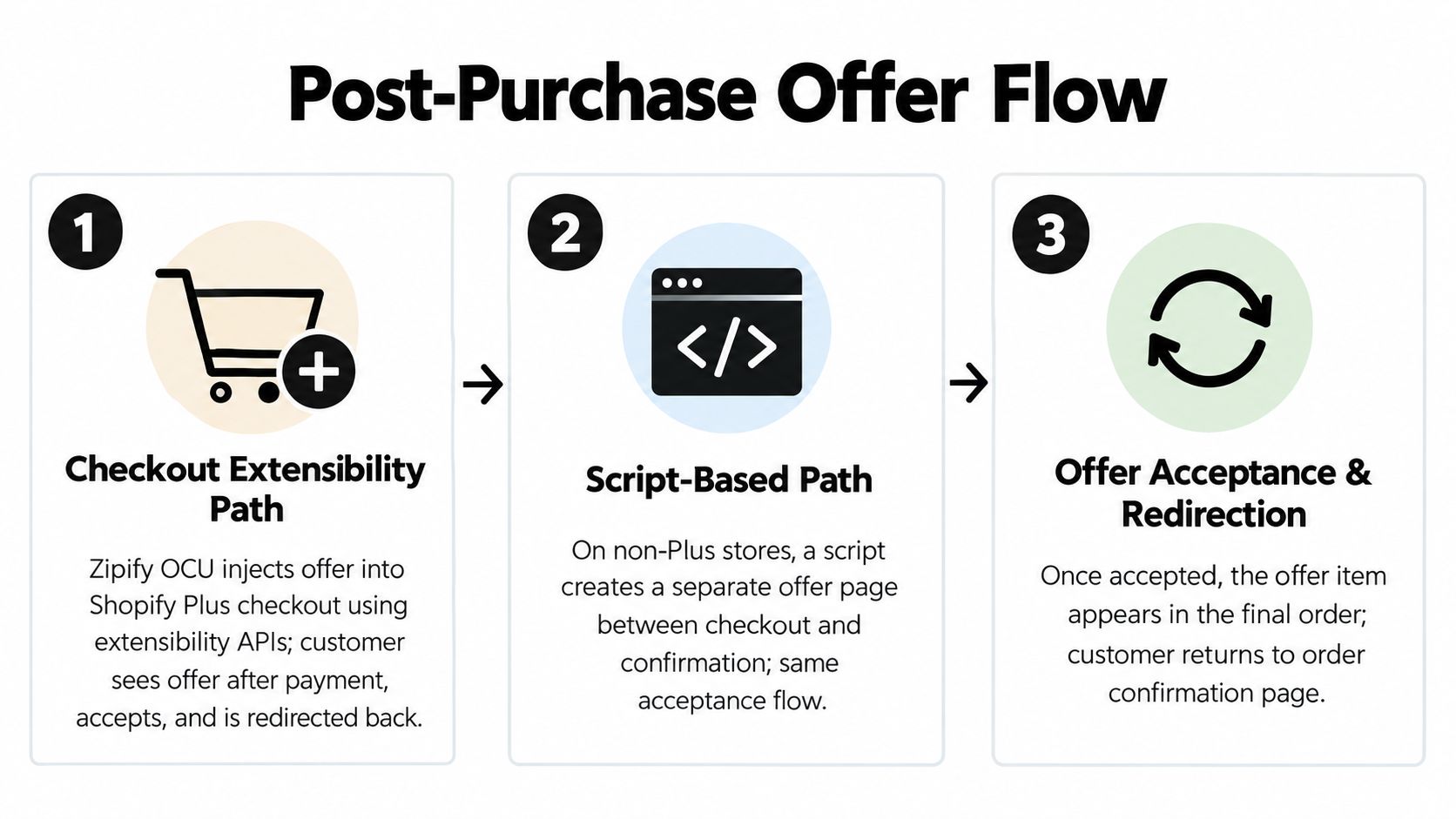
That placement gives Zipify its clearest advantage: the offer appears while buying intent is still concentrated. Customers do not need to remember the brand later or return to an account page. The cost is operational dependency. The offer requires the correct app activation, an eligible payment method, and compatible checkout conditions. Zipify's documentation states that merchants must select the app in Shopify admin for post-purchase activation, and that offers appear only when Shopify's payment and checkout requirements are met.
Mayra starts with the order rather than the transaction. A customer opens an order detail surface in the account or order status experience, reviews available actions, and accepts a relevant addition within that workflow. Staff can make comparable changes through an order edit modal. Accepted items are written back to the existing Shopify order through the order edit path. Merchants comparing this model with one-click upsell on Shopify should evaluate where customers already return after checkout.
Why the order record matters
The difference appears after the click:
- Zipify's model treats the upsell as a dedicated campaign action attached to the completed purchase.
- Mayra's model treats the upsell as an allowed change to an active order.
- Zipify's strength is speed and focus immediately after payment.
- Mayra's strength is keeping additions close to customer-account and support workflows.
Neither placement wins for every store. A fashion brand with a simple catalog may want one accessory presented immediately. A subscription merchant may prefer to offer a quantity addition while the customer is already editing an order.
For practical guidance on reducing friction in the primary buying path, boost sales with checkout fixes provides useful context. Post-purchase performance cannot compensate for a checkout that creates avoidable hesitation.
The operational distinction is direct: Zipify asks, “What should this buyer add now?” Mayra asks, “What does this customer need to change on this order?” Choose the surface that matches how customers and staff interact with the order.
Feature Parity, Integration Differences, and UX
The two products overlap on the visible promise. Both can support one-click additions, offer eligibility, and product recommendations. The differences become clearer when you examine the system around the offer.
Zipify uses a funnel-building model. Marketers create an offer, define the trigger, select eligibility conditions, and evaluate performance in the app's analytics environment. That setup is well suited to a team that treats upsells as campaigns requiring creative, testing, and iteration.
Mayra uses the order as the organizing object. Rules govern which customers and orders can be edited, what actions are allowed, and when additions appear. The experience stays closer to Shopify's customer accounts, order status page, admin order editor, and order record.
A delivery team would make the same distinction when comparing Peak Transport's route optimization approach with a simple dispatch workflow. The question isn't which workflow has more buttons. It's which workflow matches the operating reality.
Zipify OCU vs Mayra: Feature and Integration Comparison
| Capability | Zipify OneClickUpsell | Mayra Order Edit and Upsell |
|---|---|---|
| Primary placement | Dedicated post-purchase offer page | Customer account and order status order-edit surface |
| Core UX | Focused offer immediately after payment | Contextual offer during order management |
| Offer setup | Funnel builder with triggers and eligibility rules | Merchant-defined order-edit and offer rules |
| Shopify integration | Checkout extensibility on Shopify Plus, script-based flow on non-Plus plans | Customer account, order status page, and Shopify order-edit workflow |
| Order relationship | Adds the accepted offer through the post-purchase flow | Writes accepted additions back to the existing order |
| Marketing workflow | Campaign-led, with offer testing and app-level analytics | Operations-led, with account and order context |
| Customer actions nearby | Offer acceptance and post-purchase navigation | Quantity, variant, address, addition, removal, and cancellation workflows where configured |
| Offer capacity | Zipify's FAQ describes a maximum of two post-purchase offers per order | Offer visibility depends on configured eligibility and order-edit rules |
| Checkout dependency | Stronger dependency on post-purchase activation, payment methods, and checkout conditions | Less dependent on the immediate post-payment offer surface, more dependent on account and order-page engagement |
| Best UX fit | A single, high-intent recommendation | A helpful addition during a customer-initiated order change |
The table exposes the central trade-off. Zipify concentrates attention. Mayra distributes attention across the account relationship. If your team wants a clean experiment around a single offer, Zipify is easier to reason about. If your team wants one controlled surface for several post-purchase tasks, Mayra's model is more coherent.
Settlement, Refund Handling, and Fulfillment Holds
The revenue team often chooses the app, then finance discovers the implementation details. That order should be reversed.
A post-purchase offer creates a financial event after the original payment. The important questions are whether the addition is attached to the existing order, how Shopify collects the extra amount, how taxes and shipping are recalculated, and what happens if the customer or staff later removes the item.
Zipify's flow is designed to charge the original payment method after acceptance and add the product to the order. That's convenient for the customer, but merchants should validate gateway behavior, payment capture settings, market currency, tax configuration, and fulfillment timing before launch.
Mayra follows Shopify's order-edit and invoicing model. The customer or staff member changes the order, Shopify processes the additional charge, and the order record remains the operational source of truth. Mayra also supports refund handling aligned with merchant-defined approval rules, so finance can decide which changes process automatically and which require review.
Settlement and Refund Behavior Comparison
| Behavior | Zipify OneClickUpsell | Mayra Order Edit & Upsell |
|---|---|---|
| Addition trigger | Customer accepts a dedicated post-purchase offer | Customer or staff accepts an addition during an eligible order edit |
| Payment action | Charges the original payment method through the post-purchase flow | Issues an additional Shopify invoice through the order-edit workflow |
| Order treatment | Accepted offer is added through the OCU post-purchase process | Accepted item writes back to the original order |
| Tax and shipping review | Test against payment method, market, tax, and shipping configuration | Test Shopify order-edit recalculation against market, tax, shipping, and fulfillment rules |
| Refund governance | Validate app and gateway behavior for rejected or later-refunded additions | Merchant can configure automatic handling or approval above a defined threshold |
| Fulfillment protection | Confirm whether the original order remains pending while the offer resolves | Active edits can place fulfillment on hold to prevent shipping during the change |
| Finance concern | Reconciliation between original payment and post-purchase addition | Reconciliation inside Shopify's order and invoice workflow |
| Support concern | Explain the post-purchase addition if the buyer later disputes it | Give customers a controlled path to change or cancel the order |
Don't treat “one click” as “one accounting event.” Multi-currency stores, manual capture gateways, tips, discounts, and orders already moving through fulfillment can produce different outcomes. Run acceptance, decline, refund, partial refund, and fulfillment tests with the payment methods your customers use.
Mayra's explanation of refunds on Shopify is useful when finance and support need to agree on approval responsibilities. The right configuration depends on risk tolerance, not just conversion ambition.
Finance rule: Never launch a post-purchase app until finance can reconcile an accepted addition, a removed addition, and a refund without consulting the marketing team.
Platform Constraints and Native Account Integration
Shopify controls the surfaces available after payment, and those constraints shape the reliability of every upsell implementation.
Zipify depends on the post-purchase experience, app activation in Shopify admin, and the conditions under which Shopify allows the offer to render. Shopify Plus stores can use checkout extensibility for the relevant placement. Other stores may rely on a script-based offer page. Payment methods, checkout conditions, and changes to the checkout configuration can affect eligibility.
Shopify's checkout and accounts editor centralizes customization for checkout, thank-you, order status, and customer account pages. The order status page can also be revisited by customers, which makes it an important part of the broader post-purchase surface.
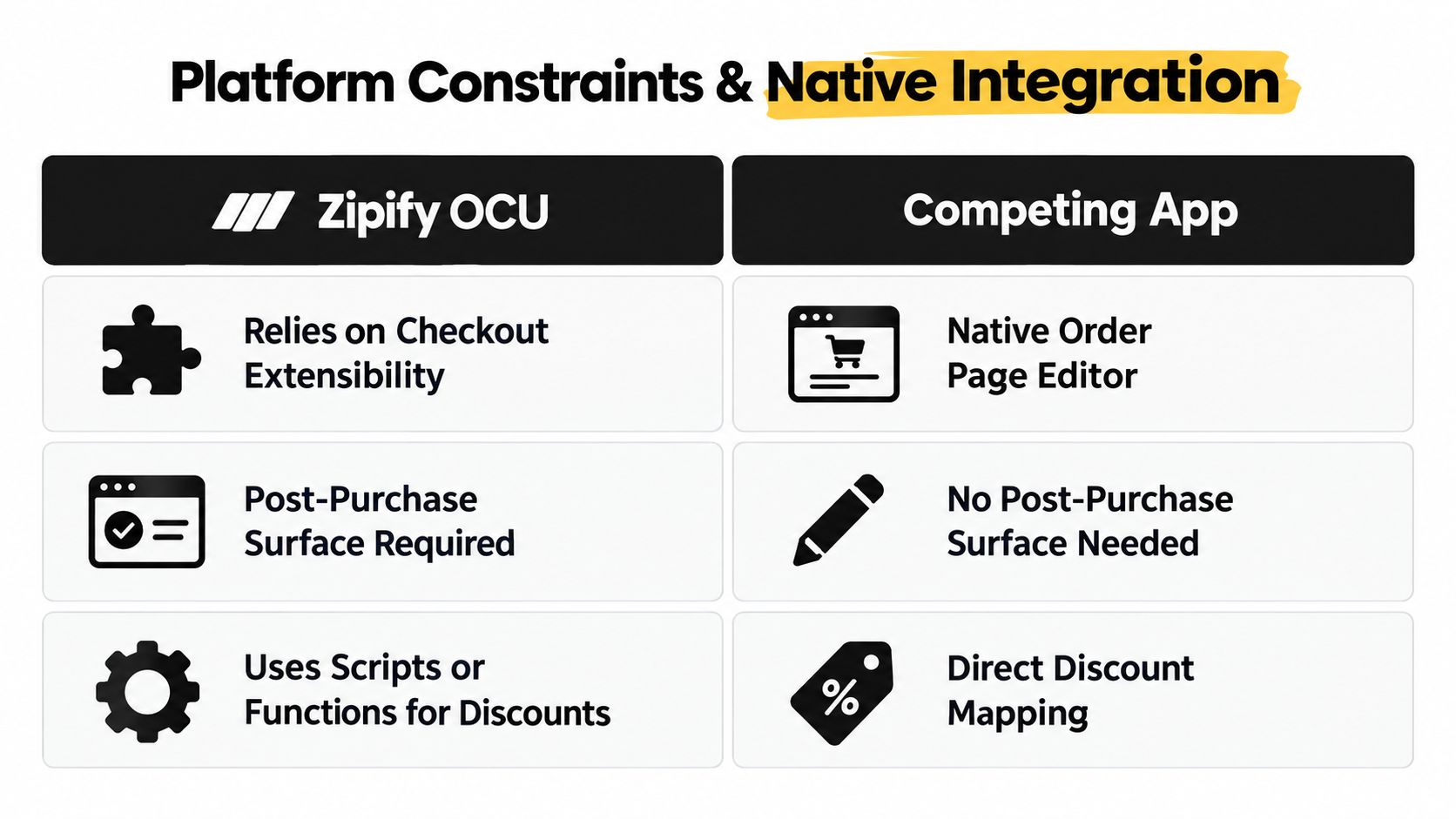
Mayra operates inside customer accounts and the order status page, with an administrative order-edit experience. That reduces dependence on the immediate post-payment takeover, but it creates a different constraint: the customer must reach the account or revisitable order surface, and Shopify must permit the relevant order fields to change.
The operational trade-off
Zipify offers stronger immediacy. The customer doesn't need a later reason to return. That's valuable for impulse-friendly products, complementary accessories, and simple offers that make sense directly after purchase.
Mayra offers stronger continuity. The upsell sits beside the tasks customers already perform after purchase. If your support team receives regular requests for address corrections, variant changes, additions, or cancellation alternatives, a native account surface can consolidate those actions.
The cost of immediacy is platform sensitivity. Checkout-surface tools need monitoring when Shopify changes checkout behavior, payment eligibility, app activation, or page placement. The cost of continuity is engagement dependency. Account-surface offers won't reach customers who never return to manage the order.
Choose based on the failure you can manage. If missing the immediate buying moment is expensive, prioritize Zipify. If fragmented post-purchase operations are expensive, prioritize Mayra's account-based model.
Real World Scenarios for Each Placement Strategy
The same catalog can produce different results depending on where customers naturally interact after payment. The placement decision becomes obvious once you map the customer's behavior rather than the app's feature list.
A subscription-heavy supplements store
A supplements merchant sees frequent customer-initiated order changes. Buyers adjust quantities, update addresses, add products to an upcoming shipment, or reconsider a cancellation. The growth team could build a dedicated post-purchase funnel, but many relevant interactions happen later, when the customer is already inside the account.
An account-based offer can appear as a useful suggestion during that edit. The buyer isn't being interrupted with an unrelated promotion. They're already deciding what should be in the order. The signal for this architecture is high edit volume and a strong need to reduce support tickets.
A fashion DTC brand focused on first-order value
A fashion store sells coordinated products with straightforward fulfillment. A customer buys a jacket, then immediately sees a matching accessory or care product. The offer benefits from the emotional momentum of the completed purchase, and the brand doesn't need to wait for the customer to revisit the account.
Zipify is the stronger primary placement here because it concentrates the recommendation at the moment of maximum transaction continuity. The signal is a clear product-to-product relationship and a growth team willing to test offers as campaigns.
Independent benchmark material places typical one-click post-purchase acceptance in a range of about 3% to 8%, with strong performers above 5%, because payment details are already stored and the primary checkout has finished. The Shopify upsell benchmark guide provides that broader context. Zipify's own merchant benchmark claims a 16.2% average take rate, while underoptimized stores using a single post-purchase offer sit around 4%, as reported in its post-purchase upsell guidance. Treat those as different benchmark sets, not interchangeable promises.
A wholesale-leaning store with approval controls
A B2B-oriented merchant manages pricing tiers, buyer permissions, fulfillment timing, and internal approval queues. A dedicated offer page may create an extra event for staff to reconcile. The merchant needs additions and changes to follow the same governance as the original order.
Neither app eliminates that complexity. The account and order-edit model is usually the better fit because changes can remain closer to the order workflow the team already trusts. The deciding signal is whether an upsell must pass through operational approval rather than marketing automation.
Zipify reported that OneClickUpsell users generated $156 million in upsell revenue in 2022, up from $108 million in 2021, and the company described that as 144% year-over-year growth. It also reported more than a quarter million upsell offers in 2022 and roughly 13,000 Shopify stores using the app that year, all in its 2022 year-in-review report. Those figures show the scale of Zipify's dedicated-funnel model, not a guarantee that it's the right architecture for a store with complex order governance.
Migration, Implementation, and Configuration Steps
A migration fails when teams remove the old app before they understand which customer journeys depend on it. Treat the switch as an order-flow project, not a simple app replacement.
Build an inventory before changing anything
Export or document every active Zipify funnel, trigger product, offer product, discount rule, eligibility exclusion, subscription condition, and payment limitation. Also inspect theme app embeds, checkout extensions, scripts, pixels, post-purchase settings, thank-you page blocks, and order status customizations.
Then classify each offer:
- Keep: The offer has a clear product relationship and belongs immediately after payment.
- Move: The offer makes more sense when a customer edits an order or revisits the account.
- Retire: The offer duplicates another campaign, creates margin problems, or no longer fits the catalog.
- Rebuild: The product or subscription logic needs new eligibility rules.
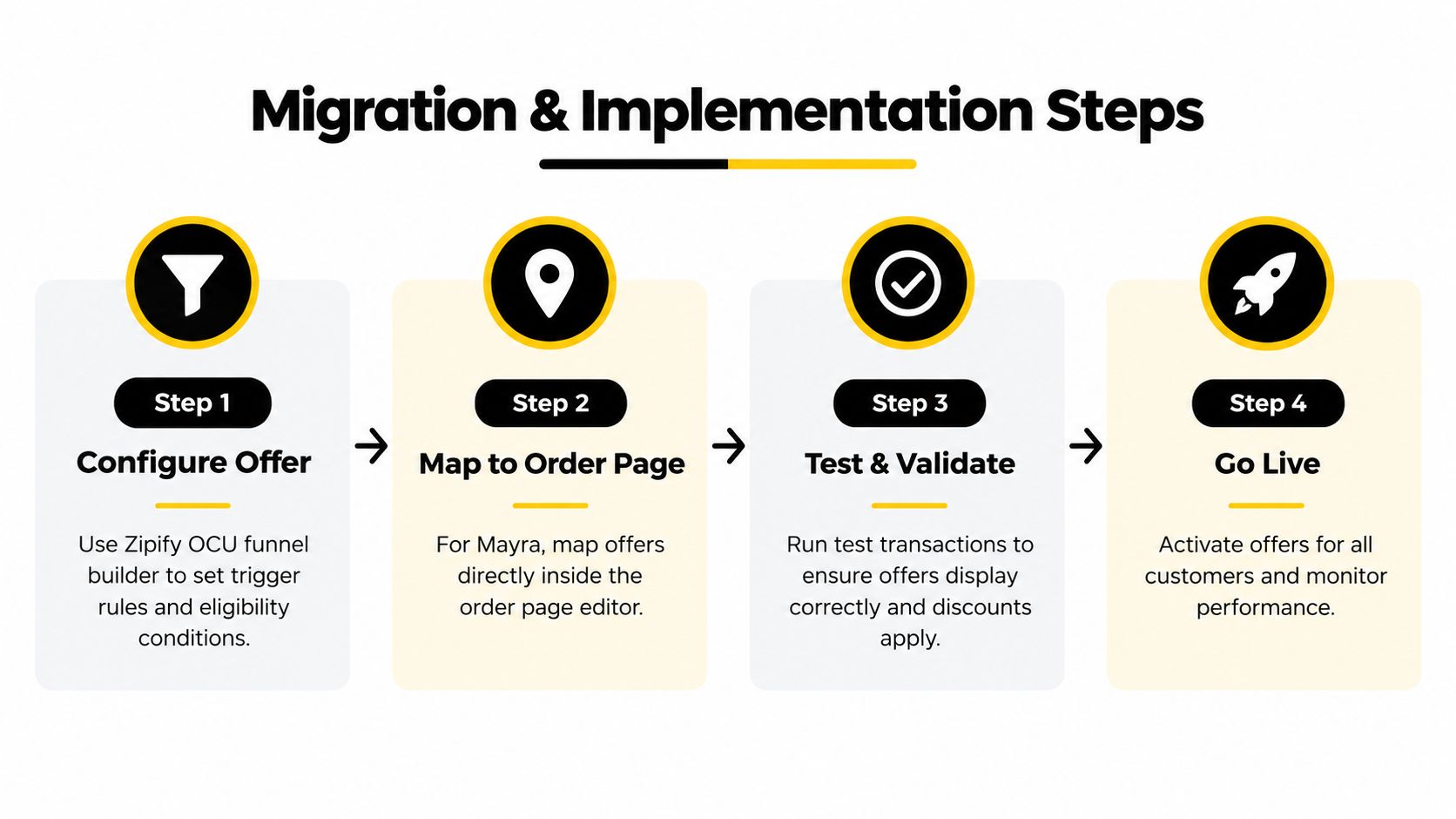
Configure Mayra's order-page placement only after you've established those categories. Map products, collections, tags, destinations, fulfillment states, edit windows, and permissions. Decide who can add items, remove items, update addresses, or trigger cancellation-save options.
Test the money, not just the display
Run controlled test orders for new customers, returning customers, subscription orders, prepaid orders, discounted orders, multi-currency orders, and orders close to fulfillment. Test accepted additions, declined offers, customer cancellations, staff edits, refunds, and edits after a fulfillment event.
Run both apps in parallel only when their audiences can be cleanly separated. For example, use one app for a defined product group or customer segment while the other handles the remainder. Never let two post-purchase tools compete for the same customer and order without explicit exclusion rules.
Migration rule: Install and validate the replacement first, then disable Zipify's offer logic, remove obsolete embeds or scripts, and keep the old app available long enough to reconcile existing orders.
Once Mayra carries the intended account and order-edit experience, retire Zipify cleanly. Disable active funnels, remove the app selection used for post-purchase activation where applicable, delete abandoned scripts and extensions, and verify that thank-you and order status pages still render correctly. Keep a written rollback plan until finance, support, fulfillment, and growth all sign off.
Which App Fits Your Store Profile
There isn't a universal winner. There's a better primary placement for each operating pattern.
Choose Zipify OneClickUpsell when the store has high-value products, relatively simple post-purchase operations, and a clear complementary offer. It suits a DTC growth team that wants to build dedicated campaigns, test sequencing, and monetize the immediate post-payment moment. Zipify's own 2024 materials reported $775 million in cumulative user upsell revenue, more than $1.5 billion in processed orders, and an average conversion rate of 16.2%; a later 2024 update reported cumulative upsell revenue of $880 million and highlighted a $7.5 million four-day peak during Black Friday-Cyber Monday. Those company-reported figures belong in the credibility assessment, but your decision still needs to follow your checkout, payment, and fulfillment realities. See Zipify's OneClickUpsell product materials for the stated figures and product context.
Choose Mayra when customers regularly return to change orders. Address corrections, variant swaps, additions, removals, cancellation deflection, and support reduction should outweigh the appeal of a single immediate offer page. Mayra Apps offers customer-account and order-status workflows for self-serve order edits and one-click additions, with merchant-controlled rules for eligibility, permissions, approvals, and fulfillment handling.
Store Profile to App Fit
| Store Profile | Primary Recommendation | When to Run Both |
|---|---|---|
| High-AOV DTC catalog with clear complementary products | Zipify OneClickUpsell | Run both when immediate offers and later account edits serve different products |
| Frequent address, quantity, or variant changes | Mayra order-edit and upsell surface | Separate immediate offers from account-based additions with strict exclusions |
| Subscription or prepaid-order business | Test the account workflow first, then validate dedicated offers | Run both only after eligibility and fulfillment timing are documented |
| Wholesale-leaning store with approval requirements | Mayra's controlled order workflow | Use Zipify for low-risk DTC orders outside approval-heavy segments |
| Simple catalog and impulse-friendly accessories | Zipify's dedicated post-purchase placement | Add Mayra when support volume justifies account-based editing |
| Shopify Markets or complex payment mix | Pilot either app by market and payment condition | Parallel testing is useful when each app owns a distinct market or segment |
The practical recommendation is to select the primary customer action, not the most impressive feature list. If customers want to buy one more thing now, use Zipify. If they want to manage the order they already placed, use Mayra. If both behaviors are material, run a controlled hybrid architecture rather than stacking ungoverned offers.
Mayra Apps provides customer-account and order-status order editing, cancellation deflection, and one-click upsells that keep accepted additions connected to the Shopify order workflow. Visit Mayra Apps to evaluate whether an account-based placement fits your store's post-purchase operations.