
A customer wants to change a variant after checkout. Another asks where a shipment is, while someone else requests a return and a fourth buyer reaches out through WhatsApp. Your team can answer all four questions, but they shouldn't require the same workflow. The best Shopify apps for customer service solve different layers of support. Some organize agent conversations, while Mayra Apps moves eligible post-purchase changes into the customer account and Order Status page.
Use this comparison to match the app to the job: post-purchase self-service, ticket operations, all-in-one support, AI automation, enterprise scale, live chat, or WhatsApp-led service. Compare each tool by its primary use case, Shopify workflow depth, automation model, channel coverage, billing trade-offs, and implementation fit. For broader context on channels and AI in ecommerce service, the key principle is simple:
Identify the support request you want to eliminate or handle better first. Then choose the app category built for that request.
Table of Contents
- 1. Mayra Apps for Post-Purchase Self-Service
- 2. Gorgias for Ticket Operations
- 3. Reamaze for All-in-One Support
- 4. Richpanel for AI Automation Without Ticket Metering
- 5. Zendesk With the Shopify App for Enterprise Scale
- 6. Tidio for Live Chat and Accessible AI
- 7. DelightChat for WhatsApp-Led Service
- Top 7 Shopify Customer Service Apps, Feature Comparison
- Match the App to the Bottleneck
1. Mayra Apps for Post-Purchase Self-Service
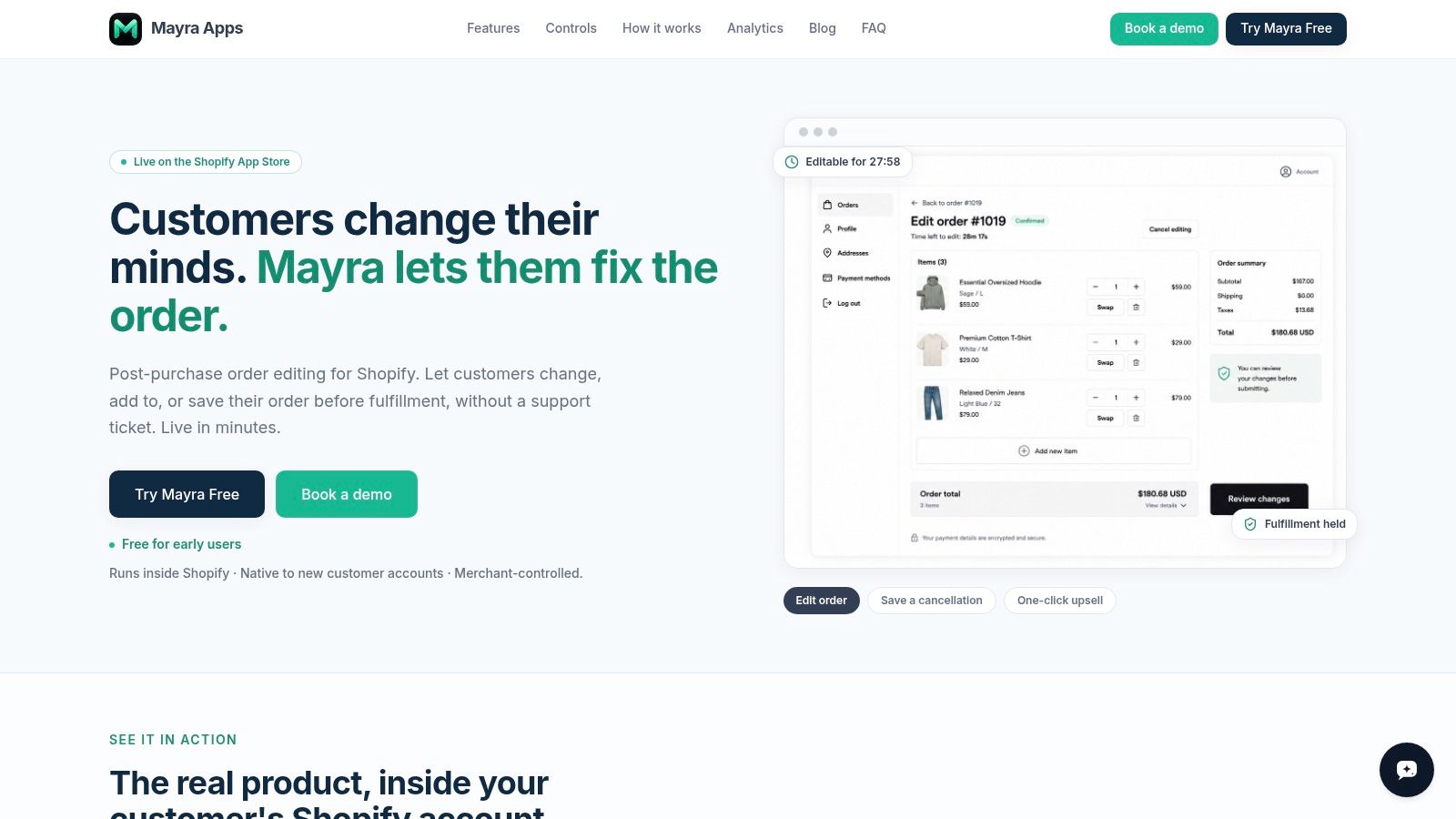
Mayra Apps is the strongest choice when repetitive support requests begin after checkout. Mayra Order Edit & Upsell lets customers handle eligible changes inside their Shopify customer account and Order Status page instead of starting an email thread or opening a ticket. Customers can change quantities, swap variants, update shipping addresses, add or remove line items, and cancel when a cancellation is appropriate.
That workflow matters because Shopify's Order Status page is the final checkout page where customers track orders and shipping updates. Shopify documentation has supported customer account UI extensions and app access to order data on the pre-authenticated Order Status page since June 2024, making in-account workflows for order edits, address changes, and cancellation deflection more practical for merchants (Shopify Order Status capability reference).
Why Mayra fits operations teams
Mayra writes changes back to the original Shopify order, so the Shopify admin remains the source of truth. It can hold fulfillment while an edit is active, invoice extra charges through Shopify, and process refunds automatically or route them for approval above a merchant-defined threshold. That design connects customer service directly to fulfillment and financial control.
Merchants can configure edit windows, turn specific capabilities on or off, require approvals, and exclude products, collections, tags, orders, or countries. The app also supports cancellation reason capture, store-credit save offers, and one-click add-ons that settle on the same order.
Practical rule: Let customers self-edit routine orders, but use eligibility rules and approval thresholds to protect fulfillment and margin.
Mayra's analytics report store-specific activity, including orders edited, revenue recovered, orders saved, and modeled tickets avoided. An inputs-based estimator helps merchants assess potential impact without relying on generic industry promises. The app installs from Shopify and adds to the customer account and Order Status page without theme rewrites.
The trade-off is maturity. Mayra is currently available to early users at no cost, and its feature set may continue to evolve. The fully native experience also depends on newer Shopify customer accounts and Order Status functionality. Stores still relying on older account behavior may need additional setup or may not access every workflow.
Choose Mayra if: your main support bottleneck is order edits, address changes, cancellation requests, add-ons, or other post-purchase tasks that should be resolved before a ticket reaches an agent. Visit the Mayra Apps website to review the workflow.
2. Gorgias for Ticket Operations
Gorgias is the right choice when your team needs a Shopify-first helpdesk that gives agents order context and operational actions inside the inbox. It pulls customer and order information into conversations, allowing agents to work from a support workspace rather than switching repeatedly between Shopify and separate tools.
The platform suits direct-to-consumer brands that already manage support through email, chat, social channels, and structured ticket workflows. Agents can use rules, macros, automation, and CSAT reporting, while conversational AI can handle or assist with recurring requests. Its integration ecosystem also fits common ecommerce stacks, including marketing, subscriptions, loyalty, and fulfillment tools.
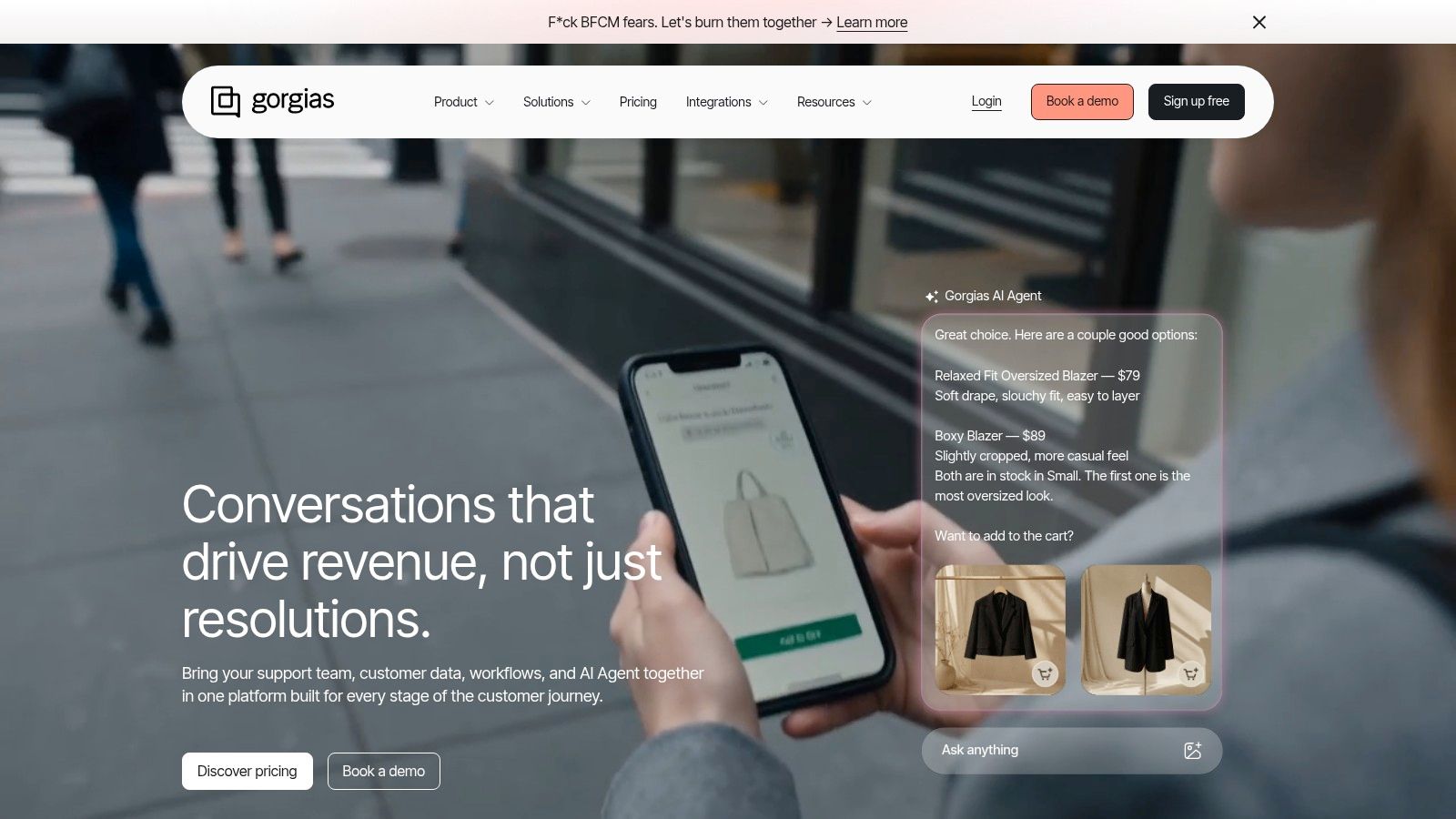
Gorgias stands apart from a general-purpose helpdesk because its workflows are built around ecommerce actions. An agent can see order history in context and perform supported Shopify actions without treating every request as a manual back-office task. That makes it useful for returns questions, delivery issues, order-status requests, and customer conversations that still need human judgment.
Read this practical guide on reducing Shopify support tickets if you're deciding whether prevention or inbox automation should come first. Gorgias is strongest after a customer has contacted the brand, while Mayra is designed to move eligible changes out of the queue entirely.
The main trade-off is billing complexity. Ticket-metered plans can become more expensive during seasonal peaks, and fully automated AI resolutions may be measured separately. Teams should model ordinary and high-volume periods before committing, then define which requests deserve AI handling and which require an agent.
Choose Gorgias if: your agents need deep Shopify actions, mature ecommerce macros, and broad integrations in a helpdesk. Choose another category if your priority is preventing post-purchase tickets before they're created.
3. Reamaze for All-in-One Support
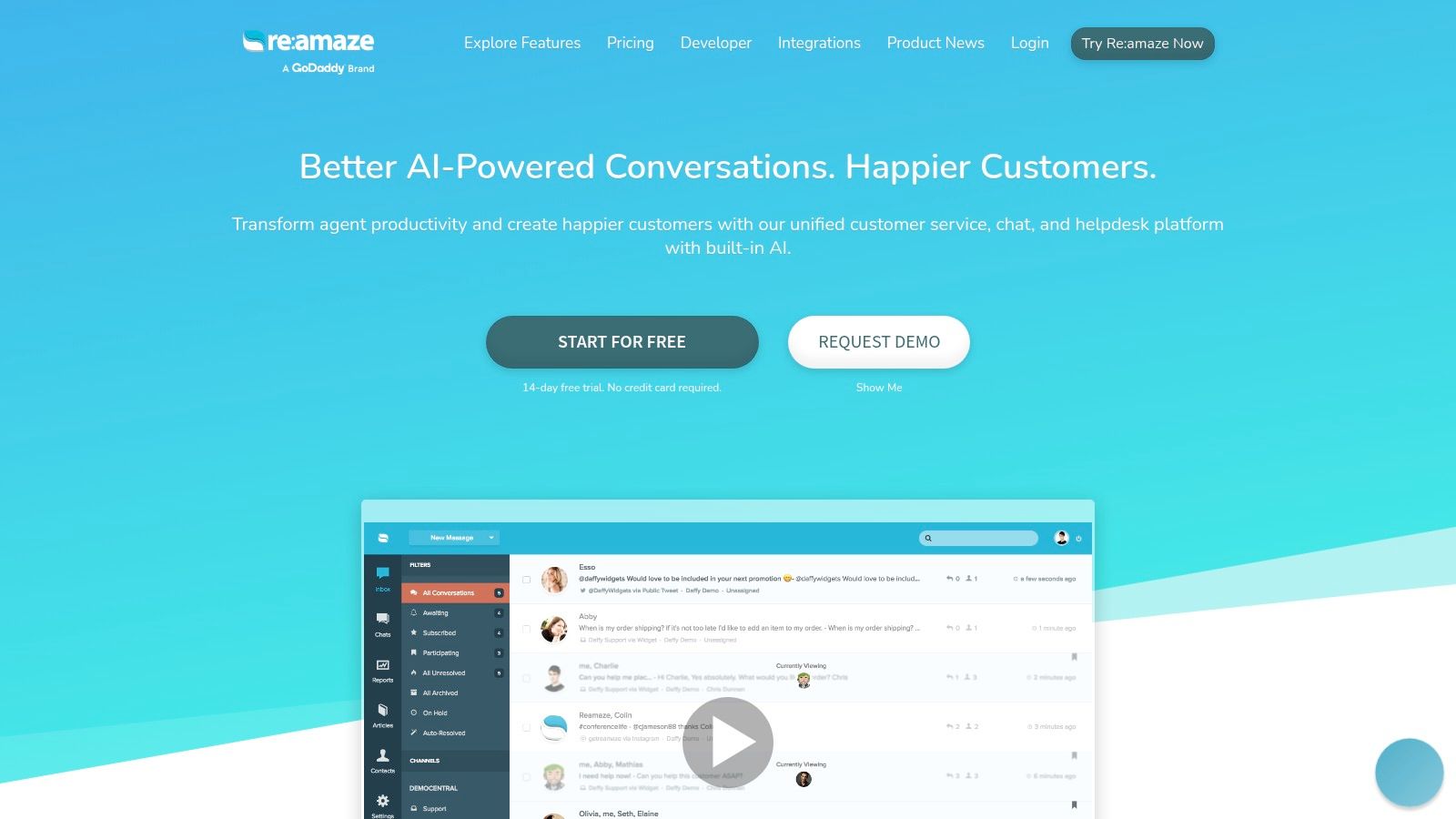
Reamaze is the balanced option for merchants that want an inbox, live chat, chatbots, FAQs, and Shopify actions in one product. Instead of building a separate stack for customer conversations and self-service content, teams can place those functions within a unified support environment.
Its Shopify integration brings store context into conversations, while embeddable chat, contact, and FAQ widgets give customers several ways to find help. Live-site tools such as proactive messages and Live View can help agents understand what shoppers are doing before they ask for assistance. The platform also supports push campaigns, status-page experiences, chatbots, and higher-tier communication features such as SMS and voice.
Reamaze works well for a small or mid-sized support team that doesn't want to stitch together a helpdesk, chat widget, knowledge base, and automation layer. Its seat-based structure, including a flat-rate Starter option, can be easier to understand than a model that meters every ticket. However, merchants still need to monitor AI usage, because resolutions beyond included amounts can incur additional fees.
The product becomes more capable at higher tiers. Multi-brand support, advanced reporting, and deeper brand management aren't equally available across plans, so agencies and multi-store operators should review the plan boundary before installation. A store with one brand and a modest channel mix may get the best fit from the simpler configuration.
For guidance on designing a stronger post-purchase customer experience, treat Reamaze as the conversation hub and add specialized workflow tools where needed. Reamaze can explain policies and route requests, but a dedicated order-edit layer may be better for governed self-service changes.
Choose Reamaze if: you want live chat, FAQs, bots, and a Shopify-aware inbox without assembling several separate apps.
4. Richpanel for AI Automation Without Ticket Metering
Richpanel is built for merchants that want self-service and AI automation alongside agent support, without making helpdesk replies dependent on a per-ticket meter. Its unified inbox displays Shopify customer and order context in the conversation, giving agents the information they need without forcing a separate order lookup.
The platform combines an agent workspace with AI Agents, QA AI, and a customer self-service portal. That portal can address common order-status questions, FAQs, returns, and exchanges before a human agent takes over. Social comments and direct messages can also enter the same broader support operation.

The billing model is its clearest selection advantage. Helpdesk seats aren't charged by reply volume, while AI is priced around handled conversations. That gives support leaders a more direct way to separate human staffing costs from automated resolution costs. Enterprise buyers can also evaluate its contractual outcome guarantees for automation and cost reduction as part of procurement.
The trade-off is ecosystem depth. Richpanel is younger than established enterprise suites, so teams with unusual integrations or complex legacy processes should verify compatibility before replacing existing systems. Its returns and exchanges module is also a paid add-on, which affects the total cost for brands that need those workflows.
A customer self-service portal can reduce pressure on agents, but automation should still have clear escalation rules. Customers need a straightforward path to a person when an order is ineligible, a refund needs review, or a policy exception requires judgment.
Choose Richpanel if: you want AI-led self-service and a modern ecommerce helpdesk, while avoiding per-ticket billing for the human support workspace.
5. Zendesk With the Shopify App for Enterprise Scale
Zendesk is the enterprise choice for Shopify brands that need a broad customer-service operation, not just a store support inbox. Its first-party Shopify app surfaces order information and recent purchases in the Zendesk workspace, helping agents connect a customer's request to their commerce history.
The platform supports email, messaging, voice, help-center content, automation, and broader administrative workflows. Enterprises can extend it with tools for AI, workforce management, quality assurance, and other operational requirements. That breadth makes Zendesk suitable for organizations supporting multiple brands, regions, languages, or business units.
Zendesk's strength is governance at organizational scale. Teams can define roles, routing logic, escalation paths, reporting structures, and security controls across a large service organization. It also fits companies where Shopify is only one customer channel and where support must connect to non-commerce processes.
That scope creates overhead for smaller merchants. Per-agent licensing becomes more significant as headcount grows, while AI and advanced capabilities may require higher-tier seats or separate add-ons. Implementation also demands more planning than a lightweight chat or helpdesk app. A store that only needs order-status replies and basic live chat may pay for administrative depth it won't use.
Zendesk also isn't a replacement for every post-purchase workflow. It can help agents manage a request after contact, but merchants should still assess whether order edits, fulfillment holds, approvals, and refunds belong in a specialized Shopify-native process.
Choose Zendesk if: your support organization has complex routing, multi-brand requirements, enterprise administration, or substantial non-Shopify channel coverage.
6. Tidio for Live Chat and Accessible AI
Tidio is the practical choice for a Shopify merchant that wants live chat, ticketing, automations, and AI assistance without starting with a large enterprise system. Its Shopify app supports a fast storefront deployment, while flows and automation help the team handle routine conversations before they reach an agent.
The platform combines human chat with Lyro AI Agent, which is available on its own or as part of a broader Tidio setup. Teams can start with basic chat and ticketing, then add more automation as support patterns become clearer. That staged approach works for smaller brands that want to test AI instead of redesigning the entire service operation at once.
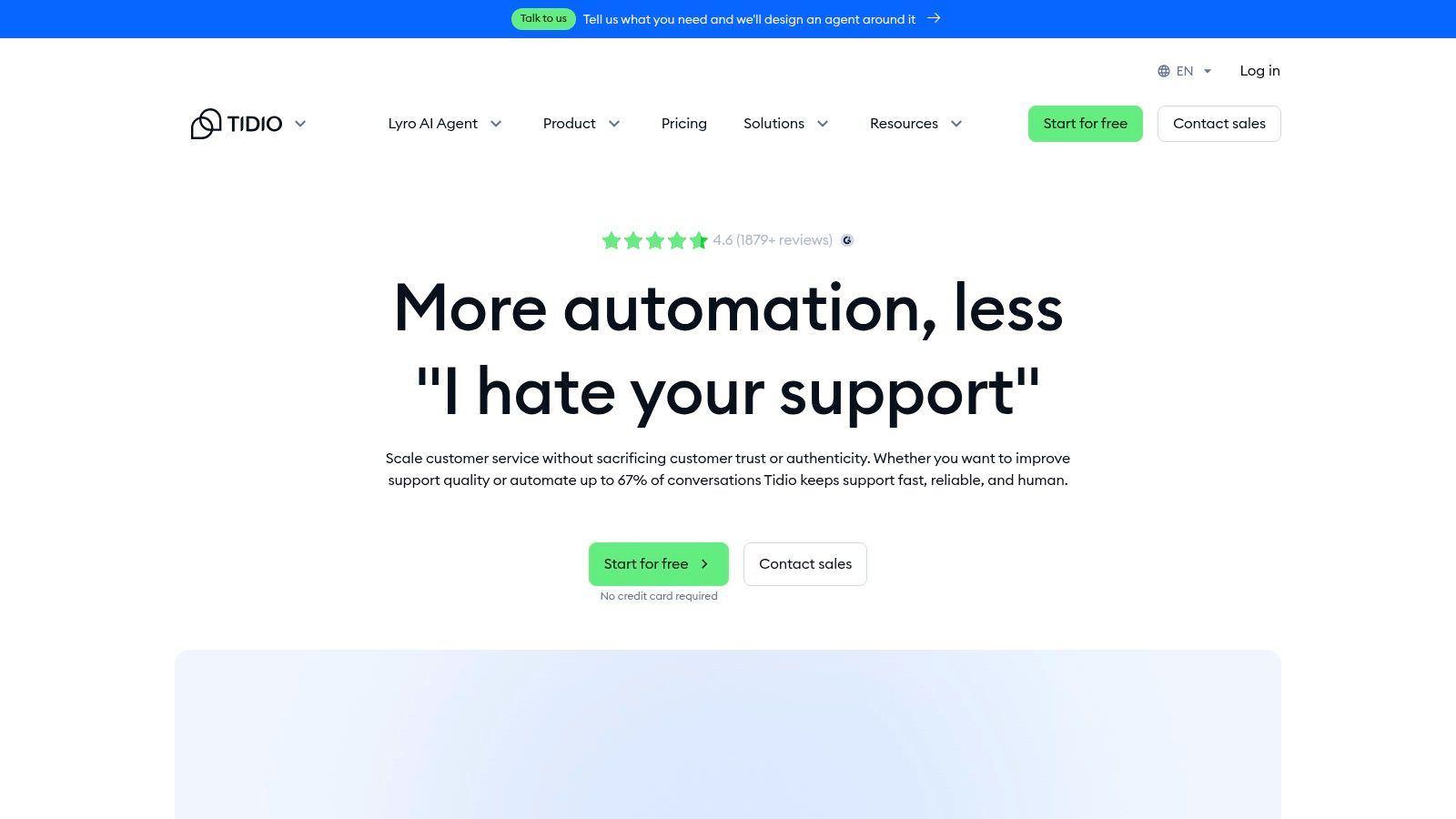
Tidio's conversation-based billing is straightforward in principle: usage is tied to replies or proactive messages. It becomes less predictable when engagement rises, because conversation caps and multiple plan levels can affect the total bill. Merchants should monitor both ordinary customer questions and proactive campaigns, rather than evaluating the subscription only against current support volume.
The app is particularly useful for product questions, basic policy answers, pre-purchase assistance, and simple order-status conversations. It's less suited to merchants whose primary problem is governed order editing. Chat can collect an address-change request, but a native customer-account flow can let an eligible customer complete that change without agent intervention.
Choose Tidio if: live chat is your immediate priority and you want to layer AI assistance onto a lean Shopify support setup. Review conversation caps before launching proactive messaging at scale.
7. DelightChat for WhatsApp-Led Service
DelightChat is the best fit for brands where WhatsApp and social messaging are central to customer service. Its unified inbox brings together WhatsApp, Instagram, Facebook, email, and live chat, while Shopify order data appears inside the conversation so agents can respond with commerce context.
The platform is especially useful when customers expect support in messaging channels rather than through a traditional email ticket. WhatsApp workflows can support both service and marketing use cases, and higher plans are designed for teams managing more stores, channels, or brands. A self-service widget can also help customers track orders and find answers to common questions.
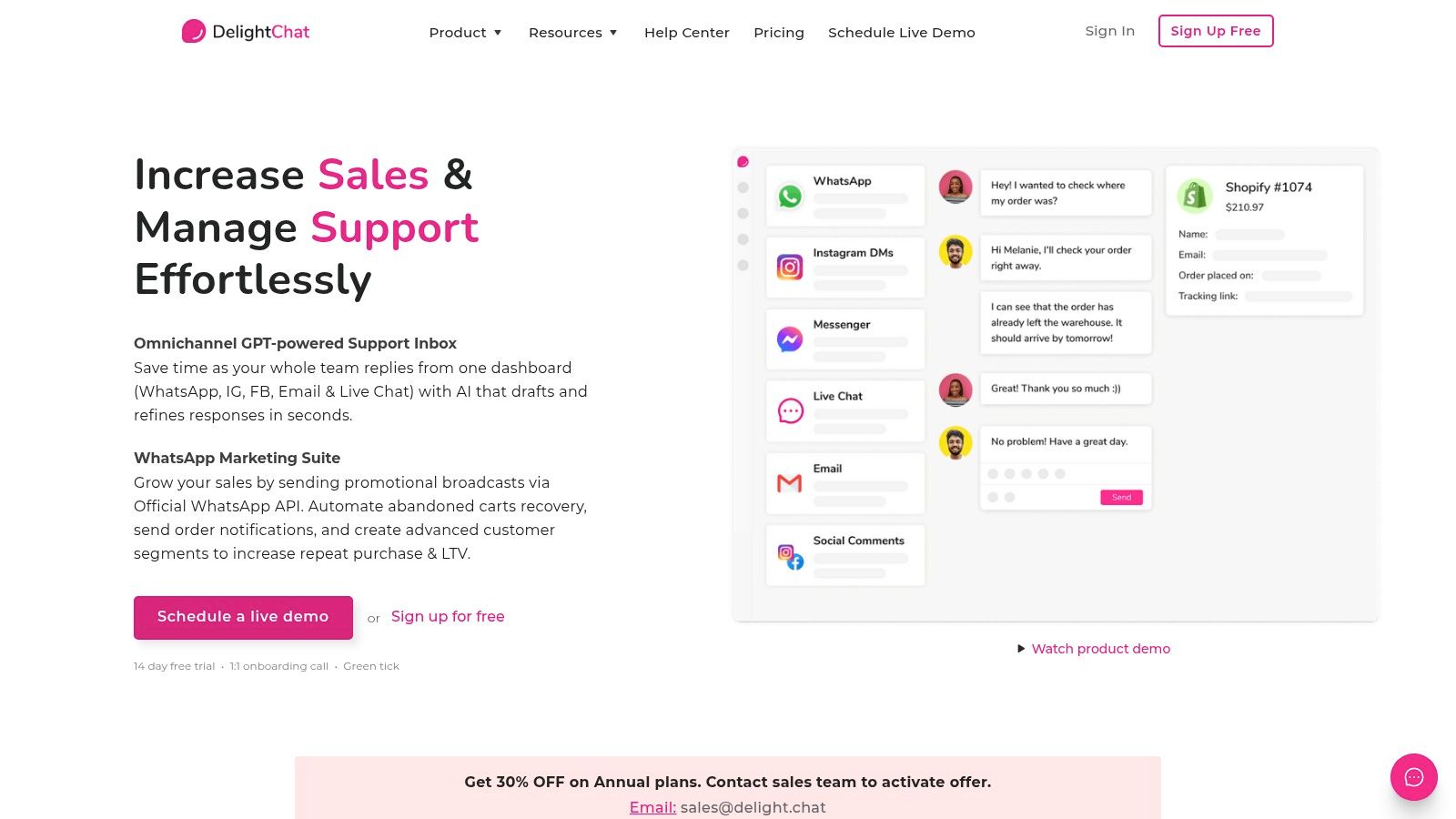
GPT-powered agent assistance is available as a token-metered add-on. That can help agents draft responses and handle repetitive work, but the team should treat tokens as another usage meter during planning. WhatsApp costs are separate and can vary by country and message type, so the app's subscription doesn't represent the full channel cost.
DelightChat also imposes plan limits around tickets and contacts. Those limits may be acceptable for a focused WhatsApp operation, but they need review before a brand moves all social and customer-service conversations into the platform.
Choose DelightChat if: customers already contact your brand through WhatsApp, Instagram, and Facebook, and your team needs Shopify order context in those conversations.
Top 7 Shopify Customer Service Apps, Feature Comparison
| Product | Implementation 🔄 | Resource Req. ⚡ | Expected Outcomes 📊 | Ideal Use Cases 💡 | Key Advantages ⭐ |
|---|---|---|---|---|---|
| Mayra Apps | Low–Moderate, Shopify-native install, no theme surgery; depends on new customer accounts/Order Status page | Low dev effort; merchant rule configuration; free early‑access option | Fewer support tickets; recovered revenue from upsells & deflected cancellations | Post-purchase self‑service edits and cancellation deflection for Shopify stores | Native order edits write back to Shopify; fine‑grained governance; one‑click upsells |
| Gorgias | Moderate, helpdesk setup and workflow configuration | Agent seats + ticket-metered costs; AI add‑ons increase cost complexity | Faster agent resolution and automation; richer in‑inbox Shopify actions | DTC brands needing deep Shopify workflows and automation | Deepest Shopify operational actions; mature macros; large integration ecosystem |
| Re:amaze | Low–Moderate, chat, FAQ and inbox setup; multi‑brand on higher tiers | Seat-based pricing; starter flat rate available; advanced features on higher tiers | Unified chat + helpdesk + knowledge base; proactive live‑site engagement | Teams wanting an all‑in‑one chat + helpdesk + FAQ solution | Strong integrated chat/FAQ/bots; clear pricing options; live‑site features |
| Richpanel | Moderate, AI + self‑service portal setup and integration | Per-seat helpdesk (no per‑ticket); AI billed per handled conversation; some paid add‑ons | High automation with reduced ticket volume; self‑service adoption | Teams avoiding per‑ticket billing and emphasizing automation | No per‑ticket fees; predictable AI pricing; automation outcome guarantees |
| Zendesk (with Shopify app) | High, enterprise deployment, integrations, and admin setup | Per‑agent licensing and many paid add‑ons; IT/admin overhead | Scalable enterprise workflows; broad omnichannel coverage | Large, multi‑brand/multi‑region support organizations | Enterprise admin/security, extensible ecosystem, workforce/QA tooling |
| Tidio | Low, fast chat and ticketing setup with optional Lyro AI | Conversation‑based billing (billed when you reply/proactively message) | Quick chat response times; incremental AI augmentation | SMBs wanting fast chat deployment and lean scaling | Rapid deployment; simple chat/ticket basics; flexible AI layering |
| DelightChat | Low–Moderate, unified inbox and WhatsApp Business API setup | WhatsApp fees separate; token‑metered GPT add‑on; plan limits on tickets/contacts | Strong WhatsApp/IG workflows; consolidated omnichannel inbox | Brands relying on WhatsApp and Instagram alongside chat/email | Clean WhatsApp workflows; generous limits on higher plans; multi‑store support |
Match the App to the Bottleneck
There isn't one universal winner among Shopify apps for customer service. The right choice depends on where requests originate, whether customers can resolve them without an agent, which channels matter, and how much operational control your team needs.
Choose Mayra Apps when the bottleneck is repetitive post-purchase work. It's built for controlled in-account order edits, cancellation deflection, address changes, and same-order upsells. Its strongest advantage is workflow prevention. Customers can complete eligible changes through Shopify-native surfaces, while fulfillment holds, approvals, exclusions, and Shopify financial handling protect the back office.
Choose Gorgias when agents need deep Shopify actions inside a mature ecommerce helpdesk. Choose Reamaze when you want an all-in-one inbox, live chat, FAQ, and chatbot setup. Choose Richpanel when AI automation and self-service matter, but you don't want the human helpdesk priced by ticket.
For larger organizations, Zendesk is the clear enterprise option. It supports complex service operations, broad channels, and administrative requirements that smaller tools don't target. Tidio is the accessible live-chat and AI choice for merchants that want to deploy quickly and expand gradually. DelightChat is the specialist option when WhatsApp and social messaging drive most customer conversations.
Before installing, check these decision points:
- Support request types: Identify whether your largest volume comes from order changes, tracking, returns, product questions, or cancellations.
- Channel coverage: Confirm whether you need email, live chat, voice, SMS, WhatsApp, Instagram, Facebook, or several channels together.
- Automation needs: Separate FAQ automation from actions that change orders, issue refunds, or affect fulfillment.
- Billing meters: Review ticket, conversation, AI-resolution, token, seat, contact, and channel fees.
- Shopify compatibility: Confirm that the app works with your customer-account model and Order Status page requirements.
- Governance requirements: Define edit windows, approval rules, fulfillment holds, exclusions, refund handling, and escalation paths.
- Implementation effort: Estimate the work needed for configuration, policy content, integrations, agent training, and customer-facing placement.
Start with your support queue, not the app store. Map the most frequent requests to the workflow that can resolve each one with the fewest handoffs, then test that workflow against fulfillment, finance, and escalation rules before expanding across channels.
Mayra Apps helps Shopify merchants move eligible post-purchase order edits, cancellation deflection, and same-order upsells into customer accounts and the Order Status page while keeping Shopify as the source of truth. If repetitive order-change tickets are your bottleneck, visit Mayra Apps and evaluate how its governed self-service workflows fit your store.