
“More clicks mean better recommendations” is one of the most popular assumptions in ecommerce, and one of the easiest ways to misread performance. A product recommendation engine can attract attention and add an item to a basket while still failing to create new revenue, or causing problems for fulfillment and customer trust.
For store owners and operations teams, the useful question isn't whether shoppers respond. It's whether recommendations change what customers buy in a way that benefits the business without creating a worse post-purchase experience.
Table of Contents
- What a Product Recommendation Engine Actually Does
- Recommendation Approaches Compared by Data and Cost
- How Item-to-Item Filtering Made Recommendations Practical
- Where Recommendations Appear Across the Customer Journey
- Metrics That Show Whether Recommendations Work
- Run a Holdout Test Before You Trust Recommendation Revenue
- Guardrails for Harm, Bias and Trust Before Going Live
What a Product Recommendation Engine Actually Does
A helpful shop assistant remembers what a customer has browsed or bought, notices what they're shopping for now, and suggests a relevant next item. A product recommendation engine automates that task across a store's catalogue. It gathers signals, ranks possible products, and presents a short list suited to the customer's current situation.
The engine works with three kinds of input:
- The catalogue: Products, variants, prices, stock, and attributes such as colour or size.
- Behaviour: Actions such as viewing a product, adding it to a cart, purchasing it, or passing over a suggestion.
- Context: What the customer is doing now, such as viewing a product page, checking a basket, or editing an existing order.
It turns those inputs into a ranked list of suggestions, not a single definitive answer. That distinction matters because shoppers usually focus on the items placed near the top. A suggestion can be relevant in general but still be a poor fit for the moment if the product is out of stock, incompatible with the existing order, or unrelated to what the shopper is trying to do.
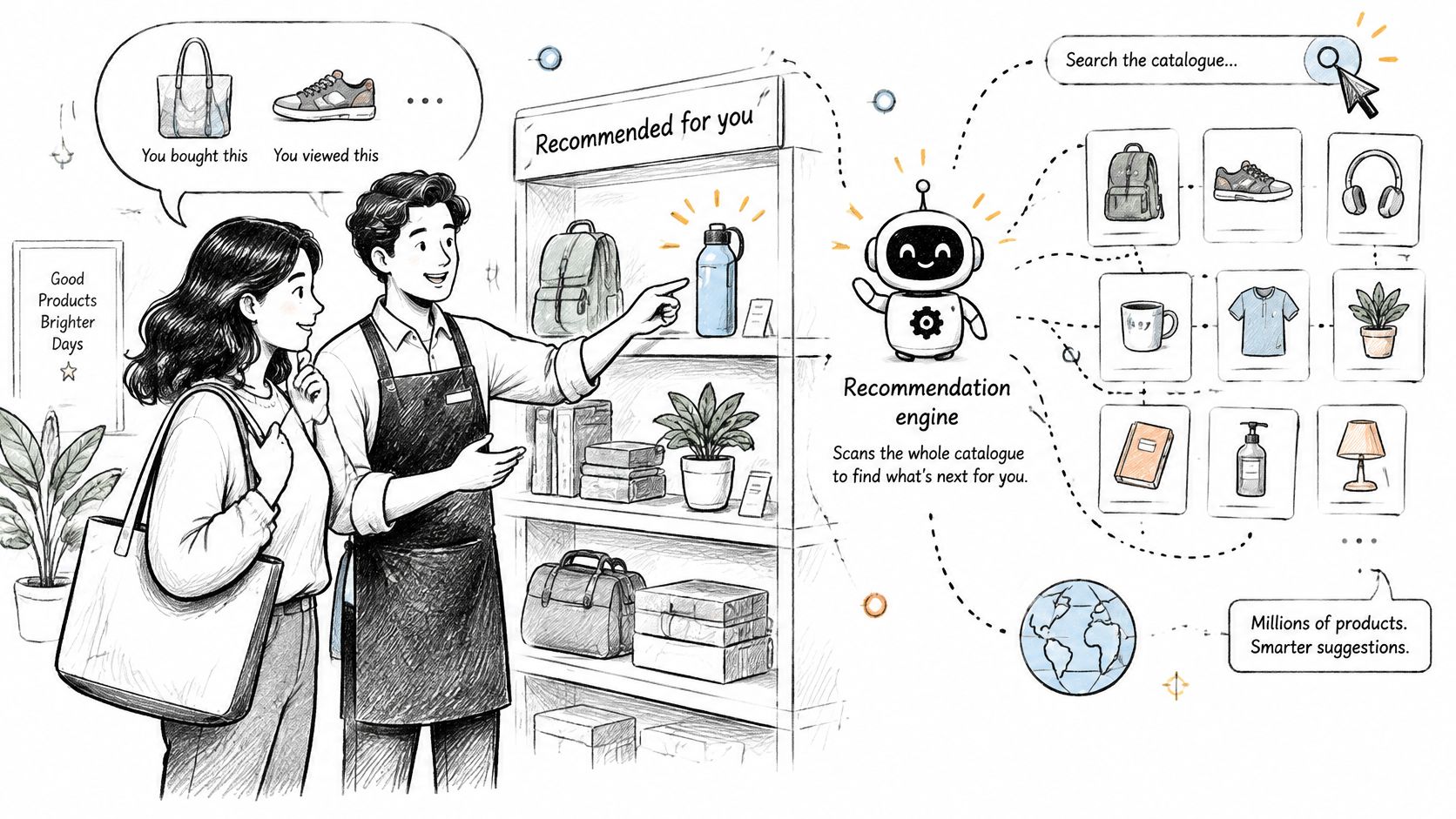
Recommendations respond to context
Search and recommendations solve different problems. Search responds to a typed query: the customer says what they want to find. A recommendation responds to the shopper's situation without requiring a query.
Say a customer buys running socks and, before dispatch, the store offers a moisture-wicking pair in another colour. That suggestion draws on the current order and the product catalogue. Whether a system uses simple rules or a more complex model, the test is the same: does the item make sense at that point in the customer's journey?
Teams choosing where to apply automation can compare different AI recommendation strategies for ecommerce, especially when deciding how to combine behavioural signals with product and page context. The central measure isn't how advanced the engine sounds. It's whether the items it puts first are useful at that exact moment.
Recommendation Approaches Compared by Data and Cost
A store doesn't need a complex model to begin recommending products. The right starting point depends on what the team knows about its catalogue and customers, and how much data it can use to make a match.
| Approach | What It Uses | Data It Needs | Main Weakness |
|---|---|---|---|
| Best sellers and popularity | Sales counts across the store | Some order history | Favours already-popular items |
| Content-based | Product attributes such as type, colour and size | Clean product data | Repeats similar items with little surprise |
| Item-to-item collaborative filtering | Items bought or viewed together | Large volume of co-purchase data | Weak for new products |
| Hybrid | Candidate rules, attributes and behaviour | Product data plus behaviour | More engineering and monitoring |
| Rules and manual curation | Merchant-picked collections or products | Merchant judgement | Does not adapt to shoppers |
Match the method to the store's data
Best sellers are a practical fallback when a store has little behavioural history. They need only order data, but popularity can reinforce itself: the products already selling well keep getting surfaced. Content-based recommendations use catalogue attributes, so they can help match a shopper to a similar product even when the store has limited interaction data. Their weakness is repetition. If a customer views a blue jacket, the engine may keep showing similar jackets instead of offering a useful alternative.
Item-to-item filtering uses relationships between products that customers view or buy together. It needs enough relevant activity for those relationships to mean something, and a newly listed product may not have that history yet. Hybrid systems mix approaches, which can make suggestions more useful across different situations, but they also require more work to build and monitor. Manual rules and curation give merchants control over which collections or products appear, but the selected items don't adjust to each shopper's behaviour.
Privacy safeguards alone don't remove the risk of popularity bias. Research on federated recommendation describes how models can still favour popular products, while privacy, fairness, explainability, and security can require joint evaluation. That's a reason to start with current context, compatibility, and availability where possible, explain why a product appeared, and audit whether exposure favours the same high-volume items. A useful companion to that work is this guide to tracking product recommendation KPIs, which can help teams keep attention on outcomes as well as activity.
For a store with few orders, begin with best sellers and curated picks. Clean up product attributes before adding attribute matching. Introduce behavioural methods only when order history makes item relationships meaningful. Keep the reason for each suggestion visible, so a shopper with little history can still understand why it appeared.
How Item-to-Item Filtering Made Recommendations Practical
In 2003, Amazon published “Amazon.com Recommendations: Item-to-Item Collaborative Filtering.” Instead of trying to match each customer directly with every other customer, the approach compared products that were frequently viewed or purchased together. A system could precompute those item relationships and retrieve relevant products during a shopping session, making recommendations more practical for a very large catalogue. That historical account and the limits of the widely repeated sales claims are discussed in research on recommendation systems and their commercial impact.
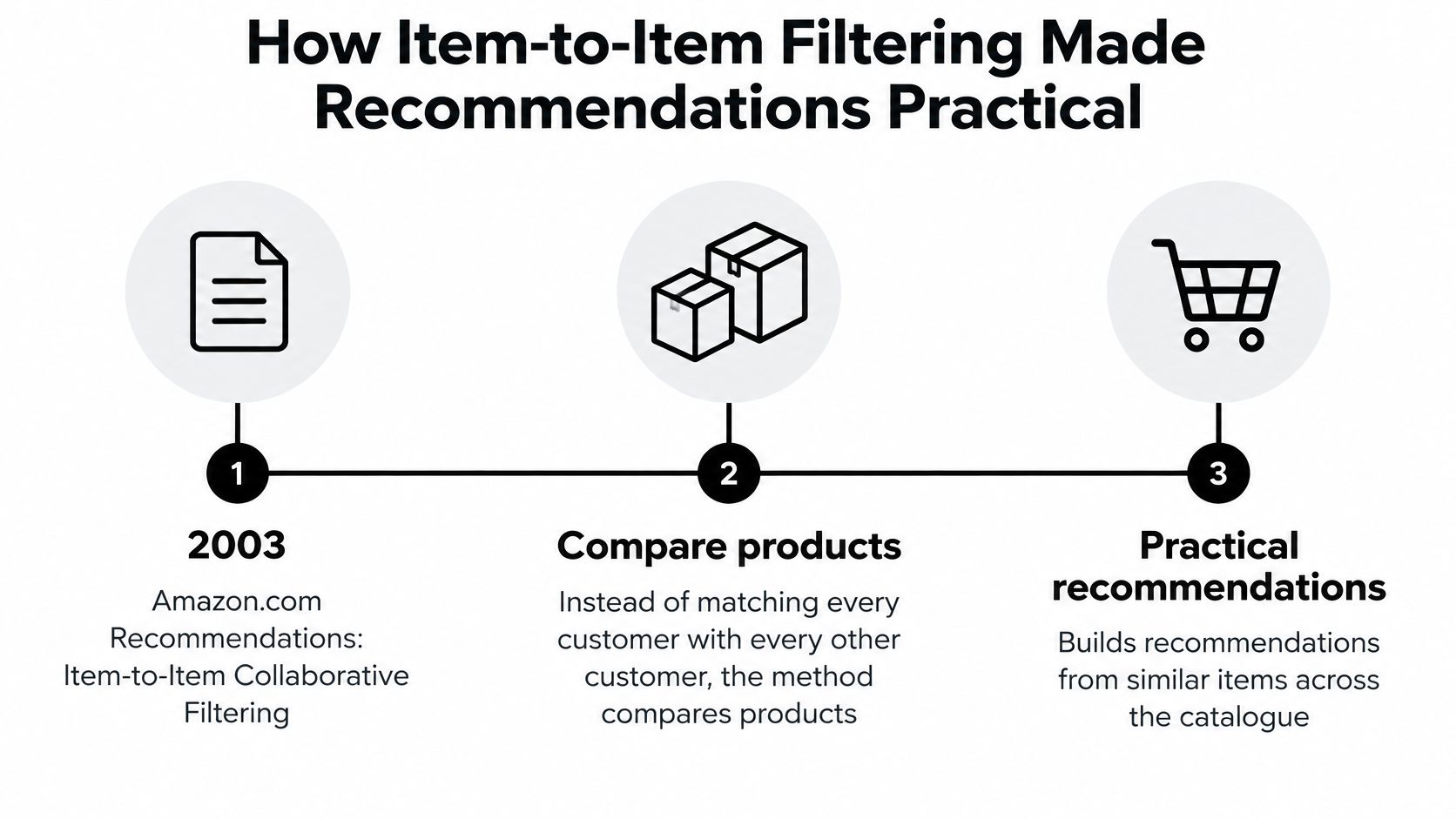
Read headline revenue claims cautiously
The method's practical advantage was about how to find related products efficiently. For a smaller store, the same logic has a prerequisite: there must be enough co-purchase activity for a product pair to carry useful meaning. Without that history, a simpler fallback is more defensible than treating weak connections as reliable signals.
The commercial figures attached to Amazon's recommendations need careful interpretation. Estimates put the recommendation ecosystem's contribution at roughly 10–30% of site activity or revenue, but those estimates aren't definitive causal measurements. A widely repeated claim that recommendations account for 35% of Amazon sales has been attributed to a 2013 McKinsey report, but Amazon hasn't publicly confirmed it, and the methodology isn't clearly disclosed.
An independent analysis of anonymized browsing logs from 2.1 million Amazon users over nine months found that at least 75% of recommendation-related activity would probably have happened without recommendations, according to the same research. That finding doesn't mean recommendations have no value. It means observed clicks and purchases may include activity customers would have generated anyway.
Treat recommendation clicks as evidence of attention, not proof of incremental revenue.
For teams considering personalization that uses customer information, technical choices should sit alongside clear data-handling practices. A practical primer on applying GDPR to promotional texts can help frame privacy questions around promotional activity, though recommendations still need their own context-specific evaluation.
Where Recommendations Appear Across the Customer Journey
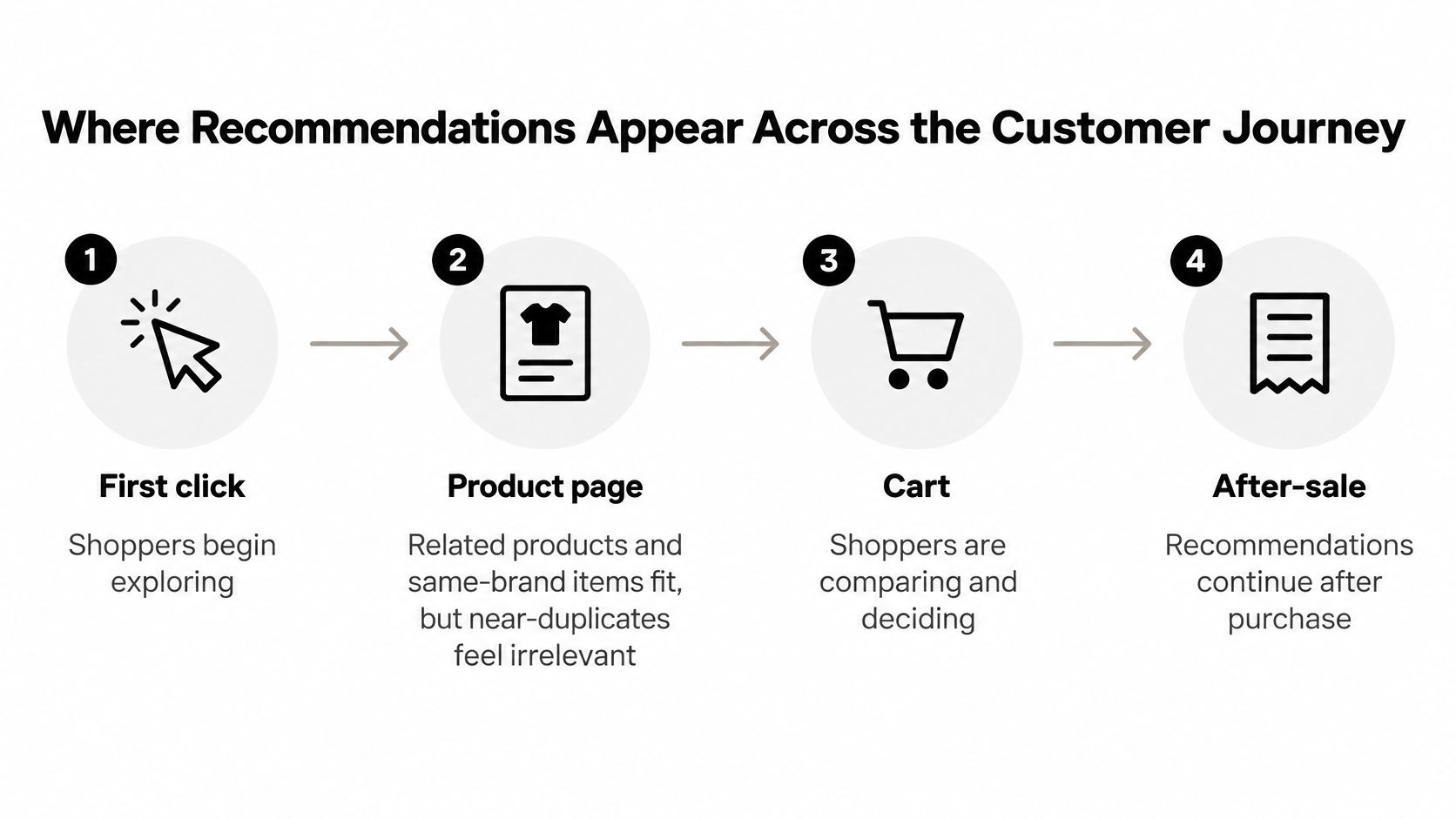
A recommendation that suits someone browsing a product page may be disruptive at checkout. The right placement depends on the shopper's intent, the information available to the engine, and the operational risk of showing an unsuitable item.
| Placement | Shopper Intent | Typical Source | Main Risk |
|---|---|---|---|
| Product page | Browsing and comparing | Related products, same brand | Irrelevant near-duplicates |
| Cart | Ready to buy, checking value | Frequently bought together, bundles | Distracts from checkout |
| Checkout | Committed and cost-sensitive | Low-price add-ons, threshold items | Surprise charges late in the flow |
| Order status page | Waiting, may want changes | Best sellers, collection picks | Offers that conflict with dispatch |
| Order edit flow | Correcting or adding to an existing order | Compatible variants and items | Adds items that cannot ship together |
| After confirmation | Satisfied, possibly open to more | Related items with a clear reason | Feels intrusive when repeated |
Fit the placement to the decision
On a product page, the customer is exploring and comparing. Related products or items from the same brand can broaden the choice, while near-duplicates may feel like noise. In the cart, the shopper is closer to buying and may appreciate a bundle or frequently bought-together suggestion. But a promotion that pulls attention away from completing checkout can undermine its purpose.
At checkout, a low-cost add-on may suit a shopper who's already committed, but the price change needs to be plain before confirmation. Unclear or late charges can make a useful recommendation feel like a surprise. On the order status page, customers may be waiting or looking for a way to make a change. Best sellers or collection picks can fit, provided the offer doesn't conflict with dispatch.
The order edit flow needs more than general relevance. A customer changing an existing order needs products that fit the items already there and can still be fulfilled in time. An offer that creates a shipping or stock problem can turn a convenient edit into extra work for the customer and operations team. After confirmation, related products may suit a shopper who's still interested, but repeating offers can feel intrusive.
Stores planning a post-purchase placement can use this overview of post-purchase upsells on Shopify to consider how offers fit alongside order changes. Choose placements based on the customer's task, not merely on how many opportunities the site has to show a product.
Metrics That Show Whether Recommendations Work
A recommendation model can lower its rating error while making the order of the few products a shopper sees worse. That's why rating prediction alone is a poor target for an ecommerce placement. The more practical question is whether the engine ranks useful, eligible products near the top.
Use offline measures to compare rankings
For a ranked list, NDCG@K rewards relevant items more when they appear near the top. An offline review can use NDCG@5 or NDCG@10, alongside Recall@K, Hit Rate, and MAP@K, to assess whether the engine is finding and prioritizing relevant products. An academic benchmark evaluation that compares MAP@10, NDCG@10, Precision@10, Recall@10, and MRR illustrates why a single measure can't capture all aspects of recommendation quality, as described in this study of recommender evaluation metrics.
Coverage and diversity add a different perspective: they help show whether the engine repeatedly surfaces the same products instead of drawing from a broader catalogue. Eligibility checks should also screen out products that can't be sold in the situation. For an order edit, that means considering compatibility with the existing order, stock, fulfillment timing, destination restrictions, and merchant rules. A high relevance score doesn't make an unavailable or unshippable item a good recommendation.
| Metric | Stage | What It Tells You | Watch For |
|---|---|---|---|
| NDCG@10 | Offline | How well the top ten items are ordered | Ignores whether items can ship with the order |
| Recall@K | Offline | Share of relevant items caught in the list | Can reward longer lists |
| Coverage and diversity | Offline | How much of the catalogue gets shown | Broad lists can look unfocused |
| Add-to-cart rate | Online | Immediate interest in a shown item | Clicks can overstate impact |
| Incremental order value | Online | Extra revenue against a control group | Needs a holdout to be valid |
| Attachment rate | Online | Share of orders with an accepted add-on | Low rates signal weak relevance |
| Refund or cancellation rate | Online | Harm caused by recommended items | Shows up late, after purchase |
Use online results to decide what stays live
Offline metrics help teams screen and compare candidates. They don't prove the engine improves business results. Online tests should measure add-to-cart rate, incremental order value, attachment rate, and the impact on cancellations or refunds. Those outcomes help distinguish an item that attracts interest from one that contributes value after the order is completed.
A team should also decide how long to watch for downstream effects. An add-on may initially look successful, then generate refunds or operational issues that a click-based view misses. For a Shopify store assessing the effect on basket size, this guide to Shopify average order value can help clarify the business measure without making it a substitute for a control group.
Offline metrics help choose candidates. Online outcomes determine whether the engine earns its place.
Run a Holdout Test Before You Trust Recommendation Revenue
Post-purchase behaviour is sparse and usually implicit. A product click, an addition during order editing, an accepted suggestion, and a later purchase can each be treated as a positive signal, with different weights. An impression without interaction is harder to interpret: the shopper may not have noticed the product, so it shouldn't automatically count as dislike.
A recommendation pipeline can generate candidates from best sellers, co-purchased products, related products, collection constraints, and curated picks. A second-stage ranker can then weigh features such as the current order, product details, inventory, margin, and operational constraints. Offline model gains can be useful, but they don't guarantee that customers will spend more or that the extra order activity will be worthwhile.
For example, a large MovieLens benchmark reported NDCG@10 of 0.415 for LightGCN versus 0.353 for KNNBaseline, a 17% relative improvement. That result demonstrates a benchmark gain, not a guaranteed commercial lift for an ecommerce store. The same study discusses the need to validate business outcomes and describes a 5–15% revenue increase from recommendation-led personalization in some businesses, a range that depends on implementation and context rather than serving as a forecast (the study's findings on recommendation models and business evaluation).
Set up a randomized comparison
- Assign shoppers at random. Keep one group eligible to see recommendations and hold them back from the other group as a control.
- Use the same customer step. For example, compare shoppers in the same order-edit flow, rather than comparing separate placements or different kinds of orders.
- Cover the complete order cycle. Include the period in which changes, fulfillment, and follow-up outcomes can occur, so the result isn't based only on immediate acceptance.
- Track both gains and costs. Measure incremental add-on revenue, conversion, average order value, recommendation acceptance, latency, and operational guardrails such as fulfillment exceptions.
Define the decision rule before the test starts. Keep the recommendation experience when it produces positive incremental margin after fulfillment costs and complaints don't rise. Narrow or stop it if the result depends on revenue that is offset by extra costs or customer problems.
An order-edit flow can make a useful test location because the shopper is already considering a change to an existing order. Mayra can recommend relevant products while customers edit an order, on the order status page, and after a committed edit. An accepted upsell is added to the same order, and the new total settles automatically through Shopify. For teams designing experiments across their storefront, this guide to Shopify conversion rate optimization offers related context on testing changes against business outcomes.
Guardrails for Harm, Bias and Trust Before Going Live
A recommendation set that converts less can still be the better choice. Suppose an add-on raises sales but can't ship with the original order, conflicts with inventory, or changes the price or tax in a way the customer doesn't expect. The immediate conversion doesn't capture the cost of the confusion or extra work that follows.
A useful review measures accepted add-on rate and incremental margin after discounts and fulfillment costs, then checks returns or cancellations for recommended items, fulfillment exceptions, and customer complaints. Segment those results by edit type, destination, product category, and time remaining before dispatch. This approach to evaluating recommenders argues for harm detection, bias audits, privacy review, explainability, reliability checks, and scenario-based testing alongside clicks and conversion (research on holistic recommendation evaluation).
Popularity bias is another risk. A privacy-preserving system can still favour products that already receive the most exposure. Audit which products are shown and accepted, comparing popular items with useful substitutes and less-exposed catalogue choices. Keep the recommendation reason specific and honest, such as “often purchased with this item” or “matches your selected variant.” During an order change, the customer has already stated an intent, so relying heavily on behavioural profiling can feel intrusive rather than helpful.
There's also a trust issue with persuasive product cues. In a 2024 survey of 1,750 shoppers in the United States and Canada, 1WorldSync found that 67% said ratings, reviews, and customer-submitted content had persuaded them to buy a product they didn't think they needed or wanted (1WorldSync's shopper survey announcement). That finding concerns customer-submitted content, not recommendation engines specifically, but it underlines why repeated nudges should be tested for trust as well as response.
Before launch, check:
- Compatibility: Can the item ship with the existing order?
- Availability: Do stock and dispatch timing allow the addition?
- Price clarity: Does the displayed change match what the customer will pay?
- Explanation: Is the stated reason for the recommendation accurate?
- Exposure: Do useful, less-popular substitutes get a fair chance to appear?
- Outcomes: Do complaints and refunds remain acceptable across customer and order segments?
Mayra ‑ Order Edit & Cancel lets Shopify customers make permitted order changes and discover relevant products during an edit, on the order status page, or after confirming a change. If you're evaluating post-purchase recommendations, visit Mayra ‑ Order Edit & Cancel to explore how customer-managed edits and product additions can fit into your store's workflow.