
Yes, you can change a shipping address after purchase, but the method changes completely depending on whether the order has left the warehouse. Before fulfillment, treat the request as an order edit; after carrier handoff, it becomes a restricted reroute that may involve fees, delays, and no guarantee of success.
The midnight message usually looks harmless: “I entered the wrong apartment number. Can you send it to my new address?” If the warehouse hasn't touched the order, the fix may take minutes. If a label already exists or the parcel is moving through a carrier network, the same request can trigger a hold, a new label, a tax review, fraud checks, or a return-to-sender decision.
That difference matters on Shopify. The right answer to how to change shipping address isn't “contact support.” It's a controlled workflow tied to order status, fulfillment state, destination rules, payment settlement, and carrier eligibility.
Table of Contents
- The Operational Reality of Changing a Shipping Address
- How Customers Can Change Their Shipping Address via Self-Serve
- Merchant Configuration of Edit Permissions and Rules in Mayra Apps
- Fulfillment Holds and Financial Implications of Address Changes
- Best Practices for Streamlined Post-Purchase Address Management
The Operational Reality of Changing a Shipping Address
An address is not just text stored against an order. It determines where inventory is sent, which carrier service can accept the parcel, how taxes are calculated, whether the destination is eligible, and whether the shipment can be insured or delivered under the original terms.
Postal operators have treated address quality as an operational and data-integrity issue for decades. The U.S. Postal Service's Delivery Point Validation system checks whether an address exists as an active delivery point against USPS address-management data. In one USPS strategic-planning assessment, mailer address quality improved by 2.5% over the prior year, while 9.7 billion addresses were processed through NCOALink, an official change-of-address database, representing a 1.51% increase from the previous year. USPS also required certain mailings to incorporate known address changes within the 95 days before mailing. These practices support a simple ecommerce rule: detect the change early, validate it against authoritative data, and apply it before dispatch. USPS explains its address-quality and change-of-address controls.
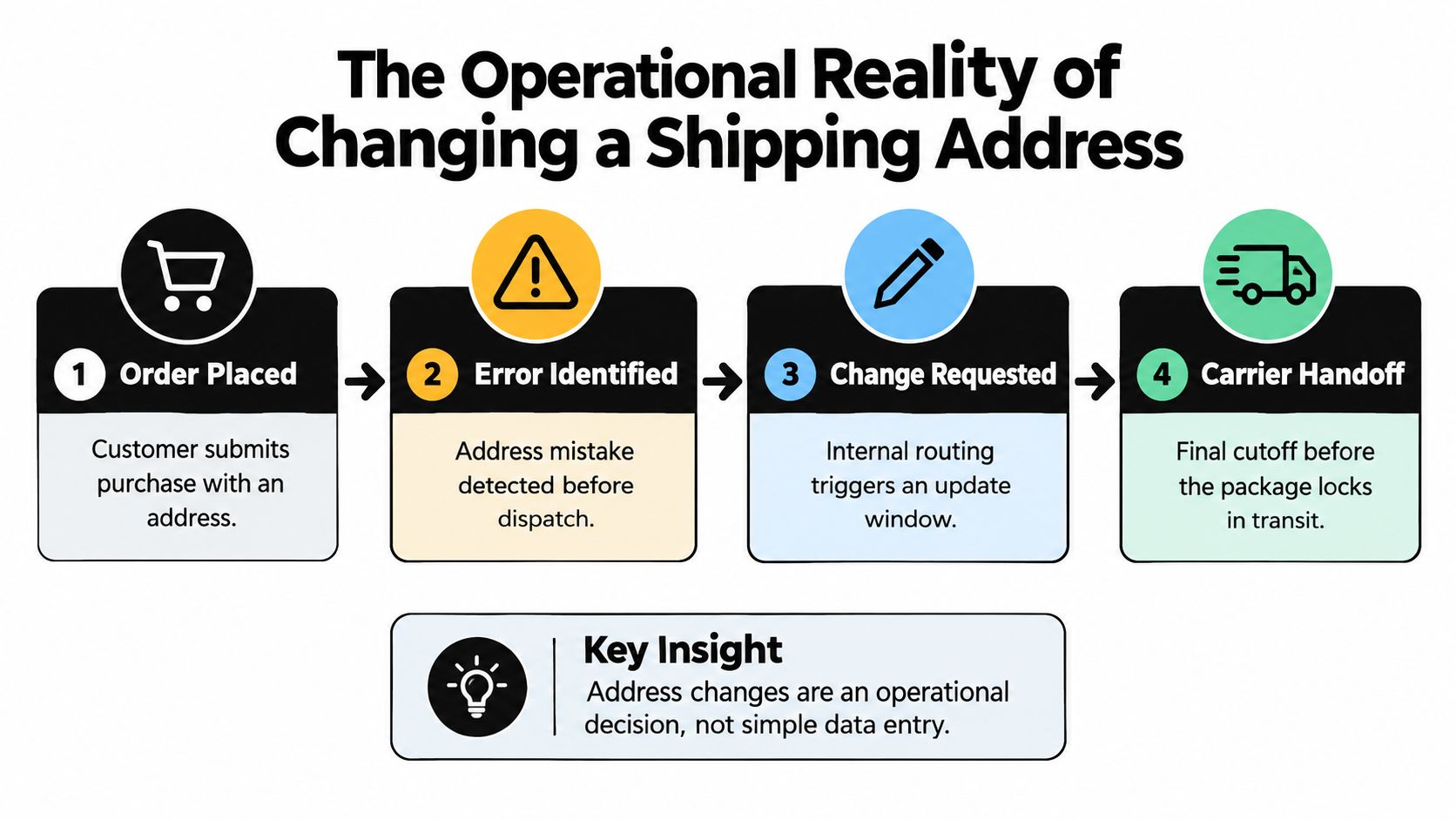
The edit window is the valuable window
Before fulfillment, the merchant still controls the original order record and shipping label. A properly designed workflow should first verify the customer, order status, destination-country eligibility, inventory state, and normalized address. The normalized record should include the recipient, street, unit, locality, postal code, region, and country.
Then place a fulfillment hold before writing the new address. Recalculate taxes, shipping availability, fraud risk, and delivery estimates. Ask the customer to confirm the change, record the event, and release the hold only after the updated order passes those checks. This approach follows the same operational logic described in FedEx guidance on correcting a shipping address.
Practical rule: Never let a customer edit the destination while a warehouse worker or fulfillment integration can still buy a label or hand over the parcel.
After fulfillment, the problem changes category. UPS allows delivery-change requests, including delivery to another address, but restrictions depend on shipment eligibility and contents. Corrections such as a missing apartment number or ZIP code may be possible, while a completely new destination can require sender involvement or a fee. UPS generally places the request before the first delivery attempt through its Delivery Intercept workflow, and a successful request can incur a charge. Its published European schedule lists address-change charges of €5.00 by phone and €3.50 through a web guest channel, while address-correction services may carry a separate per-package charge. UPS describes delivery changes and address corrections.
The operational boundary is clear:
- Unfulfilled: Edit the original Shopify order, validate the new address, and replace or regenerate the label.
- Label created: Stop fulfillment activity, confirm whether the label can be voided, then update the order before dispatch.
- Carrier possession: Use the carrier's intercept or reroute process. Don't promise that the destination can be changed.
- Out for delivery or delivered: Consider hold-for-pickup, return-to-sender, or carrier escalation instead of direct replacement.
How Customers Can Change Their Shipping Address via Self-Serve
The fastest customer experience starts with access to the order, not a support queue. A buyer who notices a missing unit number should be able to open the order status page or customer account, select the address-edit action, submit the corrected details, and receive a clear confirmation before the warehouse proceeds.
With Mayra Apps installed on the Shopify Order status page and new customer accounts, the customer can manage eligible post-purchase changes in the same place used to review order and tracking information. Address edits can sit alongside quantity changes, variant swaps, item additions, and removals, subject to the rules the merchant has configured.
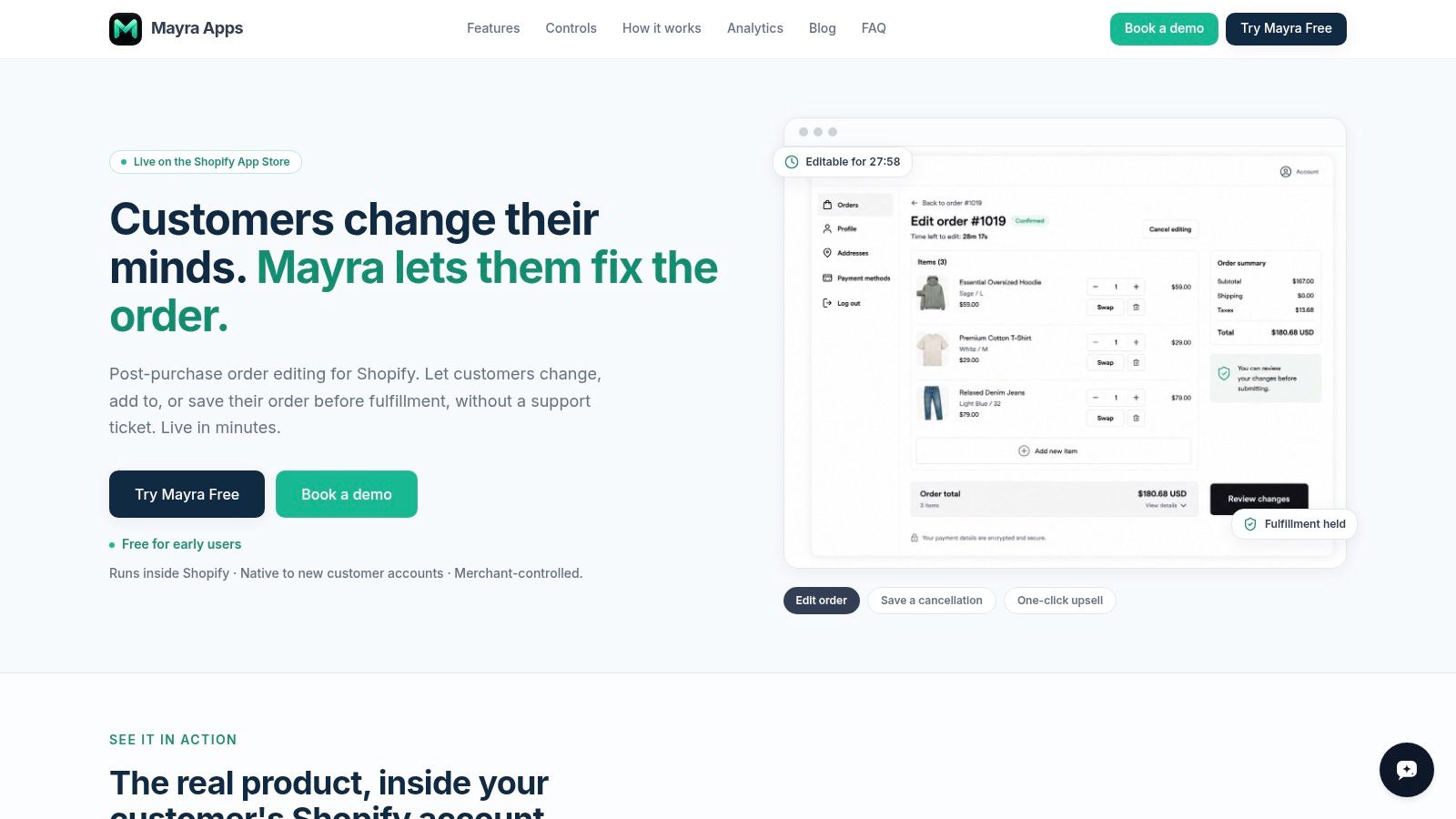
A customer-facing flow that prevents avoidable tickets
A clean self-serve experience should make the customer complete the following sequence:
- Open the order securely. Use the order status page or authenticated customer account, not an unrestricted public form.
- Choose the address action. Present the current shipping address and make clear that changing it may affect delivery timing, taxes, shipping availability, or the amount charged.
- Enter a complete destination. Require the recipient, street, apartment or suite where applicable, locality, postal code or equivalent, region, and country.
- Review the result. Show the normalized address and any change in delivery estimate or charges before submission.
- Confirm the request. The customer should explicitly approve the updated destination.
- Show the status. “Address accepted” is more useful than a generic “request received.” If the parcel has already entered a carrier workflow, show the carrier case or confirmation identifier when available.
The experience should distinguish a correction from a destination change. Fixing “Unit 4” to “Unit 14” is not the same risk as sending an order to another recipient in another country. A valid-looking address can still be unauthorized, inaccessible, or unsuitable for the intended recipient.
That's why the principles behind customer self service explained matter here. Self-service isn't merely removing a contact form. It gives the customer a controlled action while preserving authentication, eligibility checks, and an audit trail for the merchant.
Keep the order record authoritative
The edit should write back to the original Shopify order rather than creating an untracked side conversation. The customer receives a confirmation, while the merchant retains the order timeline and the operations team works from one current record.
Merchants can review the implementation details for updating a shipping address in Shopify. The important operational test is whether an edit can be completed before fulfillment, not whether the interface merely accepts new text.
One-click upsells can also appear during an eligible order edit, but they shouldn't distract from the primary safety action. The address confirmation must remain prominent, and an optional add-on must never release an order from its fulfillment hold before the destination review is complete.
For a customer who submits a request after carrier handoff, the interface should stop promising an order edit. It should direct the customer to the relevant carrier process and explain that acceptance, fees, and delivery timing depend on the shipment's latest scan and restrictions.
Merchant Configuration of Edit Permissions and Rules in Mayra Apps
A merchant should never expose unlimited address editing. The useful configuration question is not “Can customers edit orders?” It's “Which customers can change which fields, during which operational state, under what approval conditions?”
In Mayra Apps, start with the app's order-edit configuration and enable address editing only for the fulfillment states your operation can safely support. Keep the Shopify admin as the system of record, and make sure the app's permissions match the actual handoff between customer accounts, warehouse staff, and fulfillment integrations.
Define the window before defining the freedom
Set the edit window around your real dispatch process. If the warehouse begins picking quickly, the permitted period must close before pick-and-pack activity starts, not when the carrier scans the package. If your operation has a review queue, use that queue as the cutoff.
Then separate capabilities instead of granting a single all-or-nothing permission:
- Address changes: Allow corrections and destination changes only while the order remains eligible.
- Quantity edits: Permit changes only when inventory can be reserved again without disrupting allocation.
- Variant swaps: Restrict substitutions when the replacement has a different price, tax treatment, or fulfillment location.
- Line-item additions: Route new charges through the configured Shopify settlement process.
- Removals and cancellations: Require stronger controls when the change affects inventory, discounts, or refunds.
The customer should see only actions that the order can support. A hidden restriction discovered after submission creates more work than a clearly disabled control.
Use approval rules for risk, not convenience
Automatic approval suits low-risk corrections inside the same destination country, especially when the order is unfulfilled and the new address passes validation. Manual review is more appropriate when the customer changes country, recipient, destination region, or a high-value order, or when fraud signals change.
Set eligibility caps by order value where the operation requires them, and exclude products, collections, tags, or countries that should never be edited after checkout. Examples include goods with special handling, items committed to a restricted fulfillment location, and shipments whose customs or export documentation is already being prepared.
For the governance layer, merchants can use eligibility rules for post-purchase edits to define which orders enter the workflow. Document who can approve exceptions, what evidence support should request, and when the team should cancel and recreate instead of modifying the original order.
A short access-control checklist is useful here. The principles in implementing access control checklists apply directly: limit permissions, separate routine actions from approvals, review exceptions, and preserve an audit record.
Protect the original address record
Never overwrite the original address without retaining its history. The original value may matter for fraud review, payment disputes, customer authorization, or a carrier investigation. Store the requester identity, timestamp, fields changed, approval outcome, and resulting address.
The app should also place a fulfillment hold while the edit is active. A warehouse integration that receives the old address after the customer has submitted a new one is a synchronization failure, not a customer error.
Fulfillment Holds and Financial Implications of Address Changes
A shipping-address edit can change the economics of an order even when the product and quantity stay the same. The destination may alter tax treatment, shipping availability, carrier service, delivery estimates, warehouse assignment, and fraud risk. Treating the request as a harmless profile update is how merchants ship first and reconcile later.
The first control is a fulfillment hold. The moment a customer starts an eligible edit, pause label purchase, picking, packing, and release events connected to that order. Write the new address only after validation, then recalculate the affected order values and ask for confirmation before releasing the hold.
Settlement must follow the destination
A change to another region or country can affect the amount the customer owes or the amount the merchant must refund. If the new shipping service costs more, the system needs a legitimate way to collect the difference. If the new destination reduces the charge, the customer may be due a refund. Tax recalculation belongs in the same review because the destination is part of the transaction context.
A merchant should not absorb every difference or ask support staff to improvise a manual adjustment. Use a defined settlement path through Shopify, with approval thresholds for refunds and additional charges. The automated invoicing workflow should leave a clear record of what changed, why the amount changed, and whether the customer completed payment.
Correctness is not ownership
A syntactically valid address can still create delivery risk. It may belong to another person, omit a building access detail, point to a parcel locker the carrier doesn't support, or represent a move where the intended recipient no longer receives mail.
Deutsche Post's 2025 address study analyzed about 120 million addresses from 200 companies and found 13.1% were undeliverable. The study reported that 6.0% failed because of moves without a known new address or deaths, while online retail had 91.3% current and deliverable addresses. Deutsche Post publishes the address-study findings.
Those figures reinforce a practical distinction. Validation checks whether an address can be formatted and delivered. Ownership and authorization checks whether the customer has the right to redirect the parcel there.
Require the requester to authenticate through the order or customer account. Preserve the original address. Flag changes to a different recipient, country, province, or state for review where your business rules require it. Shopify notes that some countries don't use or require postal codes, and carrier labels still need to match the carrier's accepted formatting, so international edits need country-aware validation rather than a universal postal-code rule.
Special destinations deserve explicit handling:
- Military addresses: Use the required service-specific format and don't treat a conventional street address as an equivalent.
- Parcel lockers: Confirm that the carrier and service support the locker destination.
- Country changes: Recheck taxes, customs, product eligibility, and shipping service before acceptance.
- Partially fulfilled orders: Apply an address change only to the unfulfilled portion when the platform and fulfillment structure support it.
Best Practices for Streamlined Post-Purchase Address Management
The most reliable address-change program is designed before the first customer makes a mistake. It combines a clear edit window, authenticated self-service, fulfillment holds, destination validation, financial settlement, and a carrier fallback for shipments that have already left your control.
Start with the order lifecycle. Every request should receive a decision based on the latest operational state, not just the time the customer sent the message.
Use a state-based decision process
| Order state | Operational response | Customer message |
|---|---|---|
| Unfulfilled | Hold fulfillment, validate and edit the original order, then recalculate affected values | “We can review this before dispatch.” |
| Label created | Stop label use, confirm whether it can be voided, and generate a replacement if approved | “Your order is being checked before handoff.” |
| Carrier accepted | Check carrier reroute or intercept eligibility and surface fees or delivery-date risk | “The carrier now controls the next step.” |
| Out for delivery | Don't promise a destination replacement. Escalate to hold-for-pickup or another available carrier option | “Direct rerouting may no longer be available.” |
| Delivered | Investigate delivery evidence and pursue carrier or recipient resolution | “This is now a delivery investigation.” |
USPS Package Intercept illustrates why the scan state matters. Eligible domestic, trackable mail that hasn't been delivered or released for delivery may be held at a destination post office or returned to the sender. Redirection to a new delivery address is limited to commercial mailers using the USPS Business Customer Gateway, while retail senders or authorized agents need a USPS.com account and payment method for the intercept fee and applicable postage. Requests remain active for 7 business days. USPS explains Package Intercept eligibility and limits.
Give support a script and operations a control
Support agents need a short intake checklist, not a vague instruction to “ask the warehouse.” Capture the order number, authenticated requester, original address, proposed address, order status, tracking state, recipient change, and requested deadline. Then route the request according to the decision table.
Operations should monitor the handoff boundary. The warehouse, shipping software, Shopify, and any post-purchase app must agree on when an order becomes locked. If one system marks an order ready while another still allows editing, the merchant has created a race condition.
A submitted address change is not a successful address change. Success means the order record, fulfillment system, label, and customer confirmation all reflect the same accepted state.
Make the customer-facing promise precise
Tell customers what they can change, until when, and what happens if the parcel has already been handed to a carrier. Avoid promising that every correction will succeed. FedEx states that rerouting can be restricted when a shipment crosses countries, has been delivered, contains dangerous goods, or is subject to shipper restrictions. Fees may apply, and rerouting isn't always possible because the original air waybill may not be changeable.
Use explicit outcome labels:
- Address update accepted: The merchant has validated and saved the new destination.
- Review required: The request needs manual approval because it crosses a rule or risk threshold.
- Carrier request submitted: The carrier has received an intercept or reroute request.
- Carrier confirmation received: The request has a case or confirmation identifier.
- Delivery change unavailable: The order needs pickup, return, reshipment, or another resolution.

Finally, review every failed change as an operations signal. Repeated apartment omissions point to checkout validation or form design. Frequent destination changes after purchase may justify a longer controlled edit window, clearer confirmation messaging, or stronger account authentication. The goal isn't to make every request possible. It's to make the safe requests fast and the unsafe requests visible.
Mayra Apps provides Shopify merchants with customer-account and Order status page editing for eligible post-purchase changes, including shipping addresses, with merchant-controlled edit windows, permissions, approvals, eligibility rules, and fulfillment holds. Visit Mayra Apps to configure a controlled address-edit workflow that keeps the Shopify order record aligned with fulfillment and customer confirmation.