
A Shopify store usually doesn't lose sales in one dramatic place. It leaks them on product pages, in carts, at checkout, and again after the order is paid, when a customer wants to change an address, swap a variant, or add one more item. The smartest best shopify apps for sales don't try to fix every leak at once. They solve one buying-stage problem cleanly, then prove they're worth the added complexity.
That's the lens here. The ranking below is organized by where each app acts in the journey, starting on the product page and ending in the post-order change window. You'll see eligibility notes, Shopify Plus requirements where they matter, and the trade-offs that show up in live stores, like setup effort, theme friction, overlap with native Shopify features, and whether the app adds measurable profit or just more activity.
Table of Contents
- 1. Shopify Bundles
- 2. Frequently Bought Together
- 3. Rebuy Personalization Engine
- 4. Bold AI Upsell & Cross-Sell
- 5. Zipify OCU, OneClickUpsell
- 6. AfterSell Post Purchase Upsell
- 7. Mayra Apps
- 8. Yotpo Product Reviews and UGC
- 9. Klaviyo
- 10. Recharge Subscriptions
- Top 10 Shopify Sales Apps, Feature & Pricing Comparison
- Build Your Sales Stack One Bottleneck at a Time
1. Shopify Bundles
Shopify Bundles is the first tool I would use for fixed kits and multipacks on the product page. It is native, free, and managed in Shopify Admin, so there is no extra app layer to maintain when the offer is simple.
Where it fits
Use it for a starter kit, a multipack, or a fixed set of items that should always ship together. If you want to see how bundles affect average order value, read our guide to Shopify average order value.
For the product page optimization tactics that make a bundle convert, see this guide (product page optimization tactics).
Shopify's own app ecosystem history shows why merchants keep reaching for tools like this. Apps moved from a small directory to part of the core operating stack, and stores now build around the platform instead of replacing it (Shopify app ecosystem history).
Practical rule: if the bundle can be built as a fixed set of components with inventory tied to the underlying SKUs, start here before buying a more complex upsell app.
Keep the bundle boring if boring is profitable.
What works and what doesn't
The upside is straightforward, simple setup, real inventory awareness, and no subscription cost. It also gives teams a low-risk way to test bundle economics before they add another tool to the stack.
The limit shows up fast. If you need mix-and-match logic, variant-driven pricing, or more flexible offer structures, you will outgrow native bundles. That is why I treat Shopify Bundles as the baseline choice for product-page bundling, not the final word on bundle strategy.
2. Frequently Bought Together
Frequently Bought Together is a classic product-page upsell. It shows related items while the buyer is still deciding, which makes it useful for increasing basket size without forcing a new workflow.
Why merchants use it
The app supports both automatic pairing and manual curation, so you can let the recommendation engine do the obvious work and still override it for high-margin combinations. It also supports combined add-to-cart behavior, which keeps the buying flow tight when the customer accepts the offer.
Use it when: the hero product naturally pairs with accessories, replacements, consumables, or complementary add-ons.
Watch out for: discount-heavy promotions that create messy stacking rules. If you already run several promo types, the offer can become less clear, not more persuasive.
What I like and what I don't
The setup burden is low, which makes it easy to test the impact before you overcommit. That's the genuine appeal here, fast validation on product pages, not a massive personalization project. Its narrower scope is also a virtue. You're not buying a giant suite just to place a few persuasive recommendations.
The downside is equally straightforward, it's not a full personalization layer. Merchants who want product-page recommendations, cart logic, checkout offers, and post-purchase flows in one place usually move on to broader platforms. For many stores, though, this is enough to catch easy revenue near the first buying decision.
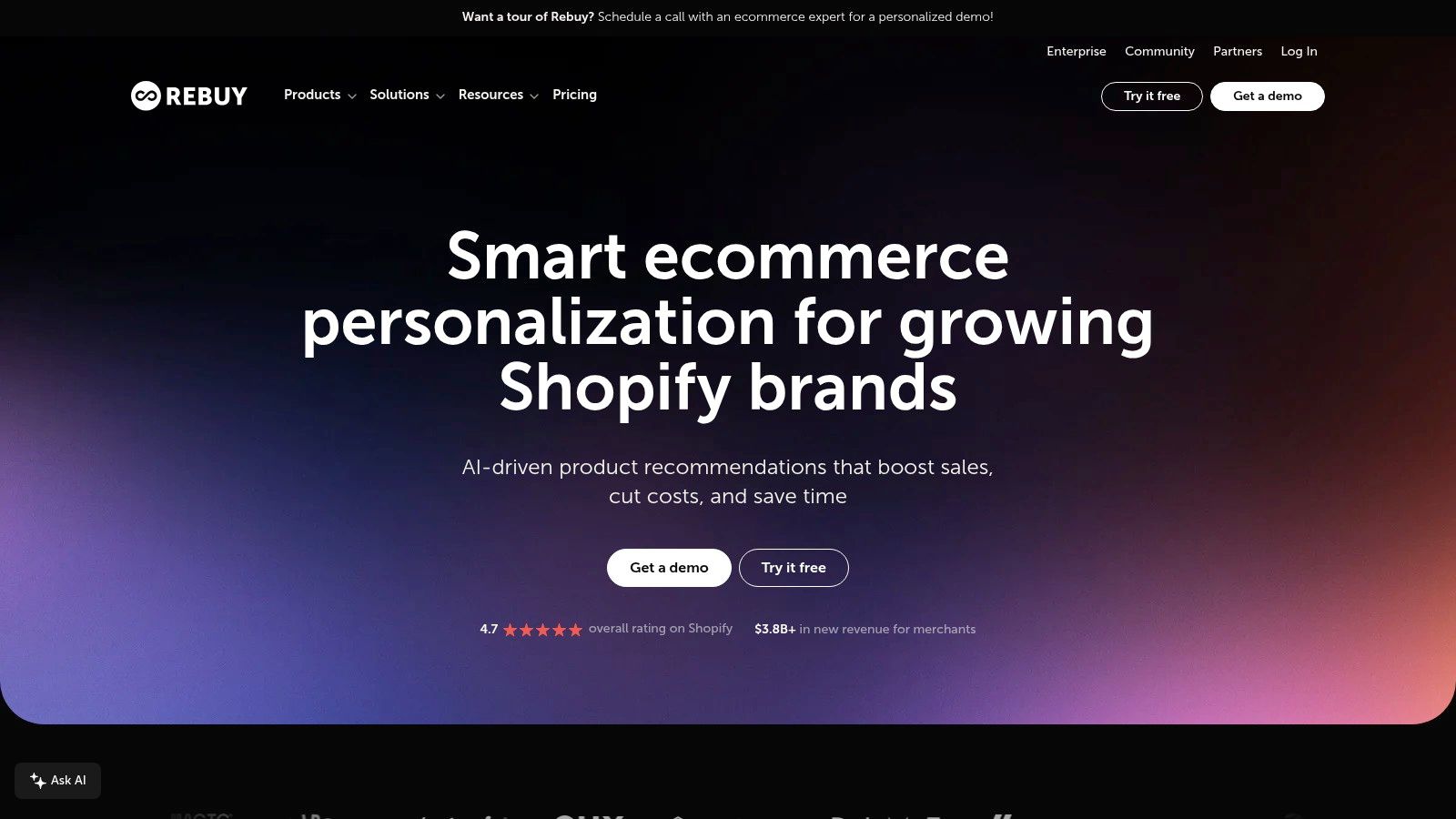
3. Rebuy Personalization Engine
Rebuy Personalization Engine sits higher on the sophistication scale. It's built for stores that want a single personalization layer across the product page, cart, search, checkout on Plus, and post-purchase.
Best fit for multi-surface upsells
This is the app I'd shortlist when the store already has enough traffic and catalog depth to justify broader orchestration. The appeal isn't one widget. It's the ability to coordinate recommendations across several surfaces so the customer sees a consistent logic instead of disconnected offers.
Rebuy's Smart Cart approach, along with integrations such as Klaviyo and Recharge, makes sense when merchandising, lifecycle marketing, and subscription logic need to work together. That's valuable for brands that don't want separate apps fighting over the same moment in the funnel.
Broad coverage can be a strength, but only if your team can maintain it.
Trade-offs to expect
The setup takes longer than a simple recommendation widget, and smaller catalogs can find it heavier than they need. Pricing also tends to scale with package and usage, so it's worth confirming what the current plan includes before assuming it's a one-time add-on.
For high-intent stores, the upside is flexibility. For smaller merchants, the question is whether you really need a personalization engine or just a simpler upsell at a single point in the journey. Rebuy is powerful, but it asks for operational discipline.
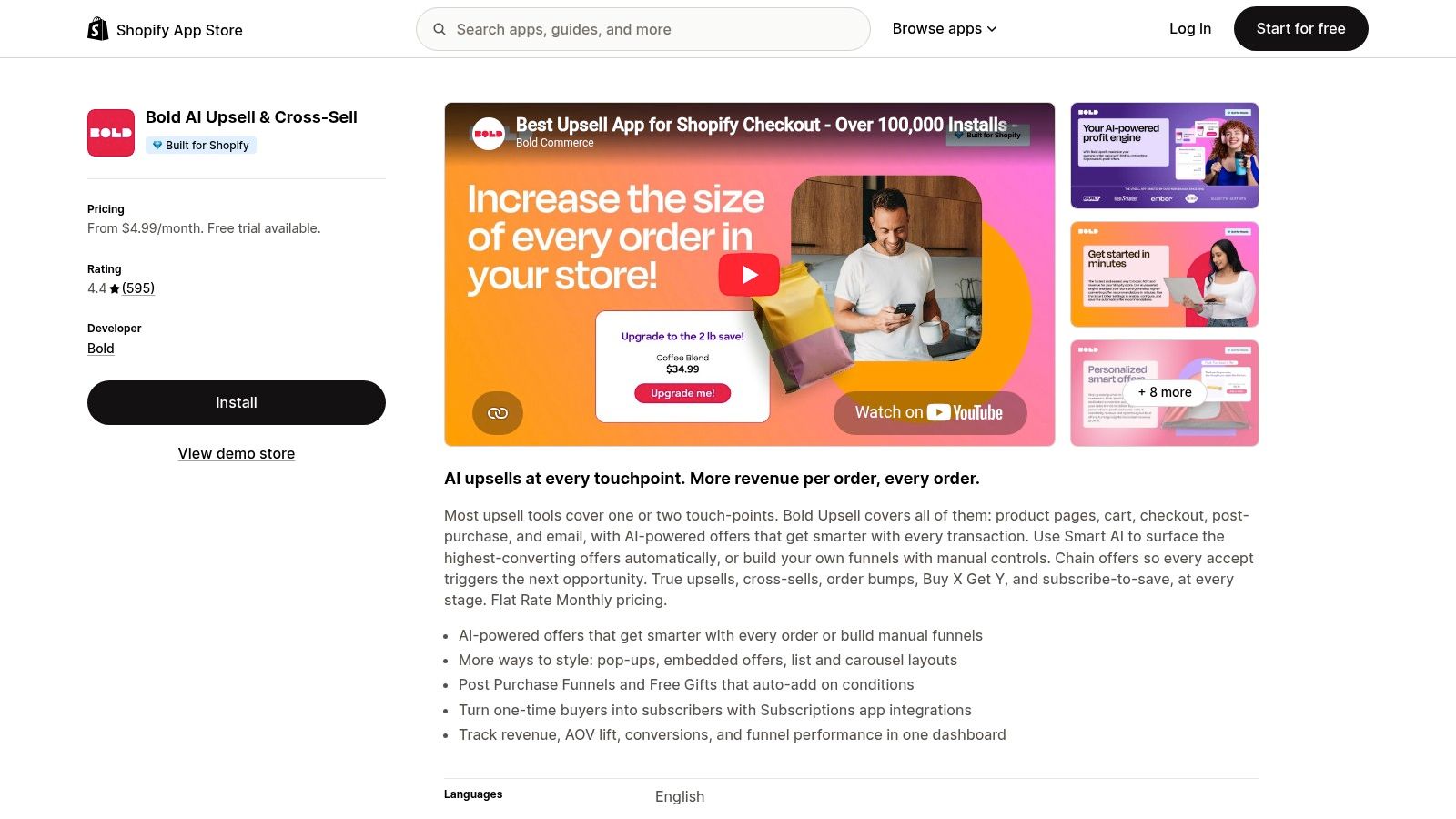
4. Bold AI Upsell & Cross-Sell
Bold AI Upsell & Cross-Sell is a mature option for merchants who want offers on the product page, in the cart, and after purchase, with checkout upsells reserved for Shopify Plus.
Where it stands out
Bold is useful when you want predictable, rules-based offer logic rather than a full personalization suite. The app has a long history in the Shopify ecosystem, and that usually means fewer surprises when you're trying to fit it into an existing stack.
It also sits well beside other Bold products, which matters if you want subscriptions, discounts, and upsells to share a common vendor family. That doesn't make implementation effortless, but it does simplify some of the operational decisions.
What to check before install
- Checkout eligibility: checkout upsells require Shopify Plus.
- Theme fit: some merchants report that implementation quality varies by theme.
- Pricing changes: the billing model can shift, so verify the current App Store listing before you assume the economics.
The main attraction here is control. The main risk is assuming a mature app will be a frictionless one. It's usually stable, but not always elegant, and the best results come when the offer logic is deliberately narrow.
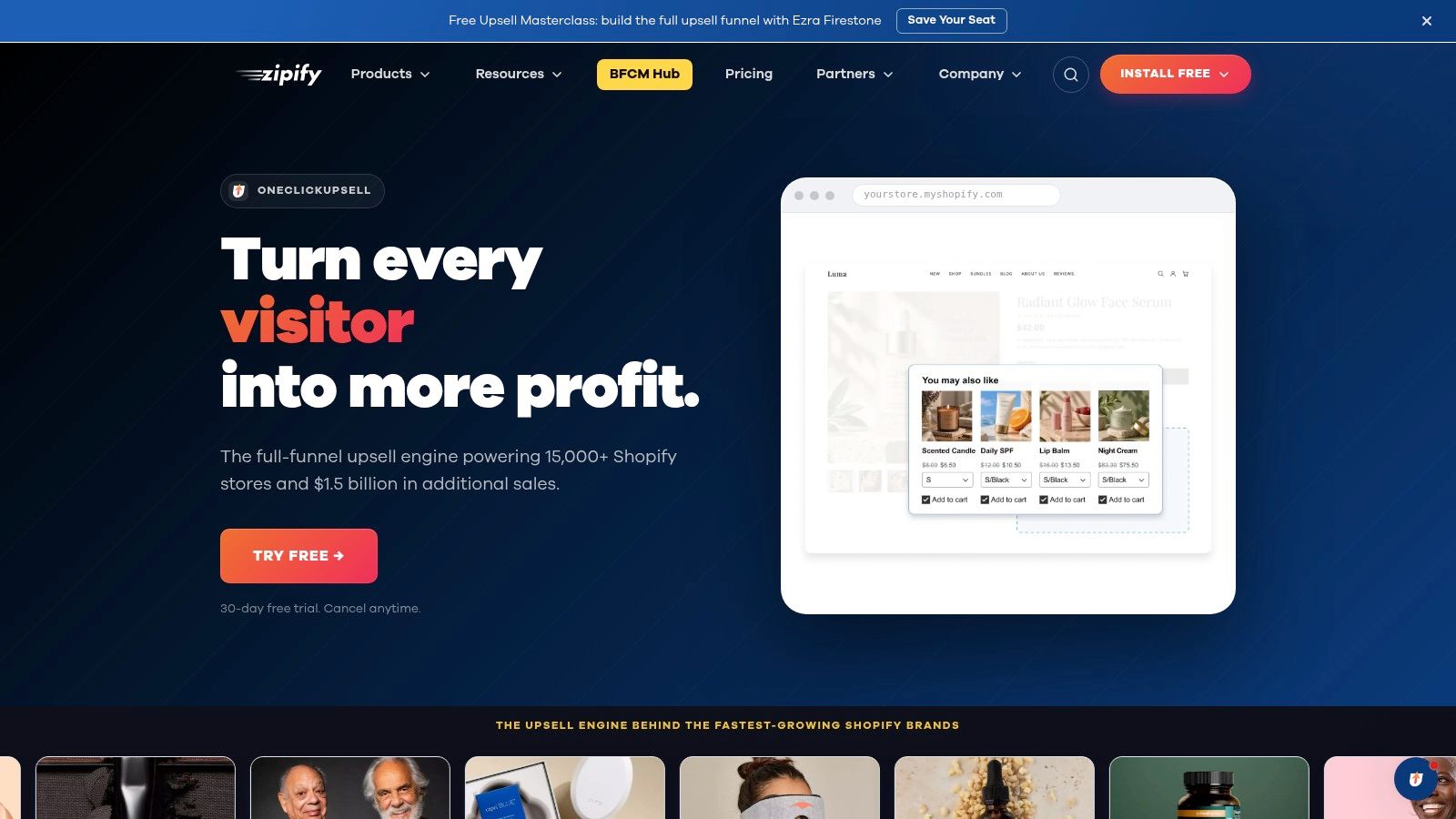
5. Zipify OCU, OneClickUpsell
Zipify OCU is built for one-click upsells across several points in the journey, with especially strong relevance after checkout. For merchants chasing post-purchase revenue, that's the point where the app earns its keep.
Why operators like it
Zipify combines funnel-level analytics, AI-assisted setup, and one-click acceptance, which reduces the gap between offer creation and live testing. It's a good fit when a team wants to move quickly from idea to validated upsell path without building everything manually.
Its optional managed service is also meaningful for brands that want help optimizing the funnel rather than just installing software and hoping for the best. For some teams, that support is the difference between launching a decent offer and launching one that gets tuned.
The caveats
Checkout upsells require Shopify Plus, so non-Plus stores should think of it as a pre-purchase, cart, and post-purchase tool first. The other issue is billing. Usage-based pricing can feel efficient early on, then become material if the app performs well.
If you want a deeper breakdown of how this kind of post-purchase tool works in practice, see this Zipify OCU implementation guide. For stores that need the most power after payment, Zipify remains one of the more serious options.
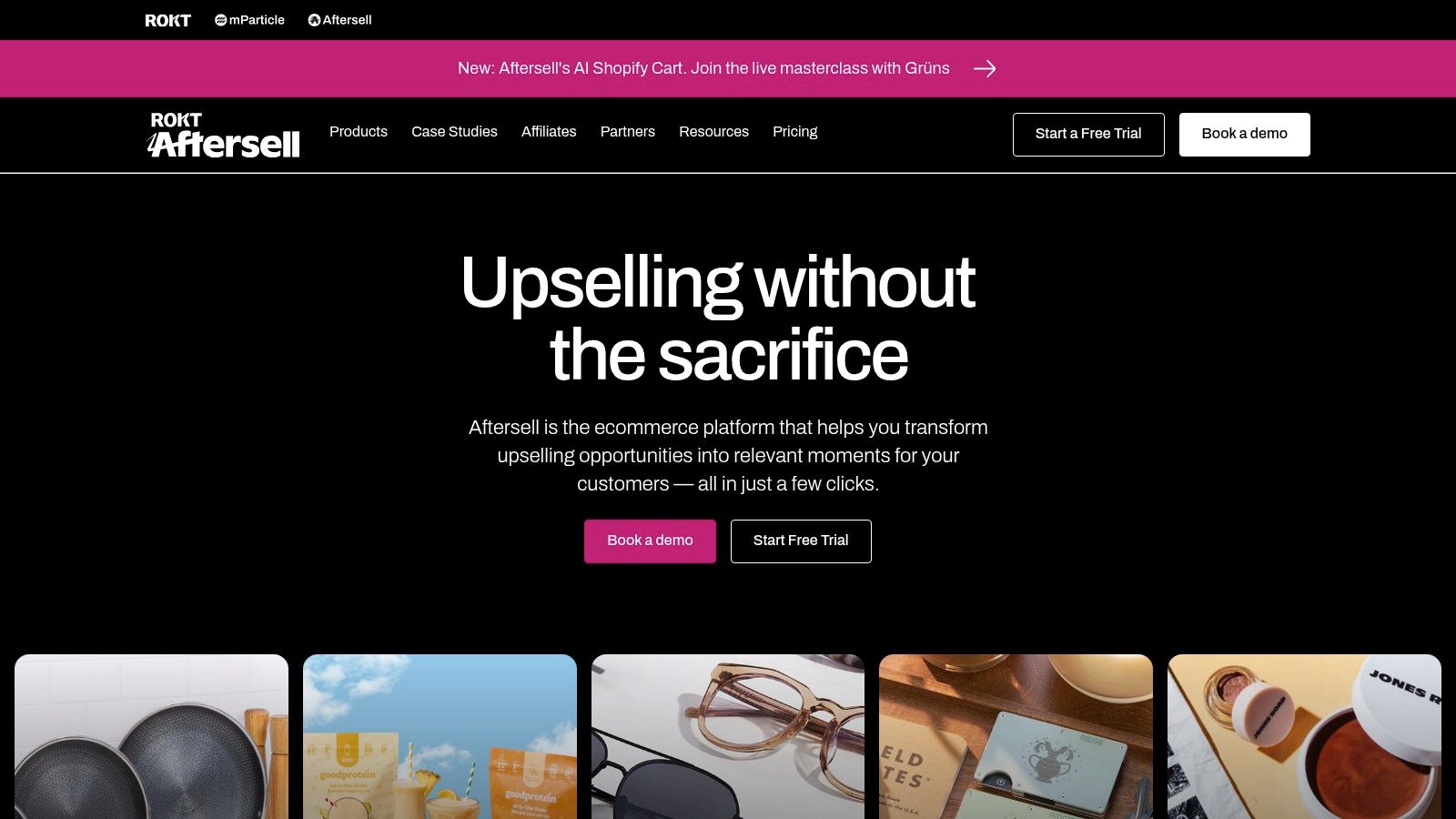
6. AfterSell Post Purchase Upsell
AfterSell is a practical post-purchase app for merchants who want to test one-click offers quickly, then expand into cart and thank-you page monetization if the numbers hold up.
Why it gets shortlisted
The post-purchase flow is its strongest lane. Customers have already committed, so the app can present a relevant next step without reopening the entire checkout process. The app's structure makes it easy to test quickly, which matters when you're trying to understand whether post-purchase revenue is real or just attribution noise.
It also pairs pre-checkout and thank-you monetization through related modules. That broader structure is useful, but it can also create more configuration work than merchants expect.
What to watch
Checkout offers are limited to Shopify Plus merchants. If you're not on Plus, the core post-purchase flow is still relevant, but don't buy the app expecting every surface to be open to you. Multiple modules can also make the setup feel more like managing a system than turning on a single widget.
For teams that want a direct look at post-purchase upsell mechanics, this AfterSell guide is a useful companion. The app is strongest when you want fast experimentation at the end of checkout, not a sprawling merchandising platform.
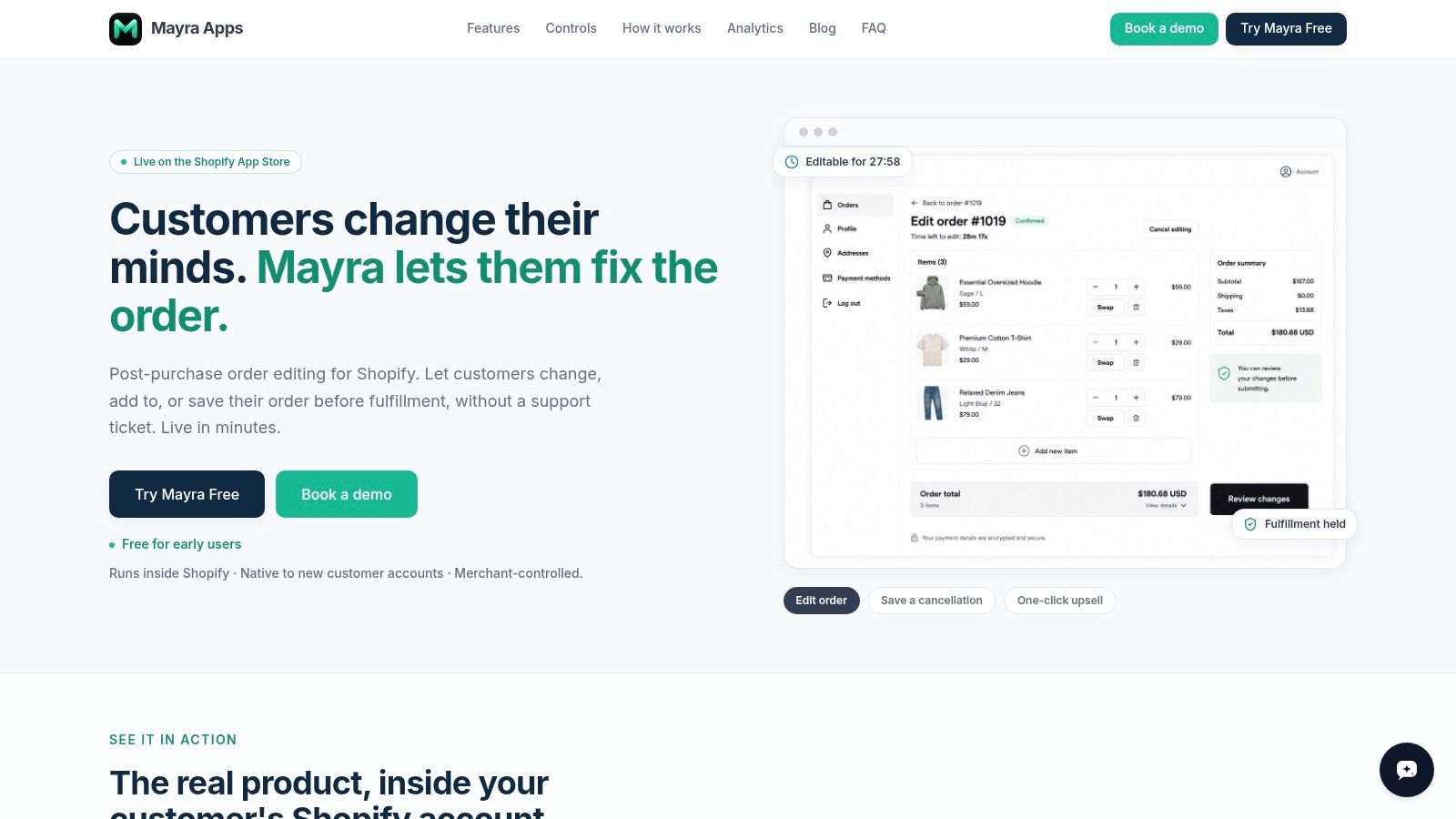
7. Mayra Apps
Mayra Apps is the clearest fit for the post-order change window. It does not treat edits as a side feature. It brings order changes, cancellation deflection, and one-click upsells into customer accounts and the Order Status page, then writes those changes back to the original Shopify order.
Why this is different
Most sales apps try to create a new purchase moment. Mayra works inside the order after payment. Customers can fix what they just bought, update shipping details, remove items, add items, and accept relevant upsells without opening a support ticket or starting a second checkout.
That changes the economics of post-purchase work. It can recover revenue, but it can also cut tickets, reduce fulfillment mistakes, and avoid unnecessary refunds. Shopify has also said that many merchants still do not track profit margin or conversion rigorously, which is why this kind of app should be judged on incremental value, not vanity revenue alone (Shopify measurement guidance).
What stands out in practice
- Native workflow: edits write back to the original order.
- Operational safety: fulfillment is paused during edits.
- Merchant control: edit windows, permissions, approvals, and exclusions are configurable.
- Upsell logic: offers appear during edits and on the order status page, and accepted items are added to the same order.
- Reporting: store-specific analytics focus on orders edited, revenue recovered, orders saved, and modeled tickets avoided.
Installation is relatively light because the app is built around Shopify's customer accounts and Order Status page, not theme rewrites. The early-access status still suggests some product maturity is evolving, so teams should expect a little setup discipline. For stores that lose money after the order is placed, this app works inside the change window rather than trying to create a new purchase moment.
8. Yotpo Product Reviews and UGC
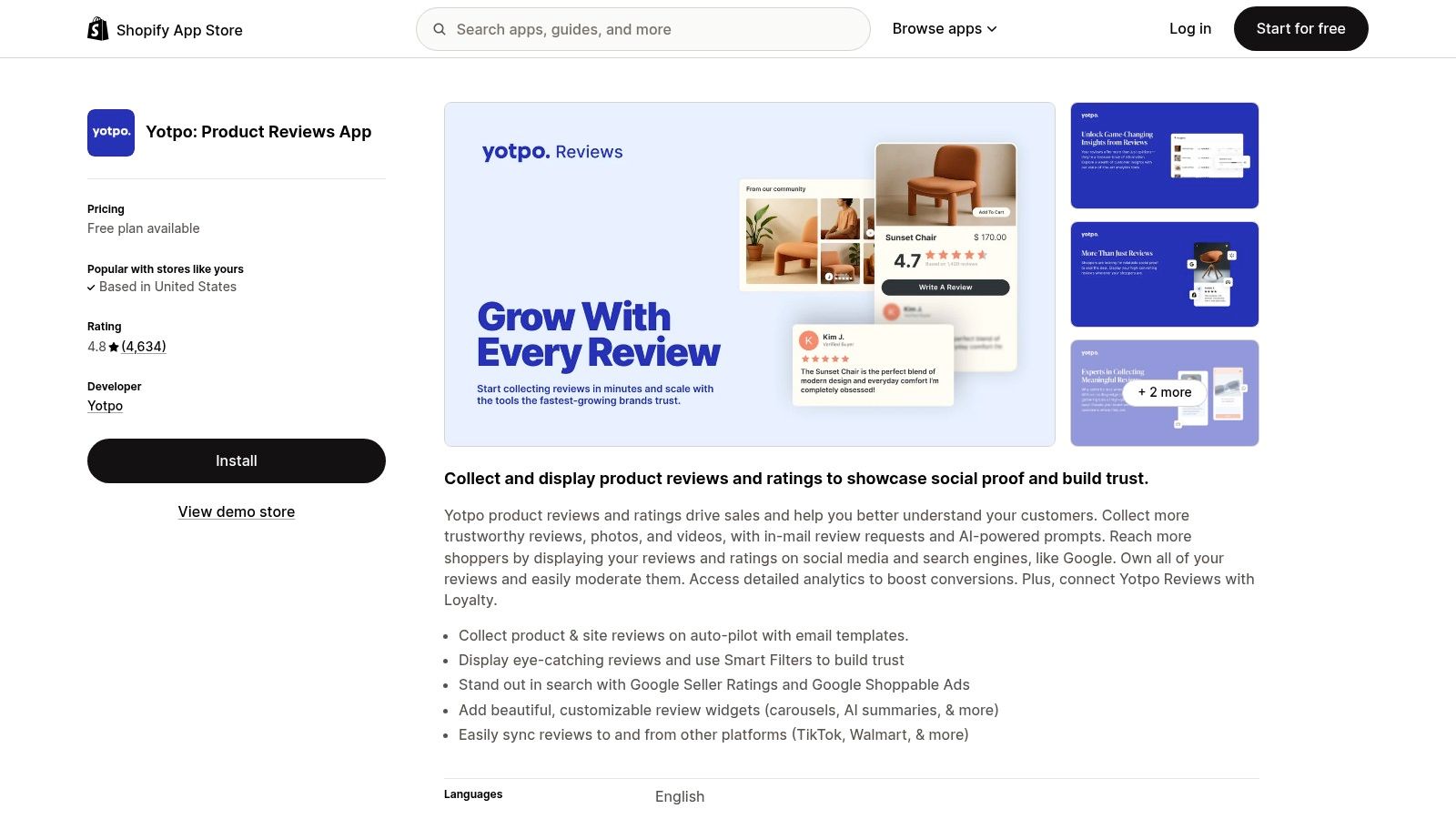
Yotpo Product Reviews & UGC lives earlier in the funnel, but it still belongs in a sales stack because trust closes product-page hesitation. Buyers who need reassurance often need less persuasion than proof.
Where it helps sales
The app collects reviews, photos, videos, and Q&A content, then displays that proof where shoppers are still deciding. For larger merchants, the syndication and ecosystem options are a real advantage because review content can do more than sit on a product page.
It's strongest for brands that already have traffic and need to convert more of it. If your product pages are thin on social proof, you're leaving easy revenue on the table.
Trade-offs
Yotpo tends to make the most sense at scale, which means pricing can feel premium compared with simpler review tools. Higher-tier features and syndication also sit behind paid plans, so it's not the cheapest trust layer you can buy.
If you want a system that does more than collect stars, it's a credible option. If you mainly need basic review capture, it may be more than you need right now.
9. Klaviyo
Klaviyo is the sales app that doesn't sit on one page. It works across email, SMS, and WhatsApp, which makes it a post-visit revenue engine rather than a single conversion widget.
Why it belongs in a sales stack
Klaviyo's value comes from lifecycle automation. Abandoned cart, browse abandonment, post-purchase, and win-back flows all help recover revenue that would otherwise disappear after the session ends. It's one of the few apps here that can influence every later stage without changing the storefront itself.
Because Shopify reported that active app installs across its ecosystem increased by nearly 20% over the prior year and the App Store had more than 21,000 apps in its 2026 account, it's clear that merchants are leaning harder on specialized tools rather than trying to force every function into Shopify alone (Shopify ecosystem scale update).
What to expect operationally
The upside is maturity. The templates are strong, the integrations are broad, and the path to launch is well understood. The downside is cost control. Profile count and SMS usage can drive spend up, so segmentation discipline matters more here than in most apps.
For a deeper comparison of automation tooling, this marketing platform guide is a useful adjacent read. Klaviyo is often the right answer when the store needs repeat revenue, not just a single checkout lift.
10. Recharge Subscriptions
Recharge Subscriptions is the repeat-revenue tool on the list. It's not an upsell app in the usual sense, but for subscription stores it's one of the most important sales systems you can run.
Where it fits in the journey
Recharge turns a one-time purchase into a recurring relationship through subscription plans, a customer portal, and retention tools. That makes it essential for brands built on replenishment, memberships, or any recurring purchase model.
It also plays well with upsell engines. Rebuy's subscription-switching flows are a good example of how a storefront can pair acquisition, upsell, and retention logic without making each app do every job.
Caveats worth checking
Recharge is battle-tested, but subscription infrastructure always comes with processing and transaction considerations, so the total cost is broader than the sticker price. Also, the pricing rules for net-new installs changed on February 9, 2026, so current terms need a fresh look before you decide.
For teams that live on repeat orders, it's a foundational platform rather than an accessory. For everyone else, it may be overkill.
Top 10 Shopify Sales Apps, Feature & Pricing Comparison
| Product | Core features | Unique selling points | UX / Quality | Target audience | Pricing / Value |
|---|---|---|---|---|---|
| Shopify Bundles (first-party, free) | Create/edit bundles in Shopify Admin; real-time inventory | ✨ Native, no app install; simple kit & multipack support | ★★★★ | 👥 Merchants needing basic bundles | 💰 Free (native) |
| Frequently Bought Together (Code Black Belt) | Auto/manual product pairing; combined add-to-cart | ✨ Amazon‑style recommendations; quick AOV test | ★★★★ | 👥 Stores testing product recommendations | 💰 Tiered, test‑friendly |
| Rebuy Personalization Engine | AI recommendations across PDP, cart, checkout, post-purchase | ✨ AI-driven personalization; deep integrations (Klaviyo, Recharge) | ★★★★★ | 👥 Mid‑market to enterprise focused on personalization | 💰 Package/usage pricing (scales) |
| Bold AI Upsell & Cross‑Sell | In‑cart, PDP, post‑purchase upsells; A/B testing & rules | ✨ Mature ecosystem; clear plan pricing tied to Shopify plan | ★★★★ | 👥 Merchants wanting predictable plan-based upsells | 💰 Plan‑based (by Shopify plan) |
| Zipify OCU, OneClickUpsell | One‑click post‑purchase & checkout funnels; analytics | ✨ AI funnel setup + optional managed optimization | ★★★★ | 👥 Brands prioritizing post‑purchase revenue lift | 💰 Usage/upsell revenue pricing; 30‑day trial |
| AfterSell Post Purchase Upsell (Rokt AfterSell) | Native one‑click post‑purchase offers; Upcart & Thanks modules | ✨ Quick post‑purchase tests + thank‑you monetization via Rokt | ★★★★ | 👥 Merchants testing post‑purchase monetization | 💰 Entry‑level plans; modular pricing |
| 🏆 Mayra Apps (Mayra Order Edit & Upsell) | Self‑serve order edits, cancel‑deflection, one‑click upsells; writes back to original order; fulfillment holds | ✨ Native Shopify customer‑account & Order Status integration; fine‑grained merchant rules; edits pause fulfillment | ★★★★★ 🏆 | 👥 Merchants who need post‑purchase control & reduce support load | 💰 Early access free; pricing TBD |
| Yotpo: Product Reviews & UGC | Reviews, photos/videos, Q&A, Google syndication | ✨ Enterprise‑grade UGC + syndication options | ★★★★ | 👥 Mid‑market & enterprise seeking social proof | 💰 Scales with volume (premium tiers) |
| Klaviyo (Email, SMS, WhatsApp) | Lifecycle automations, segmentation, near‑real‑time Shopify sync | ✨ Robust flows & multi‑channel lifecycle marketing | ★★★★★ | 👥 Stores focused on retention & LTV | 💰 Scales by contacts & SMS usage |
| Recharge Subscriptions | Subscription billing, customer portal, retention tools | ✨ Battle‑tested subscription backbone with Checkout integration | ★★★★ | 👥 DTC subscription businesses | 💰 Transaction/processing fees; plan terms apply |
Build Your Sales Stack One Bottleneck at a Time
The best stacks usually start small. A merchant maps where revenue is leaking today, then matches each leak to the least complicated app that can fix it, product page, cart, checkout, post-purchase, or the order change window. That's the clean way to evaluate the best shopify apps for sales without turning the store into a patchwork of overlapping widgets.
The practical filter is simple. Check whether the app needs Shopify Plus, confirm the current pricing in the App Store or vendor listing, and decide whether the tool solves a revenue problem or just adds another dashboard. If the store already has good product-page conversion but loses money after purchase, a post-order tool is more useful than another bundle app. If carts are weak, a cart or checkout offer may matter more than email.
Merchant maturity matters too. StoreCensus' directional market data shows that many Shopify stores use only a few apps, while a smaller slice runs very large stacks, which is a reminder that more tools aren't automatically better (StoreCensus stats). Shopify's own ecosystem history also points to the same conclusion, the merchants who got the most out of apps were the ones who used them to solve specific, measurable problems rather than chase feature lists (Shopify app ecosystem history).
Start with one leak, not ten apps. Launch one workflow at a time, measure it against your own baseline, and keep the apps that improve gross profit, not just attributed revenue. That's how a sales stack stays useful instead of becoming expensive noise.
Mayra Apps helps stores recover revenue after the order is placed with self-serve edits, cancellation deflection, and one-click upsells inside customer accounts and the Order Status page. If your biggest leak is post-purchase friction, visit Mayra Apps and see whether it fits the way your store sells.