
Store credit is a monetary balance a merchant issues to a customer that can only be spent at that merchant, rather than returned as cash. In the broader U.S. retail-credit ecosystem, retail credit outstanding reached $130 billion at the end of 2023, and nearly 85 million people had a retail credit account, according to Federal Reserve analysis summarized by Rivo.
You may be looking at it right now because a customer wants to cancel an order, return a product, or resolve a service problem. The checkout team says, “We can refund you,” while the retention team asks whether a useful credit offer could keep the next purchase with the brand. Both teams are talking about value, but they're not talking about the same mechanism.
Store credit is a merchant-issued balance for future purchases. It usually follows a service event, such as a return, damaged item, order adjustment, subscription cancellation, or goodwill gesture. A cash refund reverses a completed payment. A gift card is typically purchased or given before the recipient decides what to buy. That distinction matters to customers and to the Shopify operators building the workflow.
Table of Contents
- A Cancellation Moment That Shows What Store Credit Really Does
- Store Credit Compared to Refunds and Gift Cards
- Why Store Credit Is a Mainstream Retail Mechanism
- How Cancellation Deflection With Store Credit Works in Practice
- Accounting, Tax, and Legal Rules You Need to Know
- Setting Up Store Credit on Shopify With Mayra Order Edit
- Customer Experience Trade-offs and When Store Credit Wins
A Cancellation Moment That Shows What Store Credit Really Does
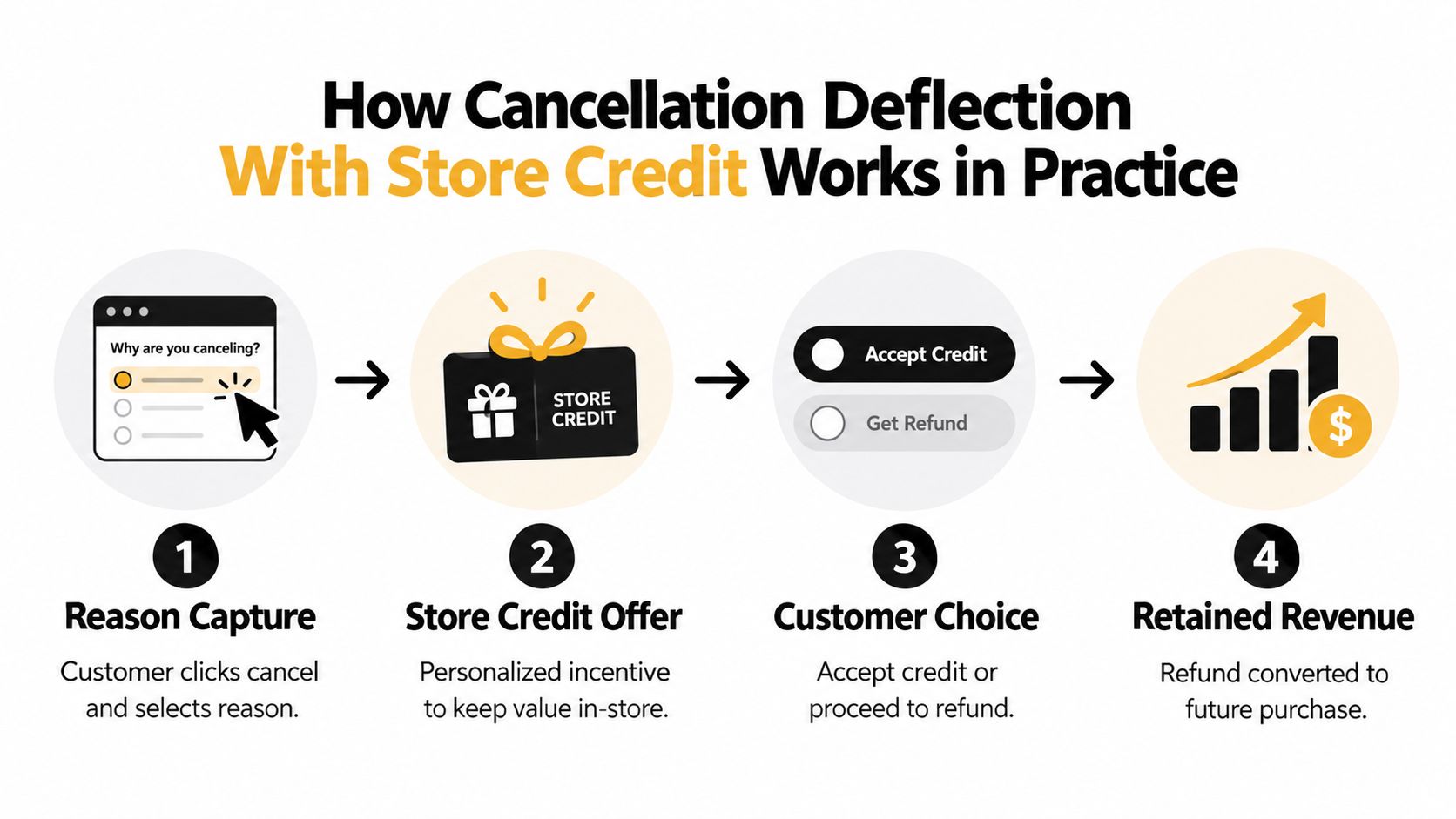
A shopper opens their account on a Shopify store and clicks “cancel order” on a subscription box. The cancellation flow loads a short reason selector: too expensive, product no longer needed, wrong frequency, or another reason. After the shopper chooses “too expensive,” the next screen offers 20% store credit valid for 90 days.
That offer isn't cash. The merchant isn't sending money back to the customer's bank or card. The merchant is adding a balance to the customer's account, and the customer can use that balance only for a later purchase at the same store, subject to the stated terms.
What the customer is choosing
The customer now has a real decision:
- Accept the credit, keep the value in the store, and continue with the relevant order or subscription arrangement.
- Decline the offer, complete the cancellation, and receive the refund or other remedy that applies under the merchant's policy and local law.
The difference between those options should be visible. A customer shouldn't have to guess whether the credit expires, whether it can be combined with another discount, or whether the merchant will convert it back to the original payment method.
Customer rule: Store credit is attractive when it feels like a useful choice, not a disguised refusal to refund.
For a Shopify operator, the same screen is an operational control point. The reason selector captures why the customer wants to leave. The offer tests whether a targeted incentive can solve that reason. Acceptance pauses or changes the cancellation path, while a decline sends the customer through the standard fallback.
The finance team also needs to track the balance correctly. Until the customer redeems the credit, the merchant has an obligation tied to a future purchase. That means the flow affects customer experience, cancellation reporting, fulfillment, and accounting at the same time.
Store Credit Compared to Refunds and Gift Cards
A customer cancels an order after payment. The merchant can return the money through the original payment route, or offer value that stays available for a later purchase. That second option is store credit. It usually follows a return, cancellation, damaged item, order adjustment, support interaction, or goodwill decision. A gift card starts differently: someone voluntarily buys or gives prepaid spending power before the next purchase.
| Dimension | Store Credit | Cash Refund | Gift Card |
|---|---|---|---|
| Typical trigger | A return, cancellation, damaged item, order adjustment, or goodwill decision | A qualifying return, cancellation, overcharge, or other refund event | A customer or purchaser voluntarily buys or gives prepaid value |
| Where it can be spent | Usually only with the issuing merchant | The refunded funds return to the customer's original payment method | With the merchant or brand named on the card, subject to its terms |
| Expiry | May have an expiry date if the terms allow it | Usually isn't a spendable balance with the merchant | Terms vary by product and jurisdiction |
| Refundability | Usually isn't automatically convertible to cash | It is the cash-equivalent remedy itself | Usually follows the gift-card terms rather than refunding to the purchaser's card |
| Transferability | Often tied to the customer account that received it | Not normally transferred as merchant credit | May be designed to be given to another person |
| Breakage | Unused balances may require specific accounting treatment | There's no outstanding store balance after payment is returned | Unredeemed value may also create accounting and legal obligations |
| Tax handling | Depends on whether it reverses a prior transaction or acts as a promotion | Usually follows the reversal of the original sale | Tax treatment generally depends on redemption and the underlying goods |
| Shopify object | A customer balance or store-credit transaction | A refund connected to the original order | A gift-card product or gift-card balance |
The practical distinction is the direction of value. A refund sends funds out of the merchant's system and back to the original payment method. Store credit records a balance against the customer account, which can be spent only according to the stated terms. A gift card records prepaid value that may be purchased for the customer or another person.
For a Shopify operator, these are different administrative actions. The order record, payment transaction, customer balance, and reporting trail should match the outcome shown to the customer. A cancellation flow might present credit as a save-offer, but acceptance should change the cancellation path only after the customer understands the amount, expiry, eligible products, and any restrictions. A decline should leave the standard refund or cancellation route available.
A useful comparison of the operational differences appears in store credit versus refund in Shopify. It helps separate a balance adjustment from a refund connected to the original order, which prevents customer-service and reconciliation errors.
Store credit also carries a legal boundary. The ACCC's consumer warranty and refund guidance explains that a seller generally cannot insist on store credit when a consumer is entitled to a refund. Similar EU-style cooling-off rules can require money returned through the permitted method in relevant cases. A merchant may offer credit for voluntary returns or as a cancellation incentive, but the offer cannot remove a refund right created by local law. Retailers should check the rules that apply to the customer and transaction before making credit the only option.
Why Store Credit Is a Mainstream Retail Mechanism
Store credit belongs to a broader retail-credit system rather than sitting outside normal commerce. The Federal Reserve analysis cited earlier estimated $130 billion in retail credit outstanding at the end of 2023, representing more than 2.5% of total outstanding consumer credit. Nearly 85 million people held a retail credit account, while the median outstanding balance was $194 per account and the median monthly payment was $29. Those figures show a familiar pattern: retail credit reaches a wide customer base, even when each individual balance is fairly modest.
Store-card activity points in the same direction. The Consumer Financial Protection Bureau reported that one out of every four credit card accounts was a store card in 2024, with more than 160 million open store-card accounts. It also reported a decline in private-label accounts from 253 million in 2018 to 161 million in 2024. The share of consumers who said they had a store card fell from more than 60% in 2015 to 38% in 2024. The retail credit and gift-card overview from CaiGeek sets out these figures and their retail context.
What that scale means for Shopify merchants
For a Shopify merchant, a store-credit balance keeps purchasing value inside the business after a customer decides not to continue with an order or subscription. It works like a bridge to a later purchase, rather than an immediate cash payment leaving the business. That bridge can support retention, but it does not guarantee another order or make credit automatically better than a refund. The customer must want a future purchase, understand the terms, and be able to redeem the balance without friction.
The operational side is less visible to shoppers. Issued credit must be tracked until redemption, expiry, or another permitted resolution. Store credit is therefore both a retention instrument and a liability-management task. Merchants need written issuance rules, accurate account transactions, and reports that distinguish credit issued from credit redeemed. A save-offer may protect revenue, but only when the offer is recorded correctly and the customer can use it as promised.
How Cancellation Deflection With Store Credit Works in Practice
A useful cancellation flow doesn't hide the exit. It identifies the reason, presents a relevant alternative, and leaves the customer free to continue with the original cancellation.
A subscription customer clicks cancel and selects “the delivery schedule doesn't work.” The flow might offer a frequency change instead of credit, because the stated problem is cadence. If the customer selects price, the merchant may present a store-credit offer. If the customer selects a product issue, the right response may be support, replacement, or refund rather than an incentive.
A practical decision path
- Capture the reason. Ask one clear question and keep the choices understandable. “Too expensive,” “wrong product,” “too much inventory,” and “not using it” lead to different interventions.
- Choose the offer. A merchant can set different offers for different customer groups, but the rule should be documented and margin-tested. One segment might see a percentage-based credit, another a fixed amount, while a high-value customer might receive a shipping-related concession.
- Show the terms. Put the value, expiry, eligible products, and redemption method beside the acceptance button. Don't force the customer to open a separate policy page to discover a material restriction.
- Record acceptance. If the customer accepts, create the credit transaction, pause or modify the cancellation, and show the updated account state. The customer should receive confirmation by email or inside the account.
- Keep the fallback intact. If the customer declines, the original cancellation or refund path should proceed without a support maze.
The offer itself should solve a stated problem. A customer who can't justify the price may appreciate credit if they already plan to shop with the brand. A customer who received the wrong item may see the same offer as an attempt to avoid responsibility.
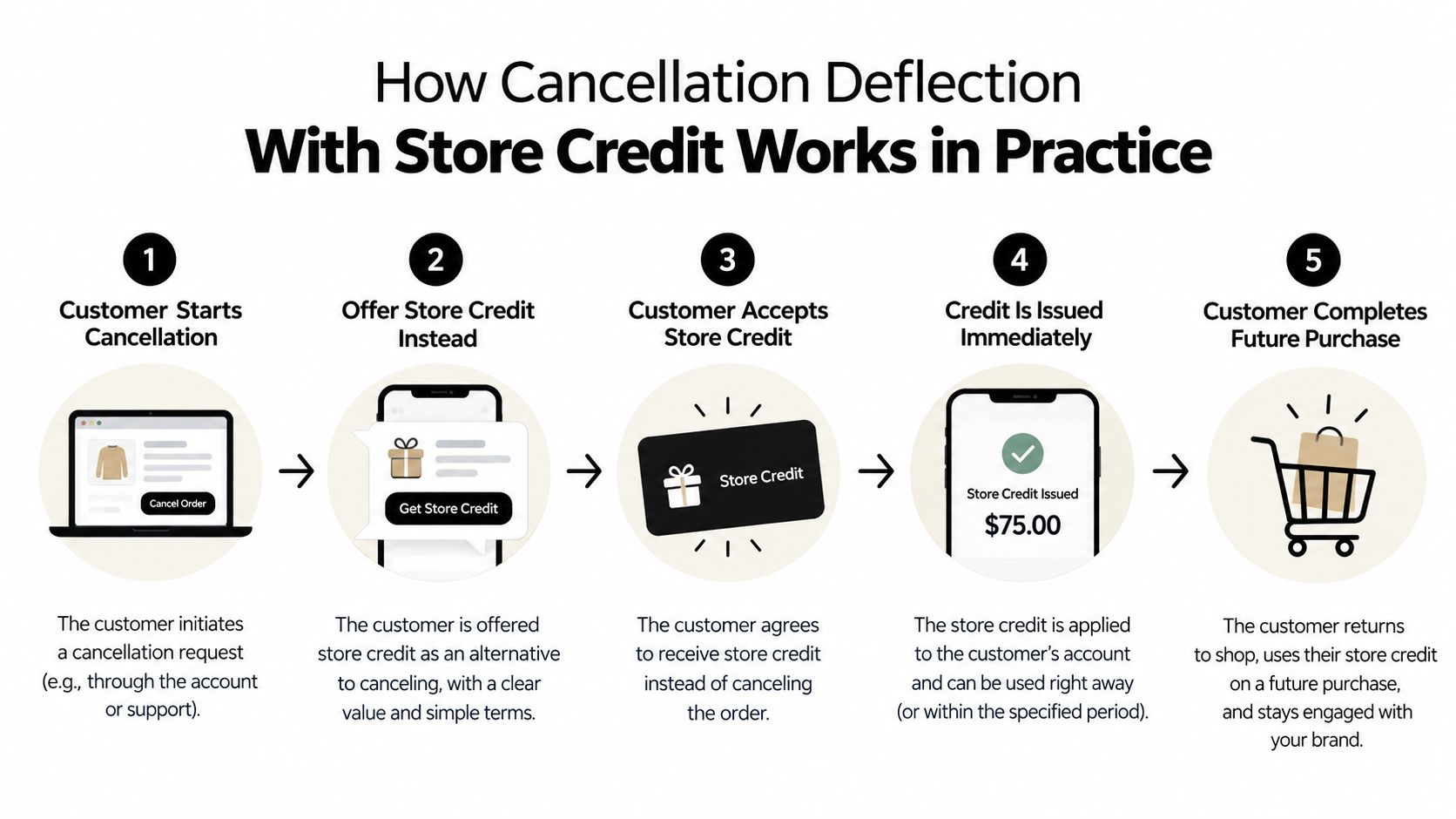
The merchant should measure the flow as a sequence, not as a single “saved” number. Track cancellation attempts, reason selections, offers shown, offers accepted, cancellations completed, credit redeemed, and the revenue associated with later orders. This guide to cancellation deflection with store credit is useful when designing that measurement model.
A full-cancel fallback protects trust. The customer can say no without being punished, delayed, or sent into a separate support queue. That balance is what turns store credit from a coercive substitute into an optional retention offer.
Accounting, Tax, and Legal Rules You Need to Know
A customer accepts store credit after a cancellation, then uses it weeks later. On the books, those two events are separate. Issued store credit is not the same as recognized sales revenue. Until the customer redeems the balance, or it is otherwise resolved under applicable accounting rules, the merchant generally records an obligation.
Track the obligation before the sale
Each credit entry should show why it was created. Record whether it followed a return, supported a promotion, or came from a cancellation save-offer. That reason helps the team reconcile orders, apply tax treatment, answer customer questions, and report balances correctly.
Unused balances, often called breakage, need their own review. Treatment depends on the credit terms, expected redemption, accounting standards, and jurisdiction. An expired balance cannot automatically be moved into income. The merchant should follow its documented accounting policy and confirm the approach with its accountant. For practical marketplace reconciliation tips, match store-credit entries with Shopify orders, refunds, and settlement records.
Tax treatment follows the event that created the credit. Credit issued to reverse a returned taxable order may follow the original transaction's reversal. Promotional credit added on top of a purchase may operate as a discount when redeemed. The merchant's tax adviser or accountant should confirm the treatment for its products, destinations, and tax registrations.
Consumer rights override a preferred policy
A merchant may offer store credit for a voluntary return when the policy states that option clearly and local rules allow it. The position changes when the customer has a legally protected refund right. As noted earlier, Australian sellers generally cannot insist on store credit when a refund is owed. The supplied consumer-rights guidance also identifies EU cooling-off situations where a cash refund is required.
| Region or standard | Accounting treatment | Consumer-rights rule |
|---|---|---|
| General merchant accounting | Keep issued balances separate from completed revenue until redemption or another permitted resolution | Apply local refund, warranty, and disclosure rules |
| Australia | Reconcile the customer balance and its eventual redemption or expiry under the merchant's accounting policy | Store credit generally cannot replace a refund owed to the consumer |
| EU cooling-off context | Track the balance separately if credit is offered voluntarily | Store credit cannot replace a required refund during the applicable cooling-off period |
| Promotional credit | Classify and report it according to the promotion and redemption structure | Disclose restrictions clearly and do not use it to defeat a mandatory remedy |
Build the legal decision before displaying the offer. The flow should identify whether the customer wants a discretionary retention option or is exercising a refund right. That check keeps a save-offer from replacing a remedy the merchant must provide, and gives support staff a clear rule to follow.
Setting Up Store Credit on Shopify With Mayra Order Edit
Start with policy, not software. Write down when the merchant may issue credit, who qualifies, how the balance can be used, and what happens when the customer declines. A tool can enforce those rules, but it can't decide whether an offer is fair or legally available.
Configure the workflow in sequence
- Define issuance triggers. Separate cancellation save-offers from return resolutions, damaged-item remedies, and goodwill credits. Each trigger should have its own approval path.
- Set offer boundaries. Choose conservative default amounts and document expiry windows such as 90 or 180 days where permitted. The customer-facing screen must show the exact terms.
- Control the edit window. Stop customers from changing orders after the operational cutoff or after fulfillment has begun. This protects inventory and prevents a credit decision from colliding with warehouse activity.
- Set eligibility rules. Decide whether credit is available only to active customers, which products or collections are excluded, and whether order value or fulfillment state limits the offer.
- Enable fulfillment holds. If a customer edits an order or accepts a save-offer while the order is still changing, hold fulfillment until the transaction is settled and the order state is final.
- Connect the account experience. Display the balance inside the customer account and at checkout. A credit customers can't find will look like missing money.
Measure redemption, not just issuance
A dashboard should show credit issued, credit redeemed, expired balances where applicable, cancellation offers accepted, and revenue connected to deflected cancellations. Keep the definitions stable. An accepted offer isn't the same as a redeemed balance, and a redeemed balance isn't the same as incremental revenue.
Mayra Apps can be configured as one Shopify option for this workflow. Its Mayra Order Edit and Upsell App supports customer-account and order-status-page changes, cancellation deflection with store-credit offers, merchant-controlled edit windows, eligibility rules, fulfillment holds, and analytics for orders saved and revenue recovered. The app writes edits back to the original order, keeping Shopify as the admin system of record. Merchants reviewing the implementation details can see how Shopify store credit works with Mayra.
Send a follow-up message soon after issuance, but make it informative rather than urgent. Tell the customer the balance, where it appears, what it applies to, and when it expires. The message should reduce support questions and help the customer make a deliberate next purchase.
Customer Experience Trade-offs and When Store Credit Wins
Store credit can feel generous or restrictive based on the moment in which you present it. An unexpected balance after a minor service issue may feel like a thoughtful gesture. The same balance offered instead of money owed for a defective product can feel like the merchant is trapping the customer inside the store.
The decision usually comes down to four questions:
- Is the customer entitled to a refund? If yes, provide the required remedy first. Credit can be an optional enhancement only where the rules allow it.
- Does the customer have a reason to return? Credit works better when the customer already values the product, brand, or subscription.
- Are the terms obvious? State the amount, expiry, eligible products, and redemption process before acceptance.
- Is redemption easy? Let the customer see the balance in their account and apply it at checkout without contacting support.
A refund is normally the right response when the merchant caused the problem, the product is defective, or the customer has a legal right to money back. An exchange fits a sizing or variant issue when the customer still wants the product. Store credit can fit a voluntary cancellation, a goodwill gesture, or a customer who prefers future value, provided the offer is optional.
Poorly controlled credit flows can also attract abuse. Pair clear eligibility rules with tools that protect your catalog from fraud, especially when customers can edit orders, request returns, or create multiple account transactions. Fraud controls should support the customer journey, not make legitimate redemption harder.
The operational test is simple: does the offer preserve trust while creating a credible path to the next order? If customers understand the choice, can use the balance easily, and receive the remedy the law requires, store credit can turn a service interaction into a future purchase. If the merchant hides the terms or blocks a required refund, the same mechanism can damage retention rather than improve it.
Mayra Apps helps Shopify merchants manage post-purchase edits, cancellation-deflection offers, store-credit account transactions, fulfillment holds, and one-click upsells within the customer account and order status experience. Visit Mayra Apps to review the available Shopify workflow and decide whether it fits your store-credit and cancellation process.