
U.S. retailers were projected to receive $849.9 billion in returned merchandise in 2025, according to the National Retail Federation and Happy Returns. Cancellation isn't the same as a return, but stopping an unwanted order before dispatch can avoid sending a parcel the customer already intends to send back.
A useful ecommerce cancellation policy connects customer choices to warehouse actions and payment events. It tells customers what they can do, tells staff what to stop, and distinguishes a cancellation request from a completed refund. The strongest approach is easy exit plus targeted alternatives, not unrestricted changes after dispatch or repeated offers that obstruct cancellation.
Table of Contents
- Cancellation Policy Elements to Write Down
- Cancellation Windows and the Clocks That Start Them
- Fulfillment Status Decides What Can Be Canceled
- Refund Timing and How Money Returns
- Customer Alternatives and Why Easy Exit Wins
- Sample Cancellation Policy Wording
- Test Your Cancellation Policy Before You Publish
Cancellation Policy Elements to Write Down
| Element | Question it answers | Example setting |
|---|---|---|
| Cancellation window | How long after ordering can a customer cancel? | Voluntary pre-dispatch cancellation until the order ships |
| Trigger event | Which date starts each clock? | Order placed, delivery, or contract date |
| Fulfillment cut-off | At which status does self-service stop? | Approval required after label creation |
| Refund method | Where does the money go? | Original payment method, with optional store credit |
| Refund timing | How fast is a refund issued after confirmation? | Applicable legal deadline, tracked separately from bank posting |
| Alternatives | What can the customer choose instead? | Edit, exchange, or store credit with a disclosed expiry |
| Exceptions | Which products need special eligibility rules? | Personalized items, perishables, and qualifying digital content |
A missing element forces support agents to invent an answer while the customer waits. If the policy specifies a window but not its trigger, an agent may count from checkout while the customer counts from delivery. If it promises a refund without naming the payment destination, the customer may expect cash and receive credit.
Define the setting and its operational owner
Start with the cancellation window, but don't treat it as the whole policy. Your voluntary pre-dispatch window describes when you can stop an order operationally. It shouldn't imply that other applicable consumer rights disappear when the warehouse starts work.
The trigger event needs a recorded timestamp. Use the checkout event for an order-based editing window, confirmed delivery for a delivery-based withdrawal period, and the relevant contract event for services. Avoid ambiguous wording such as processing date.
Your fulfillment cut-off should match an event your systems receive. If the warehouse doesn't report picking in real time, don't promise automatic cancellation until picking begins. Choose a reliable boundary and provide a request route for cases that need review.
Practical rule: Don't publish a customer promise that your warehouse and payment workflow can't reliably carry out.
Make the financial outcome explicit
Separate the refund method from the refund timing. The former tells customers where money goes; the latter tells them when the merchant initiates reimbursement. A bank's posting time isn't the same event as your refund submission.
Keep alternatives optional. An address correction may solve the customer's problem without canceling anything, while an exchange may require a return and stock reservation. Each needs its own eligibility rule rather than a general promise that customers can change anything.
For exceptions, identify the product attribute and the reason for review. A custom inscription, short shelf life, or digital-delivery consent record gives staff something concrete to evaluate. Don't use a broad noncancelable tag to dismiss unrelated issues such as incorrect or defective goods.
Before writing customer-facing prose, draft one operational line per element. Give each line an owner, a system field, and an outcome that an agent can verify.
Cancellation Windows and the Clocks That Start Them
For covered EU distance purchases, consumers generally have 14 days from receiving goods to cancel without giving a reason, and the European Commission's 2025 Consumer Conditions Scoreboard found that only 59% of consumers knew of that right. A merchant may offer more generous terms, but generally can't shorten the statutory minimum for covered purchases.
That distinction matters when your store says cancellation is available until dispatch. That can describe the last opportunity to stop shipment through self-service. It doesn't replace a separate right to withdraw after receiving eligible goods.
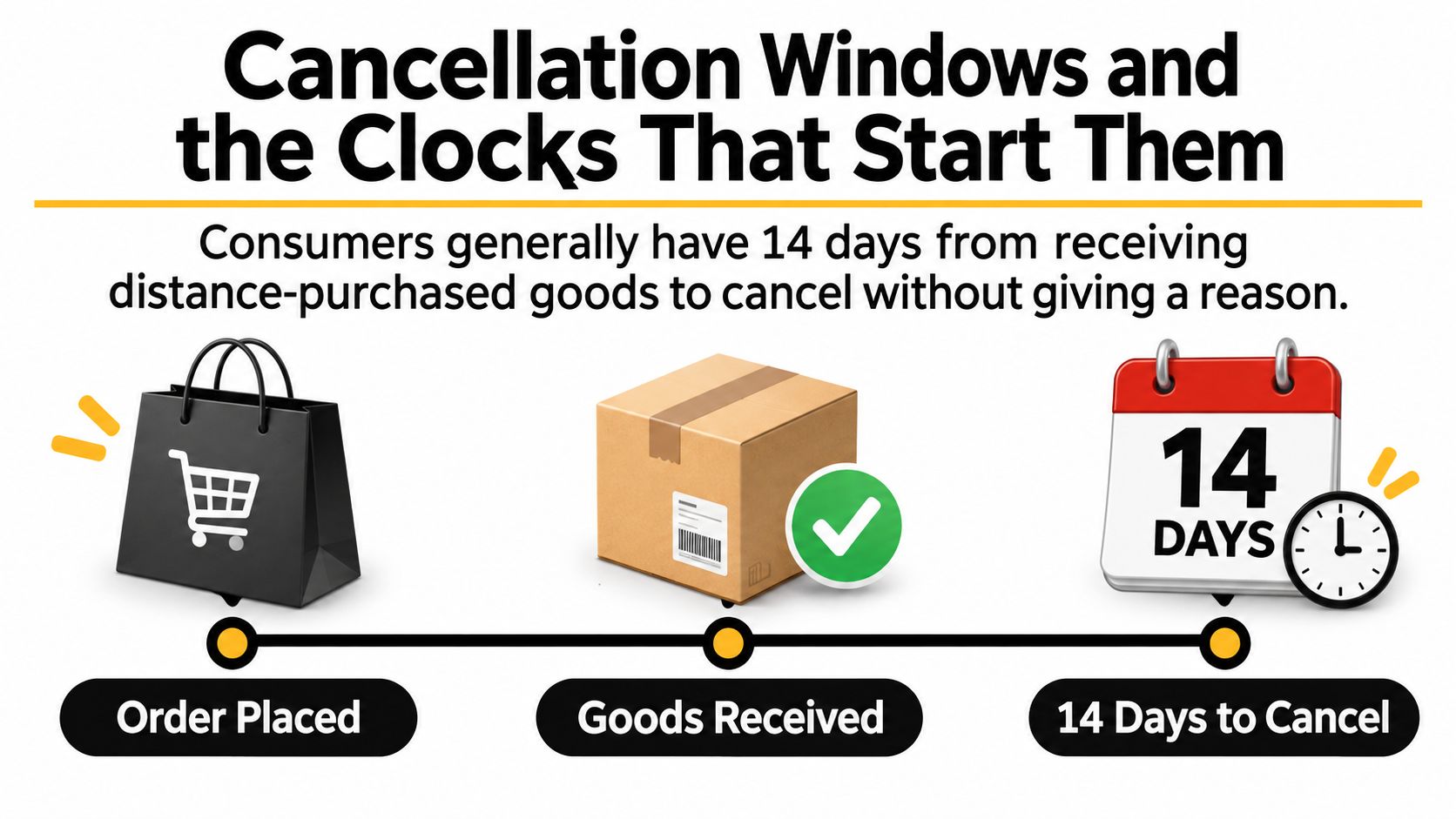
Follow an order through separate clocks
Consider a hypothetical order placed on 1 March and delivered on 5 March. Applying the EU period described above gives an illustrative cancellation deadline of 19 March, not a deadline counted from checkout. The time spent processing and transporting the parcel doesn't consume a delivery-triggered withdrawal window.
Now suppose the customer gives notice before that deadline. The next question isn't whether the original window remains open. It's when the customer must send the goods back and when the merchant must reimburse them.
Keep the events separate:
- Cancellation deadline: The last point for notifying the merchant of withdrawal.
- Return deadline: The period for sending goods back after that notification.
- Refund deadline: The merchant's reimbursement obligation, including any lawful basis for withholding payment pending return.
A customer can therefore submit a valid cancellation while the physical return is still outstanding. Support should acknowledge the notice, explain the return steps, and describe the refund's current status rather than call the entire request incomplete.
Store the event, not just the order age
An order-created timestamp is convenient, but convenience doesn't make it the right legal trigger. Goods and services can use different triggering events, so a mixed catalogue needs rules that distinguish what was purchased.
Delivery records deserve particular attention. If the carrier feed is missing or disputed, give staff a review path instead of automatically rejecting the request because the system can't calculate a deadline.
A closed self-service button should tell the customer what route remains available, not imply that every cancellation right has ended.
Use plain labels in customer communications. Request received, return awaiting shipment, and refund pending return evidence describe different situations. A single canceled badge can't explain all of them.
Print the trigger event, calculated end date, and applicable refund deadline in the relevant confirmation or status view. Where an order involves split deliveries or unusual products, have counsel confirm the calculation before automating it.
Fulfillment Status Decides What Can Be Canceled
Treat cancellation as a state machine, a workflow in which the permitted action changes as the order moves through fulfillment. Order age alone won't tell you whether a parcel can still be stopped.
The table below is an operational starting point, not a replacement for statutory rights. In particular, a shipment that can't be stopped may still be subject to withdrawal or another remedy.
| Fulfillment state | Customer can cancel? | Merchant action | Refund path |
|---|---|---|---|
| Unfulfilled and unpaid | Yes, self-serve where enabled | Cancel any authorization and release stock | No captured payment to refund |
| Unfulfilled and paid | Yes, self-serve where eligible | Confirm picking hasn't started and stop release | Full refund to original payment method |
| Picking or packing started | Request only | Hold fulfillment and confirm the parcel can be stopped | Refund after cancellation is confirmed |
| Label created, not handed over | Merchant approval | Confirm no handoff, void the label, release stock | Refund after approval |
| With carrier | Shipment usually can't be canceled | Assess interception or provide return instructions | Applicable return or withdrawal refund path |
| Partially shipped | Unshipped items can be assessed separately | Cancel remaining eligible lines | Refund for canceled, unshipped items |
| Delivered | Use return or withdrawal route | Record notice and provide return instructions | Refund under applicable return rules |
Resolve the race between request and dispatch
Label created isn't the same as carrier possession. A parcel may still be on the packing bench, or a carrier scan may arrive after physical collection. Ask the warehouse to verify the physical state before promising either a stop or a refusal.
For a shared vocabulary across support and warehouse teams, the fulfillment guidance from Million Dollar Sellers provides context for mapping order-processing stages. Match those stages to the events your own warehouse reports.
Record the cancellation timestamp and fulfillment state at that moment. Then record the decision and the action taken. Otherwise, a later shipped status can obscure that the customer requested cancellation before dispatch.
An editing workflow needs the same protection. Our fulfillment hold prevents an eligible order from shipping while the customer is editing it; fulfilled, canceled, or archived orders can't be edited by customers. When defining the boundary, use the Shopify order-editing workflow before shipment to distinguish an active edit from a request that needs staff review.
Handle delays as an exception to routine cut-offs
When a U.S. seller can't ship as promised, the buyer must be offered the choice to accept a delay or cancel for a full refund, as the FTC's guidance on merchandise that never arrives explains. A routine processing cut-off shouldn't override that obligation.
For a merchant-caused delay, don't deduct routine cancellation penalties from a required full refund. Assess shipped and unshipped lines separately, and avoid charging customers for an internal workaround such as an unnecessary replacement shipment.
A shorter window isn't automatically safer. If customers can't reach a working cancellation route, they may contact support, pursue payment disputes, or return parcels you could have stopped. Write one row per fulfillment state, with a named action owner and refund path, before configuring the customer controls.
Refund Timing and How Money Returns
For certain FTC-required refunds, methods other than creditor-issued credit generally require reimbursement within seven working days after cancellation; seller-creditor accounts use one billing cycle, according to the FTC's merchandise-order rule guide, which also sets a 30-day shipping expectation when no timeframe is stated. If the promised shipment can't happen, obtain the buyer's delay consent or refund the unshipped merchandise.
EU reimbursement is generally due within 14 days of receiving cancellation, although merchants may withhold reimbursement until receiving the goods or evidence of return, under EU consumer-rights guidance. That guidance also distinguishes delivery-triggered goods withdrawals, contract-date service withdrawals, and exceptions including personalized goods, perishables, and digital content begun with the required consent and acknowledgment.
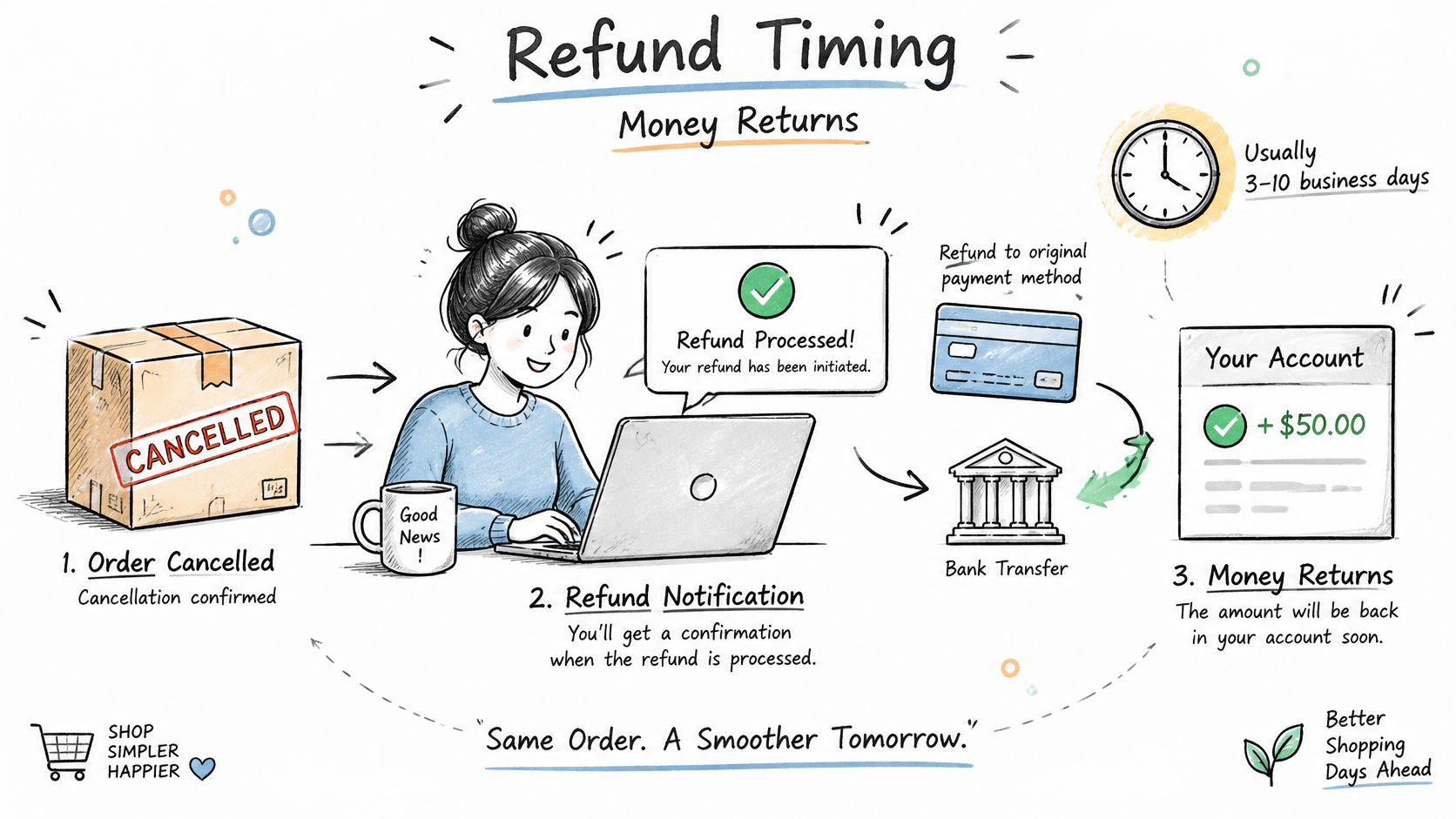
Keep an auditable payment trail
Store these events against the order:
- Shipping promise: Original promised ship date.
- Delay consent: Each notice and customer response.
- Cancellation: Request timestamp and confirmation.
- Payment instrument: The method used.
- Refund status: Pending, approved, submitted, or failed.
Freeze fulfillment before finalizing the decision, then release inventory allocation after choosing the refund or replacement path. Refunds from our editing workflow are issued through Shopify; merchants choose automatic processing or approval above a configured threshold.
Use PlatformDTC's explanation of how refunds are handled as a wording comparison, not a deadline to copy. When deciding between payment destinations, distinguish store credit from a Shopify refund. Flag refunds against their applicable legal deadline, and tell customers whether reimbursement is awaiting a permitted condition or has been submitted.
Customer Alternatives and Why Easy Exit Wins
Easy exit plus a relevant alternative gives customers control without discarding an order they only wanted to correct. In DHL's returns research, 79% of global shoppers would abandon a cart if their preferred returns option was unavailable, while a related 2025 finding reported that 58% of global shoppers had abandoned a purchase because the returns offering failed to meet expectations.
Returns evidence concerns post-delivery experiences, not just pre-dispatch cancellations. Still, merchants should make both routes visible before checkout and name them separately.
| Outcome | Best when | Timing | Watch for |
|---|---|---|---|
| Full cancellation and refund | Customer no longer wants an eligible, unshipped order | Refund workflow starts after confirmation | Keep available as the fallback for eligible cancellations |
| Order edit | Wrong variant, address, quantity, or unwanted item | Before fulfillment cut-off | Additional balance must be paid before completion |
| Exchange | Customer needs another variant after delivery | Replacement follows agreed return conditions | Return cost and replacement stock |
| Store credit with bonus | Customer voluntarily chooses to keep the order or buy again | On acceptance; retained order locks | Expiry, budget cap, eligibility, and offer limit |
Offer a solution, not an obstacle
Our cancellation workflow captures the reason first and can offer store credit to retain the order. If the customer declines, cancellation proceeds; acceptance keeps the order and locks it against further edits. Configure expiry, a monthly budget cap, and offer limits, and disclose eligibility before acceptance.
The cancellation-deflection and store-credit workflow should support that choice, not hide the refund route. Don't describe retained-order credit as though it cancels the shipment.
In subscription commerce, 31% of surveyed consumers frequently cancel and later resubscribe, according to the Mastercard and FT Strategies subscription-economy report. That's a different purchase model, but it reinforces the value of preserving a recoverable customer relationship rather than obstructing exit.
Measure the outcome the customer accepted, not merely the cancellation button they didn't finish pressing.
Report saved cancellations separately from estimated support-ticket savings. Review refund speed, repeat purchase, complaints, and disputes before declaring a retention offer successful.
Sample Cancellation Policy Wording
Use these clauses as a starting draft for a store offering pre-dispatch cancellation and applicable statutory withdrawal rights. They need legal review and operational confirmation before publication, particularly where approval requirements and automatic cancellation overlap.
Customer-facing clauses
Cancellation window. You can request cancellation at no charge before carrier handoff. We'll confirm whether we can stop your shipment. Applicable statutory withdrawal rights remain available separately.
Trigger event. Your order confirmation identifies when our pre-dispatch cancellation window starts and ends. Any applicable delivery-based withdrawal period is calculated from the legally required delivery event.
Fulfillment cut-off. Once a shipping label has been created, stopping shipment requires our approval. We'll check the parcel's actual status and explain the outcome.
Refund method. Refunds go to your original payment method unless you voluntarily choose an available store-credit option.
Refund timing. We'll explain the applicable reimbursement deadline and any lawful return-related condition when confirming your cancellation. We'll also notify you when the refund has been submitted.
Alternatives. Where available, you can correct your order or request an exchange instead. We'll show any price difference, shipping charge, or other cost before you agree.
Exceptions. Personalized goods, perishables, and some digital purchases may be excluded from change-of-mind withdrawal where the law permits. We'll identify applicable restrictions and obtain any required consent before delivery begins.
Requests outside the self-service window
Add a route that doesn't leave the customer at a dead end:
If self-service cancellation has closed, contact our store. We'll check whether shipment can still be stopped or explain any available return, withdrawal, or other remedy.
Custom-product sellers also need terms that match production commitments. Bakers can find a contract for custom cakes from Ovenbell as a separate drafting resource, rather than expecting a general cancellation clause to address every production issue.
Have counsel check each clause against every market you serve. Keep the approved wording consistent across product pages, checkout, and the order status page, without promising free exchanges or universal returns that you haven't configured.
Test Your Cancellation Policy Before You Publish
Test the customer path and the warehouse result together. A successful button click isn't enough if staff still ship the order or the refund remains unprocessed.
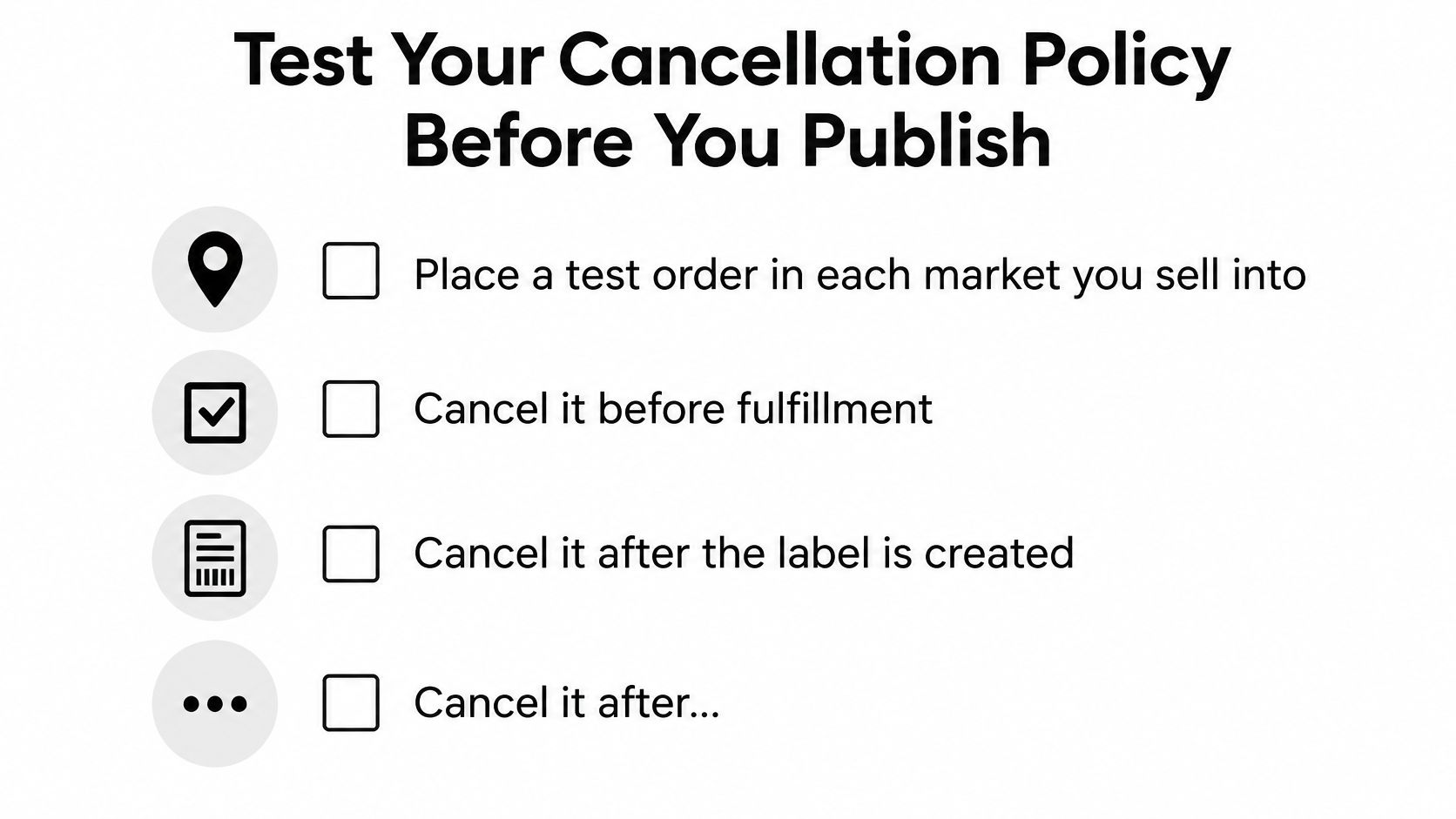
Create market-specific test orders. Use eligible and restricted products, and check that destination rules produce the intended customer options.
Test each operational boundary. Request cancellation before fulfillment, after label creation, and after delivery. Confirm that the system selects cancellation, manual review, or the appropriate return route.
Inspect the order record. Compare the request timestamp, fulfillment state, refund status, and reimbursement deadline with the written promise. Check that stock and payment records agree.
Compare customer-facing wording. Review product pages, checkout, the order status page, and footer policy. Tell shoppers to contact the store first because the merchant controls order data and we assist merchants with valid requests.
Fix mismatches and review monthly. Record every difference between the expected and actual result. Correct configuration or wording, retest, and review refund speed, saved cancellations, estimated ticket savings, repeat purchase, complaints, and disputes as separate measures.
Own the configuration
Our edit-window settings include 15 or 30 minutes; 1, 2, 6, 12, or 24 hours; or until shipment. Select a setting that fits your dispatch workflow, not just the longest available option. The merchant remains responsible for edit windows, allowed actions, refund handling, store-credit offers, and the results those settings produce.
Give customers a clear way to correct eligible orders or cancel before fulfillment, with rules your team can enforce. Visit Mayra ‑ Order Edit & Cancel to configure Shopify self-service order changes, cancellation permissions, and optional store-credit alternatives around your store's fulfillment workflow.