
In the United States, retailers expected consumers to return about $849.9 billion in merchandise in 2025, representing a 15.8% return rate across all retail sales. Online sales were projected to see a 19.3% return rate, according to the National Retail Federation's 2025 returns data. That gap matters, but the bigger operational opportunity sits earlier in the journey, often in the minutes after checkout.
A customer who chose the wrong size, entered an old address, added the wrong variant, or changed their mind shortly after ordering shouldn't have to wait for fulfillment, delivery, and a return label. The most effective ecommerce teams treat those moments as preventable post-purchase errors, then give customers a fast way to fix them before a return exists.
Table of Contents
- Why Ecommerce Returns Cost More Than You Think
- Enable Self-Service Order Edits Before Fulfillment
- Use Fit Data to Prevent Size and Variant Misorders
- Design a Return Policy That Reduces Returns Without Hurting Trust
- Intercept Cancellations With Store Credit and Smart Deflection
- Track the Right Metrics to Measure Return Reduction Impact
Why Ecommerce Returns Cost More Than You Think
A return isn't a single expense. It creates a chain of work across shipping, warehouse operations, customer support, inventory planning, and finance. The retailer may pay to move the item back, inspect it, restock it, refund the customer, and manage the conversation that surrounds the transaction. If the product can't return to sellable inventory quickly, its value can fall further through markdowns or lost selling time.
The scale of online returns makes small process failures expensive. The NRF expects ecommerce returns to remain materially higher than the overall retail average, while a historical ICSC comparison of online and in-store returns reported an average 15.2% online return rate versus 5% for physical store purchases. In discount department stores, the reported gap was wider, with 33.2% of online purchases returned compared with 6.2% of in-store purchases.
Operational rule: Don't manage returns as an unavoidable cost of selling online. Separate the errors customers can correct before fulfillment from the product issues that require a true return.
The cost layers behind one return
The exact cost varies by product, warehouse, carrier, and disposition process. A useful internal model should still account for each layer rather than treating the refund as the whole loss.
| Cost Component | Estimated % of Order Value | Notes |
|---|---|---|
| Reverse shipping | Qualitative estimate | Label creation, carrier movement, and handling can consume margin before the item reaches the warehouse. |
| Warehouse processing | Qualitative estimate | Inspection, repackaging, restocking, and inventory updates require labor and system activity. |
| Customer support | Qualitative estimate | Manual return requests create tickets, follow-ups, and refund-status questions. |
| Inventory depreciation | Qualitative estimate | Delayed or damaged inventory may need markdowns or may no longer be sellable. |
| Refund and margin loss | Qualitative estimate | Cash refunds remove revenue, while exchanges and store credit can preserve more value. |
The ecommerce operations management guidance from Mayra Apps is useful here because it frames fulfillment, support, inventory, and order controls as one operating system rather than separate departments. That perspective changes where you look for savings.
The highest-impact fixes often aren't dramatic. A customer correcting a shipping address before a label is created can prevent a failed delivery and reshipment. A customer swapping a size before picking can prevent the wrong item from leaving the warehouse. A customer canceling quickly can be offered a relevant alternative before the order becomes a refund. These interventions reduce downstream work without making the customer fight the policy.
Enable Self-Service Order Edits Before Fulfillment
The best time to prevent a misorder is after the customer recognizes it and before the warehouse acts on it. That window is easy to miss because most stores treat checkout as the end of the transaction. In practice, it starts a short period when the customer knows more than the warehouse does, including whether they selected the correct size, variant, quantity, or address.
A post-purchase editing flow should appear inside the order status page and customer account, not hide behind a support email. The customer should see clear options such as change size, swap variant, correct address, adjust quantity, or add an item, with eligibility controlled by fulfillment state and merchant rules.
Build the edit window around warehouse reality
Don't choose an edit window because another store uses it. Choose it around your pick-and-pack cadence, carrier cutoff, and fulfillment holds. If the warehouse begins processing orders quickly, the system needs to close edits when picking starts, not when a generic timer expires.
A practical implementation sequence looks like this:
- Map the fulfillment handoff. Identify when orders move from paid to picked, packed, labeled, and shipped. The edit experience must respect those states.
- Define allowed changes. Variants, quantities, addresses, additions, and removals don't carry the same inventory or payment risk. Enable each capability deliberately.
- Hold fulfillment during active edits. A temporary hold prevents the warehouse from shipping the original details while the customer is changing them.
- Set approval rules. Extra charges, high-value orders, restricted destinations, and certain products may need review instead of automatic processing.
- Keep Shopify as the source of truth. Edits should write back to the original order so inventory, payment, fulfillment, and customer history remain aligned.
- Make the confirmation explicit. Show the revised items, address, totals, and fulfillment status before the customer submits the change.
For Shopify merchants, the Mayra Apps guide to letting customers edit orders covers the operational pattern behind this workflow. Shopify's order edit capabilities or a compatible post-purchase tool can support the mechanics, but the configuration matters more than the app name.
Design for speed, not discovery
Put the edit link in the order confirmation, shipping confirmation, order status page, and account area. Use plain language, show the remaining eligibility clearly, and avoid forcing customers to explain a simple correction to an agent.
The return reduction comes from preventing the wrong order from becoming a shipped order. Track edited orders separately from returned orders so you can see which issues customers are resolving before fulfillment, rather than waiting for the aggregate return rate to move.
Use Fit Data to Prevent Size and Variant Misorders
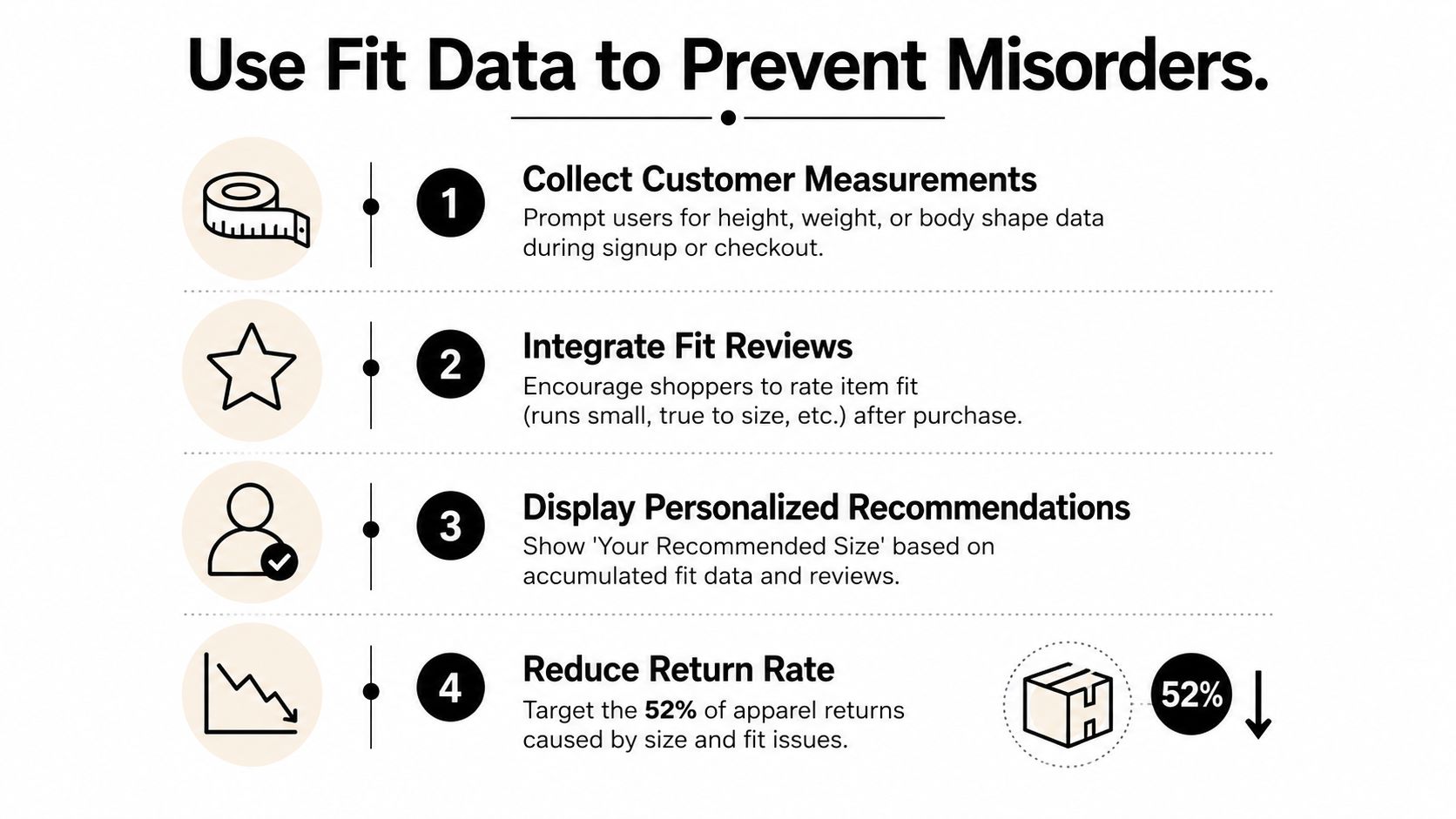
Generic size charts are necessary, but they rarely provide enough context for a customer choosing between two sizes. Fit guidance becomes more useful when it reflects the actual relationship between a product, a selected size, and the customer who bought it.
Start with structured return reasons. Capture whether the item was returned because it was too small, too large, or unsuitable for another fit-related reason. Then join that information to the SKU, variant, selected size, customer attributes you legitimately collect, and the product content shown at purchase.
Turn returns into item-level fit flags
A simple operating model is:
- Collect the signal. Record the selected size, fit-related reason, exchange outcome, and relevant product attributes.
- Compare patterns. Look for products or variants with unusually frequent fit complaints relative to their own sales and size mix.
- Require enough evidence. Don't publish a fit warning because of a handful of returns. Wait until the pattern is consistent enough to justify changing the customer experience.
- Write a specific flag. “Runs small, consider sizing up” is more useful than “check the size chart.”
- Test the intervention. Compare shoppers who see the flag with a suitable control group, while monitoring conversion, exchanges, and returns.
A large-scale fashion ecommerce experiment used a Bayesian model trained on customer return data to identify likely fit problems. The A/B test reduced size-related returns by 4.3% for items flagged as too small and 6.6% for items flagged as too big, as reported in the published fit-advice experiment. The useful lesson isn't to copy the model blindly. It's to connect historical return behavior to item-level guidance before checkout.
Practical warning: A sizing tool can increase returns when its recommendation doesn't match the customer-item mismatch. Treat fit advice as a product decision that needs calibration, not as a badge that automatically improves conversion.
A separate longitudinal analysis in the same source found that using a size finder was associated with a 0.65% higher chance of return in one high-end fashion dataset. That result doesn't mean sizing tools are bad. It means inaccurate recommendations can give customers false confidence.
Keep the product page readable
Fit intelligence should answer the customer's decision, not bury it under a questionnaire. Surface the most relevant recommendation beside the size selector, support it with detailed customer reviews, and explain why the recommendation appears when the context warrants it.
Don't copy a fit flag across every product in a collection. A warning that applies to one cut, material, or supplier run can create unnecessary uncertainty elsewhere. Use product-level evidence and remove guidance when later data contradicts it.
Design a Return Policy That Reduces Returns Without Hurting Trust
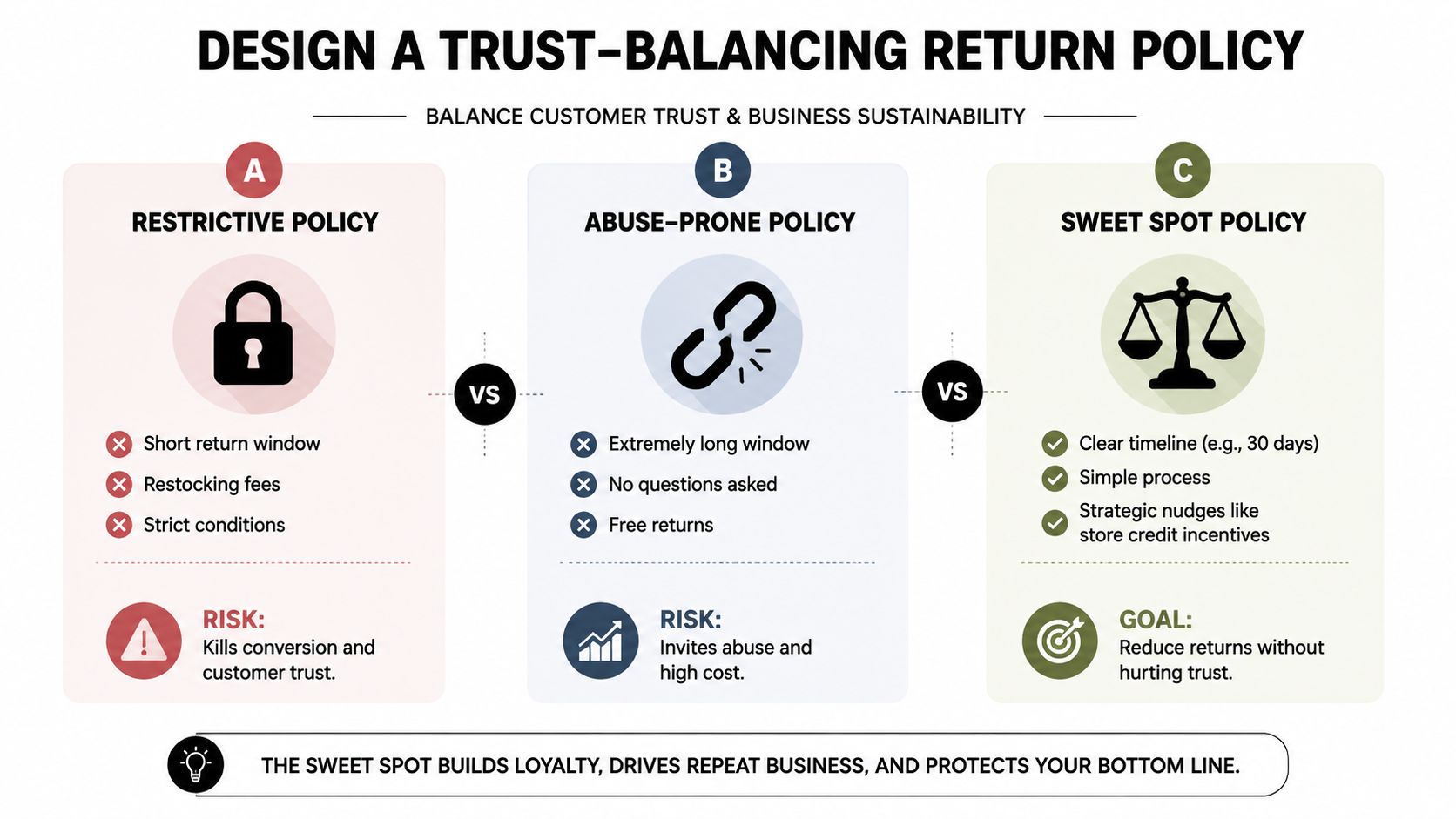
A restrictive return policy can reduce some requests while damaging conversion and repeat purchasing. An overly permissive policy can make abuse and reverse logistics harder to control. The right design makes legitimate exchanges and corrections easy, while adding measured decision points where a refund isn't the only sensible outcome.
Start with the reason for the request. A wrong-size request deserves a different path from a damaged item, a duplicate order, or a change of mind. If every reason routes to the same refund form, the policy gives up its most valuable opportunity to retain the order.
Put the preferred outcome first
For a size issue, offer a size exchange with the relevant guidance. For a variant problem, show available alternatives. For a low-value item where return shipping creates disproportionate cost, consider a keep-the-item resolution when your margin and fraud controls support it. For a customer who no longer wants the product, store credit may be appropriate, but it shouldn't be disguised as a refund.
The behavioral return-intervention research reported an average 4% reduction in return rate across six studies using messages based on social norms, reciprocity, loss aversion, commitment and consistency, and self-benefit framing. Use that finding carefully. Experimental effects vary by message design, country, product type, and customer context.
Use seasonal rules without surprising customers
Returns are behavior-sensitive and seasonal. One 2025 benchmark reported that return volume jumps 44.5% during peak season, with January identified as the busiest return month, while Returnless's 2025 benchmark also describes a UK forecast in which non-food return value falls from £26.7 billion to £25.1 billion as fees and tighter policies influence behavior.
Those figures support planning, not blanket punishment. Review gifting, bracketing, and post-holiday behavior before changing deadlines. Publish any seasonal rule clearly at the point of purchase, and avoid creating a policy that customers discover only after they need help.
A fair policy doesn't try to make returns impossible. It makes the best resolution easy to choose, while preserving a transparent refund path when the product is defective, materially different from its description, or otherwise covered by your terms.
Intercept Cancellations With Store Credit and Smart Deflection
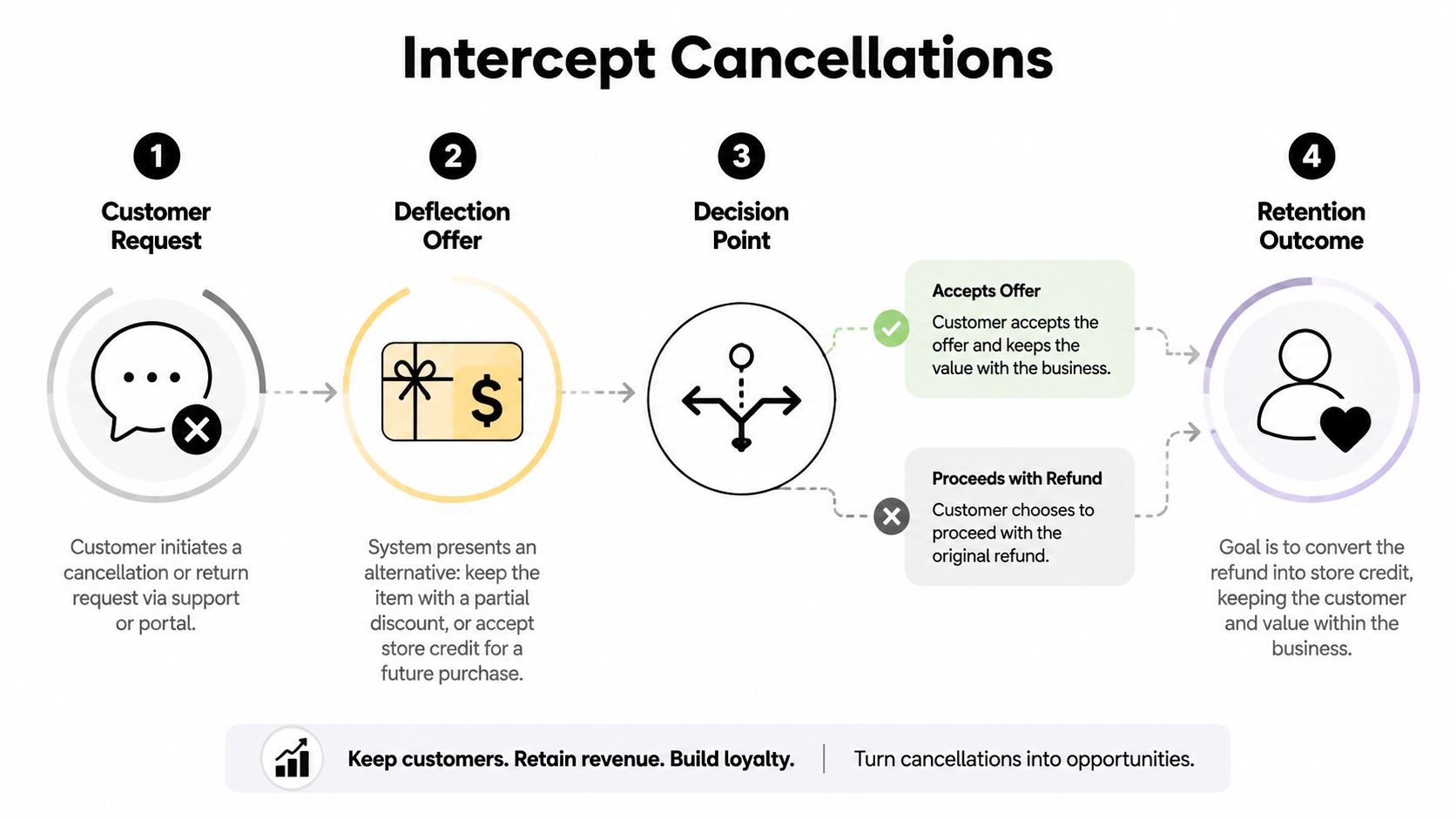
Cancellation requests are often treated as lost orders, but many happen before fulfillment and before the customer has received anything. That gives the store a narrow operational window to understand the reason and offer a relevant alternative.
The sequence should begin with reason capture. A customer who selected the wrong size needs an exchange path. Someone who entered the wrong address needs an edit path. A customer who changed their mind may respond to store credit, but only if the offer is clear and the cash refund remains available when appropriate.
Build the flow around customer intent
A useful cancellation flow can follow this logic:
- Capture the request. Let the customer start from the order status page or account without contacting support.
- Ask for the reason. Use concise choices that map to an operational action.
- Present the matching alternative. Offer an edit, variant swap, exchange, or store credit based on the selected reason.
- Show the value clearly. State exactly what the customer receives and when it becomes available.
- Keep full cancellation visible. Deflection works only when customers trust that the original option hasn't disappeared.
- Apply the chosen action automatically where eligible. Update the order, issue credit, or cancel according to merchant rules.
- Record the outcome. Store the reason, offer shown, offer accepted, and final resolution for analysis.
The Mayra Apps cancellation deflection workflow is one Shopify-oriented way to implement this model. It supports reason capture, store-credit save offers, and full cancellation as a fallback, with merchant-controlled eligibility.
Judge offers by reason, not one blended rate
Don't assume every offer should include a discount. A customer who chose the wrong variant needs accuracy, not an incentive. A customer who found a lower price may need a controlled price adjustment or a one-time code. A customer who changed their mind may prefer credit if it preserves convenience and future choice.
Avoid setting an arbitrary deflection target that pressures agents or hides the refund path. A high apparent save rate can signal that customers are being delayed rather than helped. Review complaint themes, repeat contacts, refund timing, credit redemption, and post-resolution retention alongside the deflection result.
Track the Right Metrics to Measure Return Reduction Impact
The store-wide return rate is useful for detecting movement, but it isn't a diagnosis. A lower rate can reflect fewer purchases, delayed returns, policy friction, or a change in product mix. A flat rate can hide meaningful progress if customers are switching from refunds to exchanges or resolving order errors before shipment.
Build the measurement model around the intervention. Every edited order should carry an edit event. Every cancellation save should record the reason, offer, and outcome. Every return should preserve the original item, selected variant, reason code, resolution, and whether the customer used self-service.
Use cohorts instead of averages
Compare customers who saw a fit flag with those who didn't. Compare orders edited before fulfillment with similar orders that weren't edited. Compare cancellation requests shown a store-credit offer with eligible requests routed directly to cancellation. The comparison needs a sensible control group and a consistent observation window.
Your reason codes should be specific enough to guide action. “Too small” is less useful than “too small after size guidance,” “too small without size guidance,” or “wrong variant selected.” Keep the taxonomy short enough for customers and agents to use consistently.
A dashboard that shows operational impact
| Metric | Target Range | What It Tells You |
|---|---|---|
| Return rate by cohort | Establish your own baseline | Whether an intervention changes returns for comparable customers and products. |
| Exchange-to-refund ratio | Establish your own baseline | Whether the resolution preserves value instead of sending cash back. |
| Cancellation deflection rate | Establish your own baseline | Whether save offers work by cancellation reason without creating friction. |
| Net revenue retained | Establish your own baseline | The financial result after credits, exchanges, discounts, refunds, and operational costs. |
| Self-service edit completion | Establish your own baseline | Whether customers can correct orders without support involvement. |
| Return reason distribution | Establish your own baseline | Which product, content, fulfillment, or policy issue deserves attention. |
| Support touches per return | Establish your own baseline | Whether automation is actually removing work from the support team. |
| Time from purchase to edit or cancellation | Establish your own baseline | Where the customer recognizes an error and whether the intervention arrives in time. |
Don't assign invented industry targets to these metrics. Your baseline should come from your catalog, margins, fulfillment speed, and customer behavior. Review the dashboard weekly, but make policy or product changes only after checking enough comparable orders to distinguish a pattern from noise.
Measurement principle: A successful program doesn't merely make returns harder. It prevents avoidable shipments, shifts appropriate refunds toward exchanges or credit, and reduces support work while preserving customer choice.
The strongest operating review combines four views: prevented returns, retained revenue, cost per resolution, and customer trust signals. If one improves while the others deteriorate, the intervention needs redesign rather than celebration.
If post-purchase errors are creating avoidable returns or support tickets, Mayra Apps provides Shopify workflows for self-service order edits, address corrections, cancellation deflection with store-credit offers, and one-click upsells. Visit Mayra Apps to review the available controls for edit windows, fulfillment holds, eligibility, approvals, and settlement before choosing the workflow that fits your store.