
A one click upsell funnel earns its place after checkout because the numbers are hard to ignore. A large benchmark cited in 2026 materials reports 10 to 15% average conversion, with top offers reaching 16% or higher, and the same benchmark is described as finding 14.6% conversion for physical-goods stores across 1,847 businesses (digitalapplied.com). That makes the post-purchase moment one of the strongest monetization points in ecommerce, but only if the offer, routing, and operations are built to survive real traffic.
The mistake many teams make is treating one-click upsells like a design problem. In practice, the key advantage sits in timing, eligibility, attribution, and fulfillment control. A funnel that looks clean but breaks when payment tokens fail, order edits hit support, or segments get blended together won't hold up for long.
Table of Contents
- Why Post-Purchase One Click Upsells Outperform Every Other Placement
- Designing the Funnel Architecture and Trigger Points
- Sequencing Offers for Maximum Relevance and Acceptance
- Segmentation and Measurement That Prevent False Wins
- Handling Post-Acceptance Operations and Customer Trust
- Launch Checklist and Optimization Priorities
Why Post-Purchase One Click Upsells Outperform Every Other Placement
Post-purchase one-click offers work because the buyer has already made the hardest decision, and the payment context is still warm. Benchmark summaries point to post-purchase one-click upsells converting far better than pre-checkout offers, with post-purchase results commonly in the 10 to 35% range and pre-checkout offers often much lower. That gap is not just convenience, it is lower friction after commitment.
Why the post-purchase moment is different
At checkout, the customer is still deciding. After payment, they have already signaled trust, committed the card, and accepted the transaction. A true one-click upsell works because it does not ask for a second purchase decision from scratch, it extends the original intent.
Practical rule: if the offer feels like a new shopping trip, you have moved too far from the post-purchase advantage.
That is why operators stop spending too much time on pre-checkout variations once the post-purchase layer is working. The funnel becomes a second revenue event tied to the original order, not another cart experience that competes with the primary conversion path.
Placement performance comparison
| Placement Type | Acceptance Rate | Revenue per 1000 Orders | Friction Level |
|---|---|---|---|
| Product page recommendation | Lower than post-purchase, varies by fit | Lower than post-purchase | Medium |
| Cart drawer upsell | Better than product page, but still dependent on interruption tolerance | Moderate | Medium |
| Pre-checkout upsell | Lower than post-purchase in benchmark summaries | Lower | High |
| Post-purchase one-click upsell | Strongest common placement in benchmark coverage (digitalapplied.com) | Highest among common placements | Low |
The operational reason matters as much as the conversion gap. Post-purchase placement gives you cleaner attribution, fewer interruptions to checkout, and a better chance to control what happens after acceptance. Operators who want to understand the mechanics of post-purchase placement usually find the same pattern, the offer works best when it sits after the initial sale and before operational complexity starts to creep in.
For stores with real volume, that makes post-purchase one-click upsells the easiest placement to scale without distorting the main checkout flow. The trade-off is that the back end has to keep up. If payment token handling, order edits, fulfillment holds, and segment tracking are messy, the placement advantage gets diluted fast.
Designing the Funnel Architecture and Trigger Points
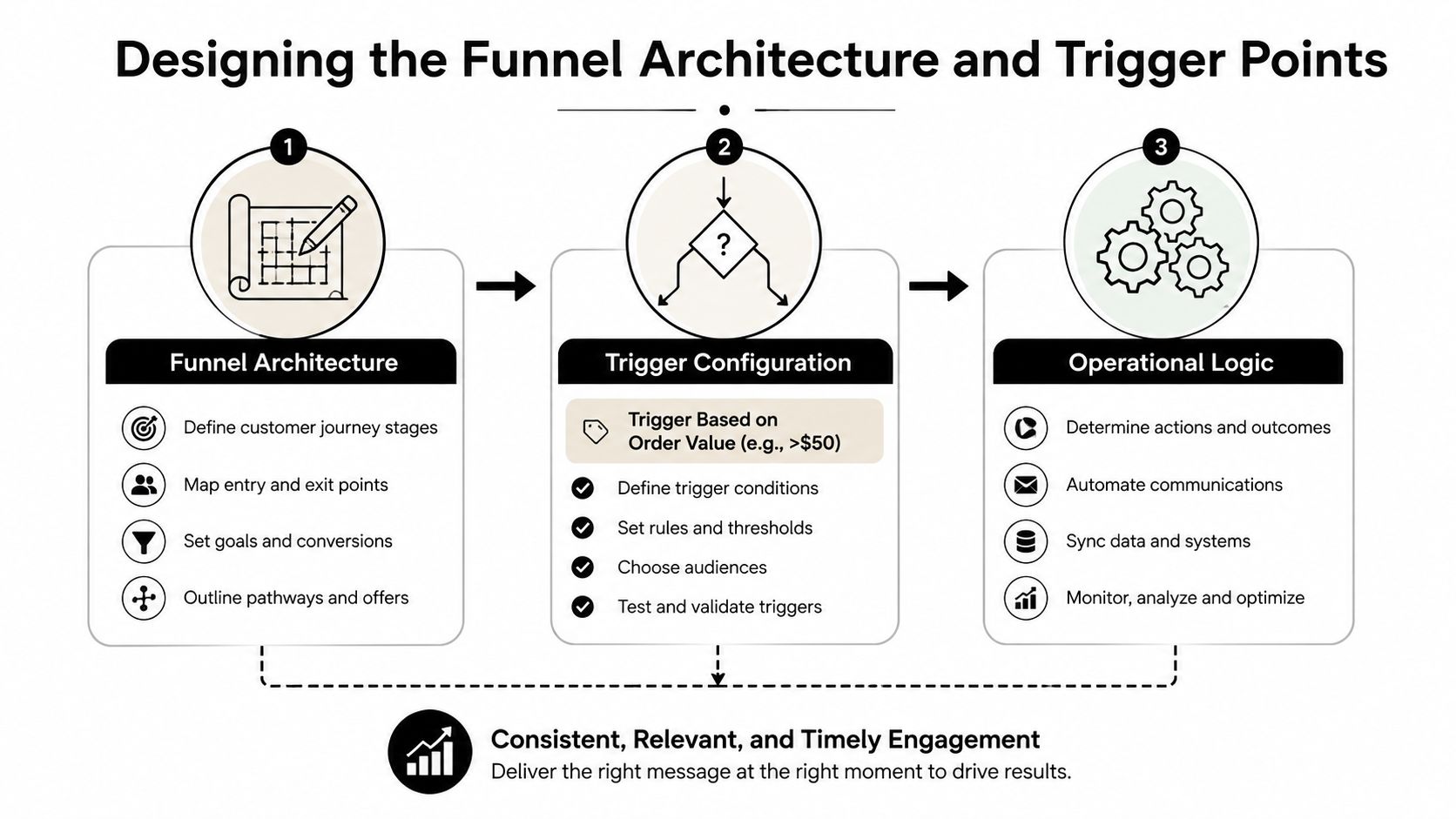
A funnel that scales starts with rules, not creative. The first decision is what qualifies a customer for the offer. In practice, that usually means setting thresholds around order value, product category, customer type, and fulfillment state, so you aren't showing the same upsell to every buyer regardless of context.
Build eligibility before you build copy
Start by separating products that can safely accept an add-on from products that can't. Subscriptions, fragile bundles, and items with special fulfillment logic often need exclusions. If a customer is in an edge case, the funnel should fail closed, not force a risky offer.
The next layer is the trigger point. Some stores trigger immediately after checkout, others wait for a specific order state or route customers into different offers based on what they bought. The cleaner your rules, the less manual intervention you'll need later. That matters because a one click upsell funnel only works if it can pass the payment token and update the original order without breaking the experience.
Protect fulfillment before revenue
The operational guardrail is a fulfillment hold. If a customer can still add items, but the warehouse has already started pick-and-pack, the upside turns into a support problem. Mayra Apps, for example, manages post-purchase changes inside customer accounts and the order status page, with fulfillment holds that pause shipment during active edits, while keeping Shopify as the system of record for the original order. That kind of setup is useful when you need edits, add-ons, and settlement to stay attached to the same order rather than creating a separate checkout flow.
Shopify order status page workflows
A good trigger rule doesn't just decide who sees the offer. It decides who should never see it.
For operational stability, add fallback logic for low inventory, destination-country exclusions, and orders that are already too far into fulfillment. International orders can also complicate tax handling, so the safest rule is usually to exclude anything that would require special manual cleanup. The funnel should expand revenue without creating exceptions your team has to untangle later.
Sequencing Offers for Maximum Relevance and Acceptance
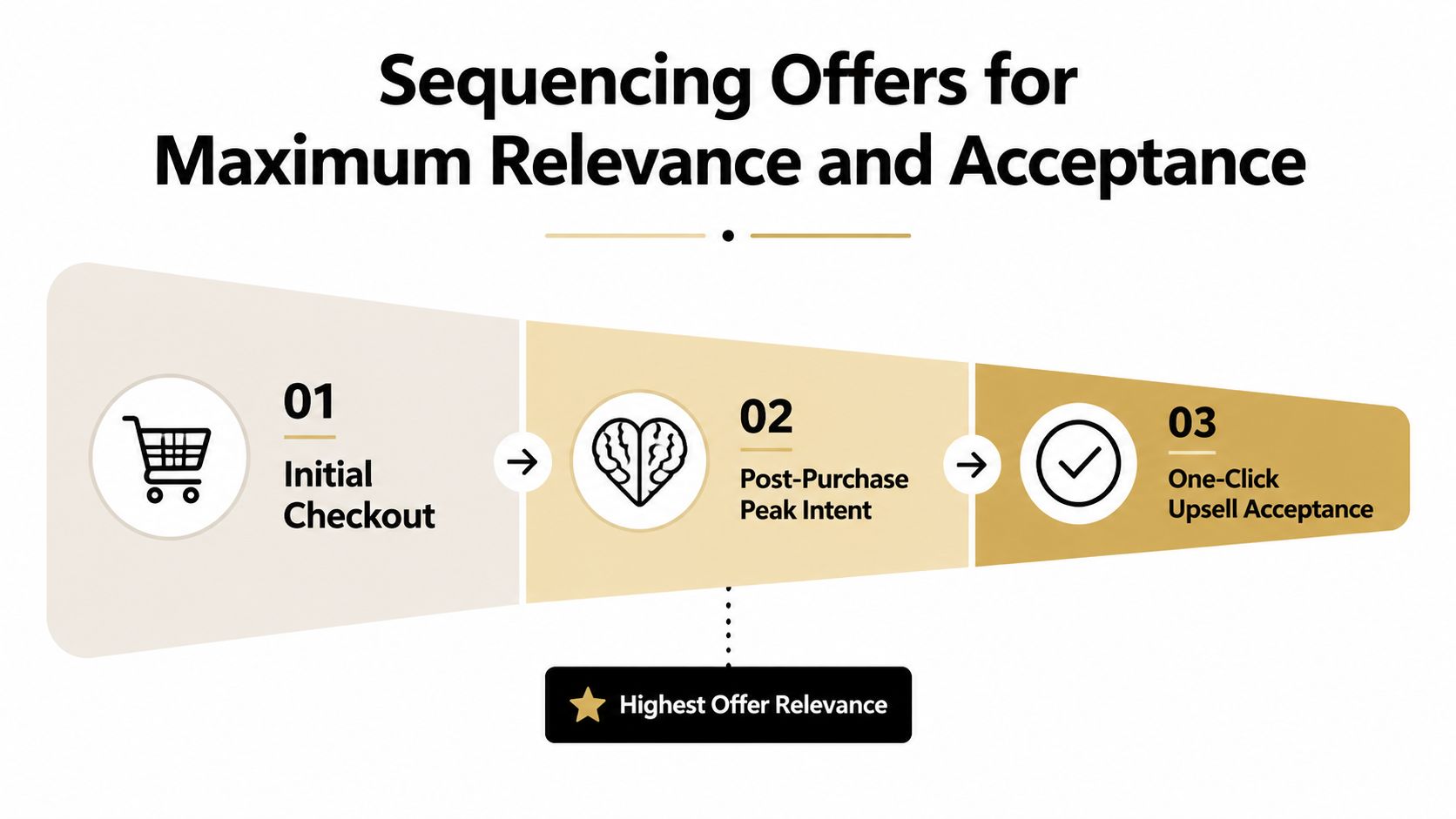
The strongest one click upsell funnel doesn't push more offers, it pushes the right offer first. The post-purchase window rewards relevance because intent is already high, so the first screen should present the product most likely to feel like the natural next step.
Lead with the highest-fit offer
In practice, that means the most complementary item goes first. If the buyer accepted it, the second offer should extend the original choice, not repeat it. If they decline, the next option should usually be smaller, cheaper, or narrower in scope.
That sequence matters because repeating the same pitch can erode trust fast. A buyer who said no to a premium add-on isn't suddenly more receptive to a similar offer with different copy. They need a different path, not a louder version of the same one.
Keep the sequence short
Stores often overbuild this layer. Three carefully chosen offers usually beat five generic ones because the decision tree stays scannable. Benchmark guidance consistently warns that the page should be understandable in under 5 seconds, with a visible decline option and a single relevant offer on screen at a time (growthsuite.net).
The offer hierarchy usually works best in this order.
- Most relevant product first, the item that completes or extends the original purchase.
- A conditional complement next, only if the first offer is accepted.
- A smaller fallback offer, if the buyer declines the main pitch.
Practical rule: every extra branch should reduce friction, not create a new sales pitch.
That's where a sequential mindset helps. The funnel behaves like a decision system, not a static page. Offer relevance stays high because every step reacts to the customer's last action, which is why 2 or 3 tightly matched offers usually outperform a long menu of unrelated ideas.
Segmentation and Measurement That Prevent False Wins
A one click upsell funnel can look healthy and still be misleading. The fastest way to fool yourself is to blend new and returning buyers, mobile and desktop traffic, and paid and organic sources into one acceptance rate. Then a good offer gets buried by a weak segment, or a weak offer looks profitable because one audience carried the result.
Separate the audiences that behave differently
Shopify's updated guidance (2024) recommends breaking results down by device, traffic source, and customer status, and using A/B testing instead of relying on one blended number (shopify.com). That matters more in post-purchase funnels than in most other placements because the buyer's context is already segmented before the offer appears.
Mobile often behaves differently from desktop because the screen is tighter and the interaction path is less forgiving. Traffic source matters too, since customers arriving through branded intent behave differently from colder acquisition traffic. Returning customers also tend to respond to different offer structures than first-time buyers, especially when the product category has a natural repeat cycle.
Track the metric that survives mixed traffic
Raw revenue alone can hide bad logic. Revenue per unique visit is the cleaner lens when you want to know whether the funnel adds value, especially if repeat buyers or mobile traffic are overrepresented in one test cell. A segment-specific dashboard gives you a clearer read than a single top-line report.
| Segment | Avg Acceptance Rate | Common Pitfall | Recommended Action |
|---|---|---|---|
| Mobile traffic | Lower than desktop in many stores | Tiny layout, accidental taps, rushed reading | Test the offer on real phones first |
| Desktop traffic | Usually cleaner engagement | Overestimating mobile-safe copy from desktop results | Keep device reporting separate |
| Returning customers | Typically stronger response to familiar offers | Mixing them with first-time buyers inflates performance | Build a separate cohort path |
| First-time buyers | More sensitive to trust and clarity | Pushing aggressive offers too early | Use the most relevant, lowest-friction offer |
If you do not isolate the segments, a winning offer can get cut for the wrong audience. That is the measurement mistake that wastes the most time. Benchmark guidance published in 2025 warns that the page should be understandable in under 5 seconds, with a visible decline option and a single relevant offer on screen at a time (growthsuite.net). A funnel only looks simple on the surface.
Handling Post-Acceptance Operations and Customer Trust
The click is not the finish line. Once a customer accepts a one click upsell, the order turns into an operational event that can touch fulfillment, invoicing, support, and trust all at once. If the back office isn't ready, the revenue you booked can come back as tickets, refunds, or confusion.
What happens after the acceptance
The first risk is order editing against an active warehouse workflow. If the upsell app appends the item cleanly, the order can stay intact. If not, your team ends up reconciling duplicate records, mixed shipment states, or inventory that was already reserved elsewhere. That is where fulfillment holds matter, because they stop the order from moving while the customer is still changing it.
A second risk is communication. The customer may accept the offer, then see a confirmation email that doesn't clearly show the extra item. That's a trust problem, not a copy problem. Support teams then spend time explaining what the buyer already agreed to, which is exactly the kind of friction post-purchase monetization is supposed to avoid.
The cleanest upsell is the one the customer can identify again without opening a ticket.
Build the trust layer into the workflow
The operational stack should include three things. First, a confirmation path that clearly lists the accepted add-on. Second, a customer-service script for buyers who don't remember the click or who want to edit the order after the fact. Third, a cancellation or removal workflow that lets them adjust the upsell without wiping the original purchase.
That's one reason the newer Shopify ecosystem is moving beyond isolated thank-you-page widgets and into account-based post-purchase workflows. When add-ons, edits, and cancellations all sit in the same lifecycle, the operational rules matter as much as the offer itself. Mayra Apps sits in that lane by letting merchants handle self-serve edits, cancellation deflection, and one-click upsells inside the customer account flow, with invoices and refunds processed through Shopify.
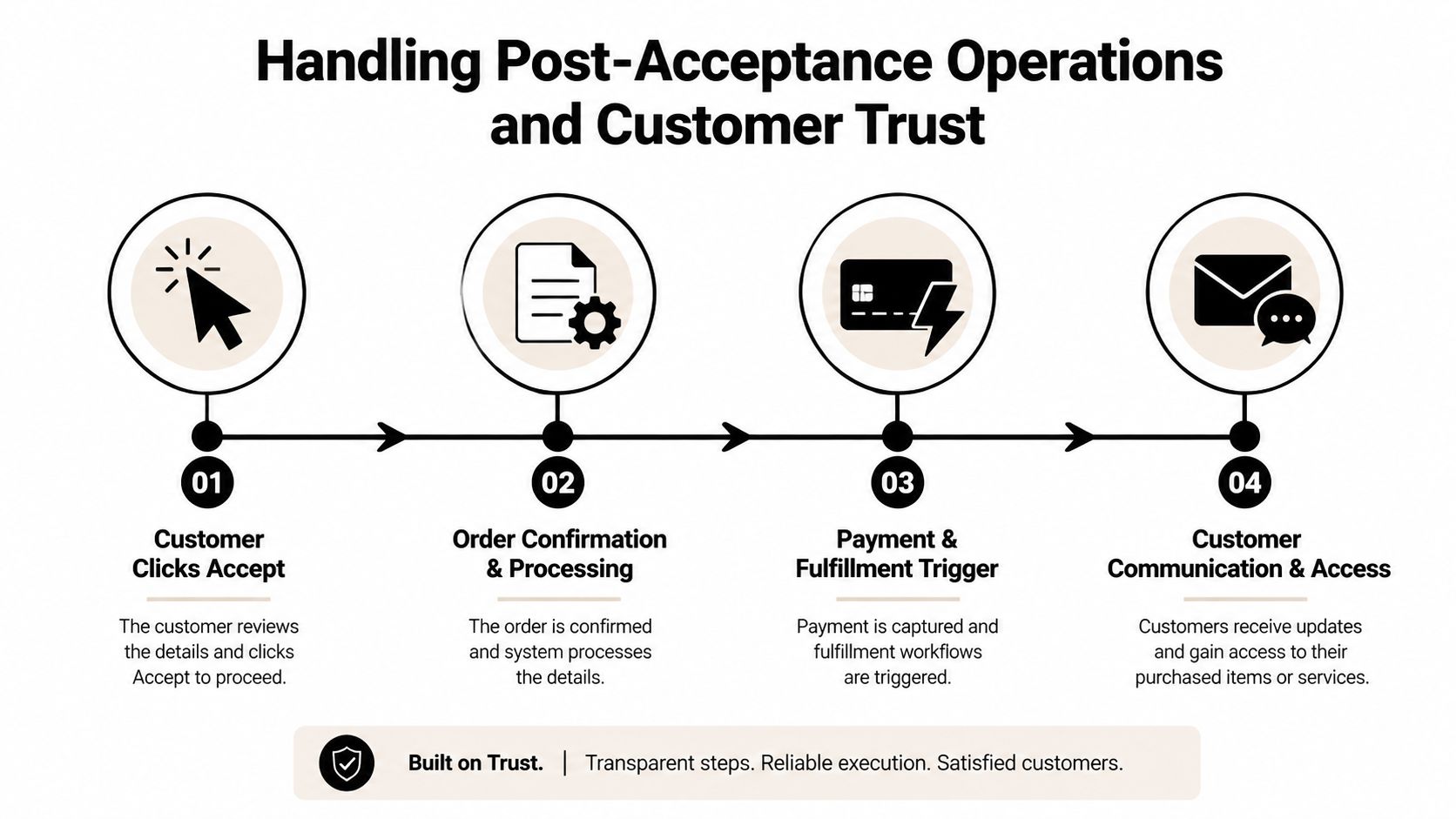
If you want the upsell to stick, the post-acceptance path has to feel boring in the best way. No surprises, no duplicate steps, no hidden state changes. Buyers don't care how elegant the routing is, they care that the order matches what they agreed to.
Launch Checklist and Optimization Priorities
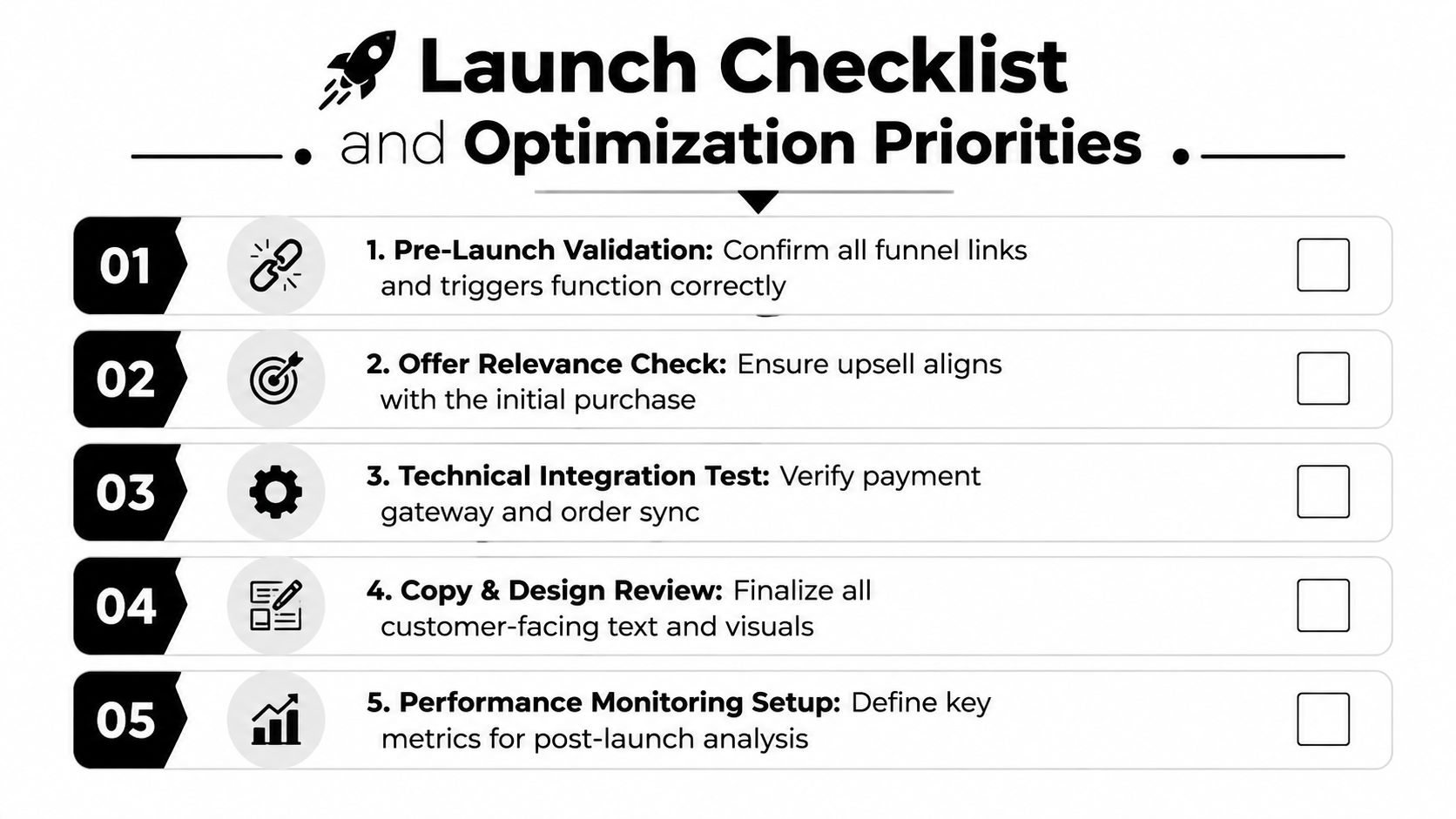
A launch only counts if the funnel survives a real order. Before going live, confirm that payment capture, order sync, and fulfillment logic all behave the way you expect on mobile and desktop. If any of those break, the funnel is not ready, no matter how good the offer looks in preview.
Go no go checks
- Payment compatibility: verify that the gateway supports post-purchase charges and that accepted items settle through Shopify without forcing a second checkout.
- Mobile validation: run the full one click upsell funnel on an actual phone, not just a desktop simulator.
- Analytics integrity: confirm the post-purchase redirect chain still fires the right events so revenue doesn't get credited to the wrong campaign.
- Inventory sync: test what happens when the upsell SKU is available, low, or missing from the fulfillment node.
- Order state handling: make sure the offer respects edit windows, approval rules, and any exclusions tied to order value or fulfillment status.
Mayra Apps one-click upsell app details
Optimize in the right order
Offer relevance and discount depth usually move the needle before visual polish does. If the wrong product is showing, no amount of copy cleanup will save it. If the pricing is too aggressive or too small, the acceptance problem is economic, not cosmetic.
That's why the first A/B tests should target the offer itself, then the trigger logic, then the creative. Design iteration comes later, after the funnel already proves it can accept a clean transaction. Don't let the test environment reward a pretty page that can't survive real order flow.
Practical rule: fix the offer before you fix the button color.
A useful rollout rhythm is simple, build, test, segment, then expand. Once the funnel is stable, watch the devices and cohorts separately so you can keep the good segments and cut the bad ones without confusing the two. The goal isn't to create more upsells, it's to create one that can be trusted enough to scale.
If you want to build a one click upsell funnel that handles edits, settlement, and customer-account workflows without turning fulfillment into a mess, take a look at Mayra Apps. It's built for Shopify stores that need post-purchase changes, cancellation deflection, and one-click add-ons to stay attached to the original order. If that's the operational layer you've been missing, start there and map your first funnel against the rules in this guide.