
An order arrives at 9:14 on Friday night. At 9:40 the same customer replies to the confirmation email asking to cancel. By Monday the parcel is on a truck, the inbox holds four messages and one refund request, and nobody has a clean answer because the policy page says cancellations are reviewed case by case.
That sentence is the entire problem. A cancellation policy isn't a legal disclaimer you paste into the footer. It's an operating rule that tells a customer, a support agent and a warehouse picker what happens next, in that order, without anyone guessing. The template below is built on that principle: every clause maps to a fulfillment state your store can verify.
Table of Contents
- Copy-Ready Clauses for Your Cancellation Policy
- Which Orders Can Still Be Cancelled at Each Stage
- How to Build the Cancellation Workflow Step by Step
- Refund Timing and Legal Rights by Market
- Offering Store Credit Without Trapping Customers
- Metrics and Pitfalls That Reveal a Weak Policy
- Publish the Policy and Test the Cancel Path
Copy-Ready Clauses for Your Cancellation Policy
Nine clauses cover what a customer needs to know and what your team needs to enforce. Write them in plain sentences, put a number or an order status in each one, and publish the result where your order status page can link to it.
Policy clauses to fill in
| Clause | What to write | Sample sentence |
|---|---|---|
| Scope | Which orders, markets and products the policy covers | This policy applies to all orders shipped to the countries listed in your shipping settings |
| Cancellation window | The customer-facing deadline in minutes or hours | You can cancel your order within 30 minutes of placing it |
| Fulfillment cutoff | The status after which self-service cancellation ends | Orders marked as fulfilled or handed to a carrier cannot be cancelled online |
| Refund method | Where the money returns and how | Refunds go back to your original payment method |
| Refund timing | Processing days plus bank posting time | We start refunds within 5 business days; your bank may take a further 5 to 10 days to post them |
| Shipping and tax | Whether shipping and tax come back on cancellation | Shipping and tax are refunded in full if the order is cancelled before dispatch |
| Store credit | Whether an alternative is optional and what it adds | You may choose store credit instead of a refund, and you can always select a full refund |
| Exclusions | Items or orders that cannot be cancelled | Personalized, hazardous and digital items cannot be cancelled once dispatched or downloaded |
| Contact path | Where and how to request a cancellation | Use the cancel option on your order status page, or email our support team |
Three clauses absorb most disputes: the cancellation window, the fulfillment cutoff and refund timing. Fill those first. A support agent cannot win an argument about a deadline the policy never set.
How to fill each clause honestly
Scope keeps you out of trouble you didn't plan for. If you ship to three countries, say three countries, and don't let a template imply you honour every statutory regime on earth.
The fulfillment cutoff is where most templates go vague. "Before shipment" means nothing to a picker holding a tote. Anchor the clause to a status your platform reports: payment not captured, unfulfilled, picking started, label created, carrier scanned. Each is a verifiable state, and each gives a different answer to whether a cancellation can still happen. Once a label scan puts the parcel with the carrier, the cancellation clause stops applying and the return route takes over. Your policy should say that in one line, because that handoff is the exact moment customers get told no.
Refund method is a decision, not a courtesy. Default to the original payment method, because that's what customers expect and what most markets require. Store credit is an alternative you offer, never the only door out.
Shipping and tax deserve their own line because they're where refund arguments start. State whether express fees and customs costs come back, and make the same numbers visible at checkout. Baymard's cart abandonment research puts extra costs such as shipping, taxes and fees at the top of abandonment reasons, with 48% of shoppers leaving checkout over them, so a policy that hides costs until after payment inherits that friction twice.
Test for a finished clause: if it can't be filled in with a number, a status or a payment method, it isn't a policy yet. It's a decision you haven't made.
The wording only holds once it matches the order statuses on your platform. Any clause you can't complete today is a decision to settle before publishing, not a placeholder to ship.
Which Orders Can Still Be Cancelled at Each Stage
Most templates answer the legal question and skip the operational one. Support's real question is narrower: can this specific order still be stopped right now?
The gap is a delivery-stage decision framework. Templates say "cancel before shipment" and leave the messy states unexplained, even though cancellations are frequently triggered by logistics problems rather than buyer remorse. In the 2025 Ryder ecommerce consumer study of 1,376 online shoppers, 17% said they had returned at least one order because it arrived too late, which is the timing problem arriving in your refund queue.
| Order status | Customer can cancel? | Outcome | Refund scope |
|---|---|---|---|
| Placed, payment not captured | Yes, self-service | Order voided | Nothing charged, nothing refunded |
| Paid, inside window, not yet picked | Yes, self-service | Cancelled and refunded | Items, shipping and tax refunded |
| Picking or packing started | Only with manual approval | Fulfillment held, review queue | Refund only after approval |
| Partially fulfilled | Unshipped items only | Split cancellation | Refund for unshipped lines only |
| Handed to carrier | No, refuse or intercept | Route to return | Refund after return is received |
| Delivered | No | Return or withdrawal route | Per return policy and statutory rights |
The two cutoffs you actually need
"Cancel anytime before shipment" is inaccurate in a way that costs money. A warehouse can start picking an order hours before the platform flips it to fulfilled. At that point the stock is committed and the pick list is printed, so a cancellation creates an inventory conflict and a payment reconciliation problem nobody owns.
Set a customer-facing deadline ("within 30 minutes") and, behind it, an internal operational cutoff that triggers a fulfillment hold the moment a valid request arrives. The first is marketing and trust. The second is what keeps the warehouse honest.
Fallback clause for every policy: "If your order has already left our warehouse, we can't stop it, but you can refuse the delivery or start a return from your order status page."
Late delivery needs its own rule rather than a paragraph of apology. When a carrier estimate moves past the promised date, for example by more than 24 hours, flag the order in a delay queue and let the customer cancel while it's still unshipped, with items, shipping and tax refunded in full. After handoff, they refuse or intercept the parcel and the refund goes out once it lands back in the warehouse. A late parcel that already arrived runs through the return route, logged with the carrier delay reason so you can claim it back.
Where the customer just wants a different size or colour, the cheaper answer is to let them modify the order instead of cancelling it, which keeps the revenue and skips the refund entirely.
How to Build the Cancellation Workflow Step by Step
A cancellation policy earns trust only when every promise maps to a real order state: unfulfilled, picked or packed, label created, handed to the carrier, delayed in transit, delivered, or locked as fulfilled, cancelled or archived. Many templates restate customer rights and stop there. Yours has to say what the warehouse, the carrier and the payment ledger do next.
Shopify's controls follow the same state logic, with windows and market rules you can configure in the Shopify return rules documentation.
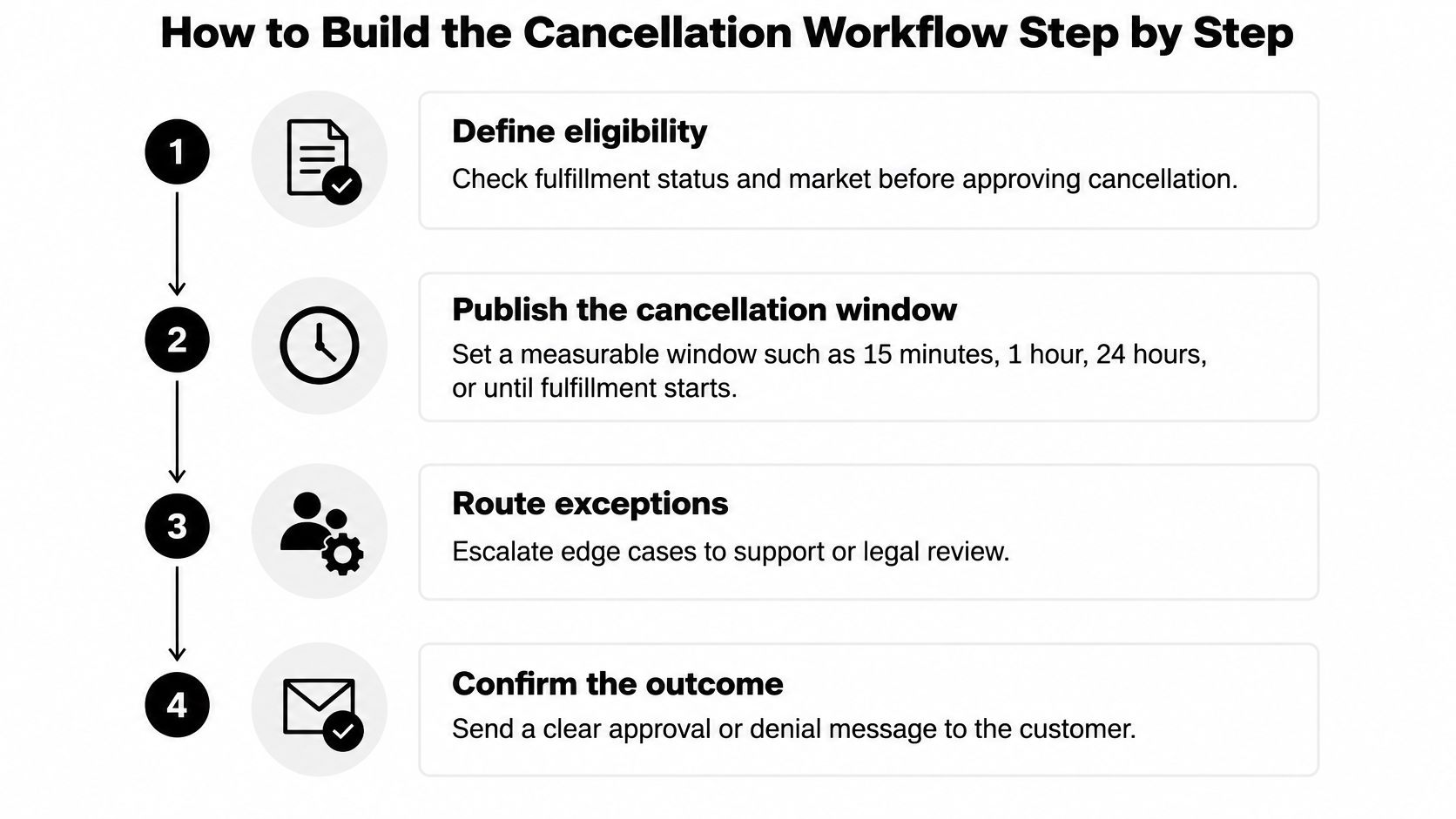
- Define eligibility by fulfillment status and market. The same order can be cancellable in one country and not another. Decide the rule before the request arrives; the usual slip is writing eligibility in prose that maps to no status your platform reports. Treat "label printed" and "carrier accepted" as different states, because one can still be held while the other has already left your control.
- Publish a measurable window. Shopify supports 15 minutes, 1 hour, 24 hours, until fulfillment, or no cancellations, and market-specific rules can be configured. The common mistake is a window measured in days when your warehouse ships in hours.
- Show the exact financial result before confirmation. Refund amount, shipping, tax and any store-credit alternative belong on one screen. Customers who see the number accept it far more readily than customers who are told "a refund will be processed".
- Capture a standard reason from a list, with an optional free-text note. Take the reason before any retention offer. Structured reasons make cohort analysis possible later, and free text is where the underlying complaint hides.
- Route exceptions to manual approval. High-value orders, items past the window and customized products need a human. A silent block is worse than a slow yes, so always show the applicable reason and an appeal path.
- Log the request, the decision, the refund or credit action and a timestamp against the original order, using a unique event identifier so a retried request cannot refund twice.
Two safeguards keep the workflow from breaking. Freeze fulfillment the moment a valid request enters review, so the order cannot ship mid-decision. Then reconcile order total, tax, shipping, capture, refund and store-credit alternative against each other before closing the ticket.
Treat editing and cancelling as one system. Orders that are fulfilled, cancelled or archived cannot be edited by customers, and while an eligible edit is open, fulfillment is held so the order cannot ship mid-change. Edit windows follow the same logic as cancel windows: 15 minutes, 30 minutes, 1, 2, 6, 12 or 24 hours, or until the order ships.
If you sell into the EU, offer an electronic withdrawal option for the statutory cooling-off right, measured from delivery of the final item, and keep it separate from pre-fulfillment cancellation because the triggers and refund obligations differ.
Before launch, place a test order in each status in your eligibility table and confirm the outcome matches the wording. Most policy failures are found in that hour, not in the legal review.
Refund Timing and Legal Rights by Market
Legal rights are the floor. Merchant windows sit beside them, and a template that blurs the two creates disputes it can't win.
Start with the EU benchmark. Consumers buying goods online generally have a 14-day cooling-off period beginning the day they receive the goods, and they can cancel without giving a reason. For services, the period generally starts when the contract is concluded, as the European Commission's online shopping guidance explains. Exclusions are specific: personalized goods, hotel or transport reservations, event tickets, and certain digital content after downloading.
Refunds are due within 14 days of receiving the cancellation notice, though you may hold the money until the goods come back or the customer shows proof of return.
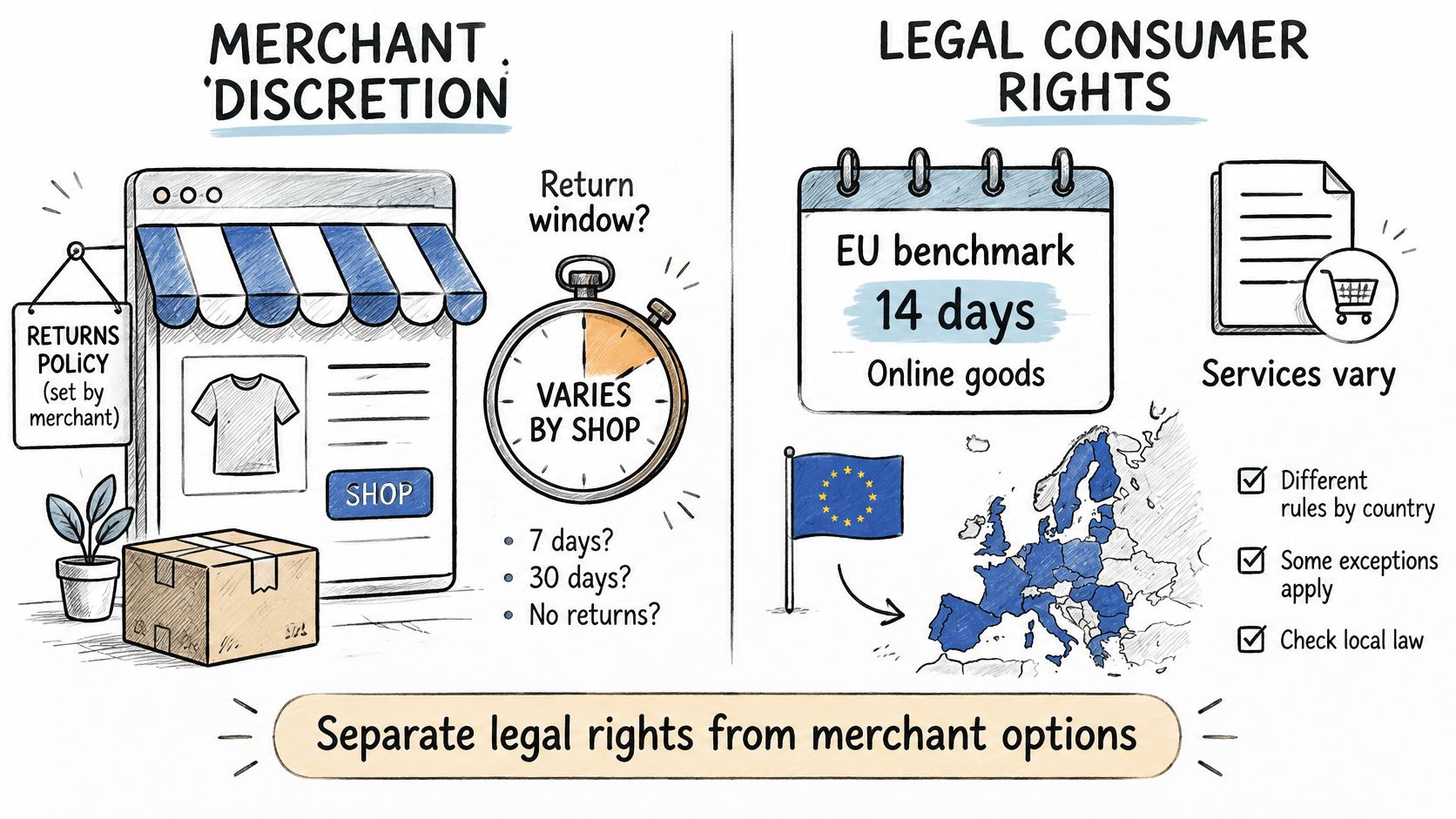
Don't present 14 days as a global rule. National law, product category and the point where fulfillment begins all move the dates. Write "where required by law" and let the specific market page carry the detail.
| Right type | Trigger | Deadline | Refund timing |
|---|---|---|---|
| EU online goods withdrawal | Receipt of the goods | 14 days, no reason needed | Within 14 days of the cancellation notice, may wait for return |
| EU online services withdrawal | Conclusion of the contract | 14 days | Within 14 days of the cancellation notice |
| Merchant pre-fulfillment window | Order placed | Your chosen window, such as 30 minutes or 24 hours | As stated in your refund policy |
| Post-delivery return | Delivery of the order | Per your return policy | Per your return terms after the return is received |
On the merchant side, choose your refund posture deliberately. You decide whether refunds process automatically every time or whether refunds above a set threshold wait for your approval. Until a large refund is approved, nothing changes on the order and no refund is owed, which is why the pending state needs its own customer-facing message. Refunds from an edit are issued through Shopify, so the money trail stays attached to the original order rather than a side ledger.
Label each row in your published policy with the path it belongs to. A customer who doesn't know whether they're inside a merchant window or a statutory right will assume the worse one applies.
Offering Store Credit Without Trapping Customers
Retention offers work when the refund stays visible. They backfire when the offer becomes the only path the customer can find.
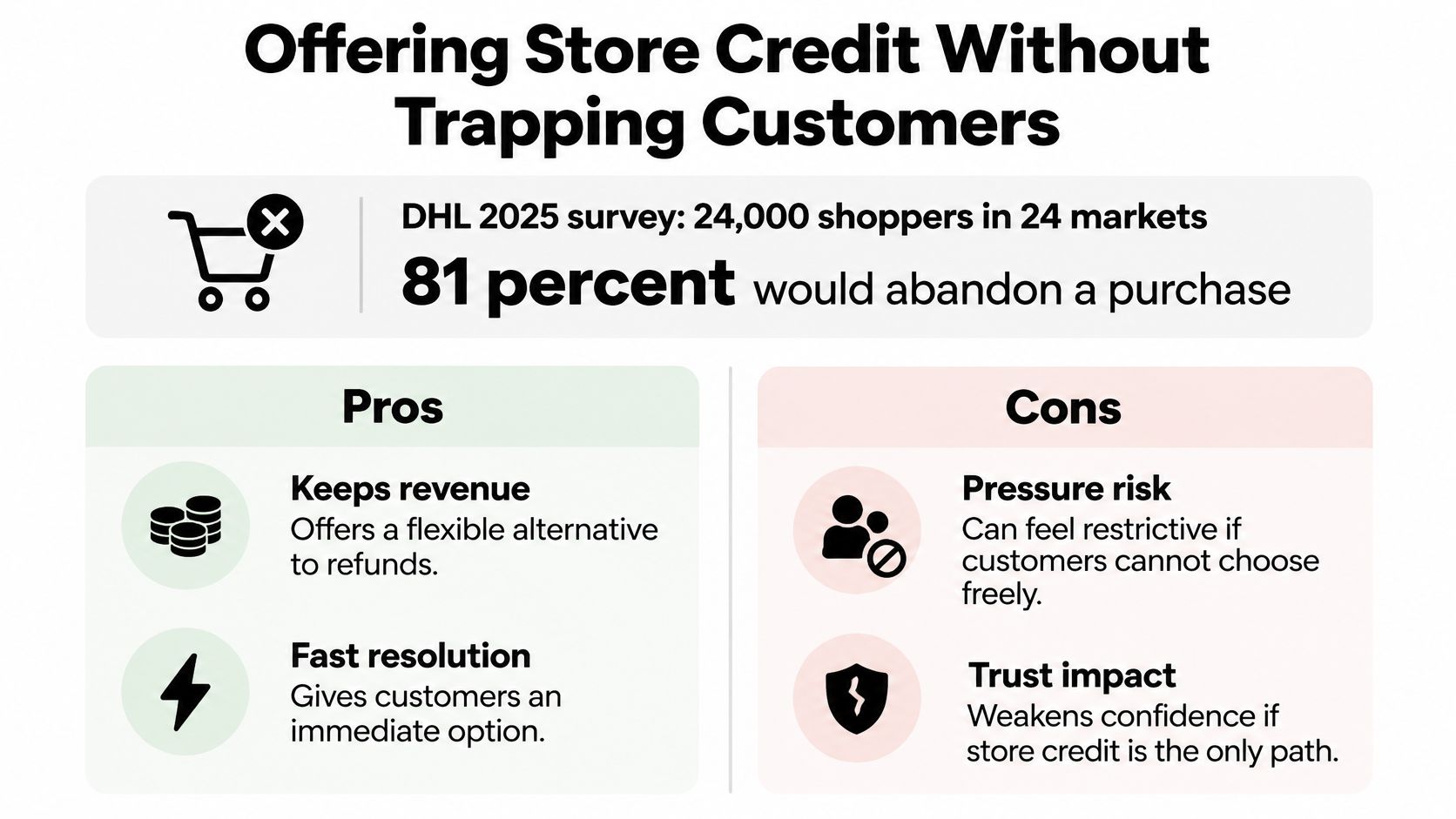
Delivery and return choices strongly influence buying decisions. DHL's 2025 ecommerce trends report, surveying 24,000 online shoppers in 24 markets, found that 81% would abandon a purchase if their preferred delivery option was unavailable, and 79% would abandon it if their preferred return option wasn't offered. The same report found three in four shoppers would not buy from a retailer they didn't trust to provide delivery and returns.
That trust is built or lost in the cancel screen, so give the customer real choices: change the item, correct the address, delay dispatch, take store credit with a bonus, or take the money back.
Pros of a fair offer
- Keeps revenue on the book when the customer wants the product and only the timing went wrong.
- Resolves the issue in one screen, without a refund cycle and a reorder.
- Gives you data on why people cancel, which is more useful than a cancellation count.
Cons when the offer is pushy
- Pressure destroys the goodwill it was meant to create. A pre-ticked store-credit box reads as a trap.
- Vague terms invite complaints. Credit value, expiry, monthly limits and exclusions such as gift cards, regulated products or fulfilled items all need stating before acceptance.
- Hidden refunds cost you repeat orders that never show up in the cancellation report.
In Mayra, the sequence is explicit: if a customer declines the store-credit offer, the cancellation proceeds, and if they accept, the order stays and is locked from further edits so the same order can't be discounted twice. That lock is a safeguard, not a cage, because declining is always one click away.
Balance rule: the refund path and the store-credit path get the same visual weight, the same font size and the same number of clicks.
Record the reason the customer selected. If you can weigh store credit against a straight refund by reason and by product category, you'll learn which alternatives save orders and which merely delay the refund.
Metrics and Pitfalls That Reveal a Weak Policy
A falling cancellation rate feels like progress. Often it means customers gave up looking for the button.
Policy clarity drives conversion as well as retention. Baymard's cart abandonment analysis, synthesizing 50 studies, puts average cart abandonment at 70.22%, and attributes 13% of abandonments to an unsatisfactory returns policy and 12% to the inability to see total order cost upfront. Cancellation terms sit in exactly that territory.
The financial context is just as blunt. NRF projected $890 billion in US retail returns for 2024 and estimated 16.9% of annual sales would be returned, while 67% of consumers said a negative return experience would discourage future shopping, as reported in the same Baymard analysis.
Track nine numbers, not one: cancellation-request rate, eligible-request completion rate, approval rate, median decision time, refund error rate, support contacts per 1,000 orders, recovered revenue from alternatives, repeat-purchase rate and post-cancellation satisfaction.
The test that matters: put your cancellation wording and its placement up against a control in an A/B test, and keep the refund path equally visible in both arms.
Guardrails keep the test honest. Never show bonus store credit as though it were the mandatory refund outcome, and disclose expiry, caps and exclusions wherever the offer appears, including whether shipping and taxes are included.
The recurring pitfalls are predictable. Measuring only cancellations saved. Counting estimated avoided tickets as realized savings. Hiding market-specific rights behind a general page. Pushing store-credit acceptance up while complaints and repeat-order loss climb.
Break results into cohorts by country, product type, fulfillment stage and cancellation reason. That's where the trade-offs show up, and where a policy that looks efficient stops being one.
A falling cancellation rate caused by a hidden cancel path is a failure, not a win.
Publish the Policy and Test the Cancel Path
Publishing is the easy part. Proving the policy matches reality takes an afternoon.
Work through four steps before you announce anything.
- Gate on the status test. For each order status, confirm the window, the price difference and the refund outcome in your live flow match the words on the page. One mismatch undoes the whole document.
- Link the path where people look. Put the cancel link in the order confirmation email and on the order status page, so nobody has to open a ticket to find it.
- Book a monthly review. Recheck the nine metrics and update the clauses whenever the warehouse cutoff moves. Peak season moves it.
- Automate only after the rules are stable. If you want windows and fulfillment holds enforced by software rather than staff memory, check whether your platform supports market-specific cancellation rules before choosing a tool.
Self-service only helps when it works. In Coveo's survey of 4,000 consumers, 49% of online shoppers encountered problems when shopping online in 2024, and 68% reported problems using online self-service to resolve them, according to Coveo's commerce industry report. Then run a test your checkout experience session on the post-purchase screens, because the cancel path and the checkout path are judged by the same standard.
Give customers real options rather than a dead end. Customers can cancel the whole order themselves, and merchants can configure the cancellation reasons and require an optional note, which turns a refund into usable data instead of a closed ticket. Where the customer only wants a different size, address or quantity, letting them change quantities, swap variants, correct the address and add or remove items themselves, with no support message, removes the cancellation before it happens.
Pick one clause to fix this week. The refund timing line is usually the weakest, so rewrite it with a processing number and a bank posting window, then publish it before Friday.
Mayra ‑ Order Edit & Cancel puts a self-serve cancel option on the order status page and customer account, captures a configurable reason, and can offer store credit before a refund goes out, with full cancellation always available as the fallback. You set the window, the reasons and the approval rules, and the order updates inside Shopify. See how it fits your store at Mayra ‑ Order Edit & Cancel.